Following the presentation made by the Director General of the Institute on his agency’s work in 2018, the Ambassadors and High-level Representatives to the Organization of American States (OAS) of Argentina, Bolivia, Canada, Costa Rica, the Dominican Republic, Jamaica, Paraguay, the United States and Uruguay, among other nations, applauded the actions of the specialized organization and its contributions to economic and social development in Latin America.
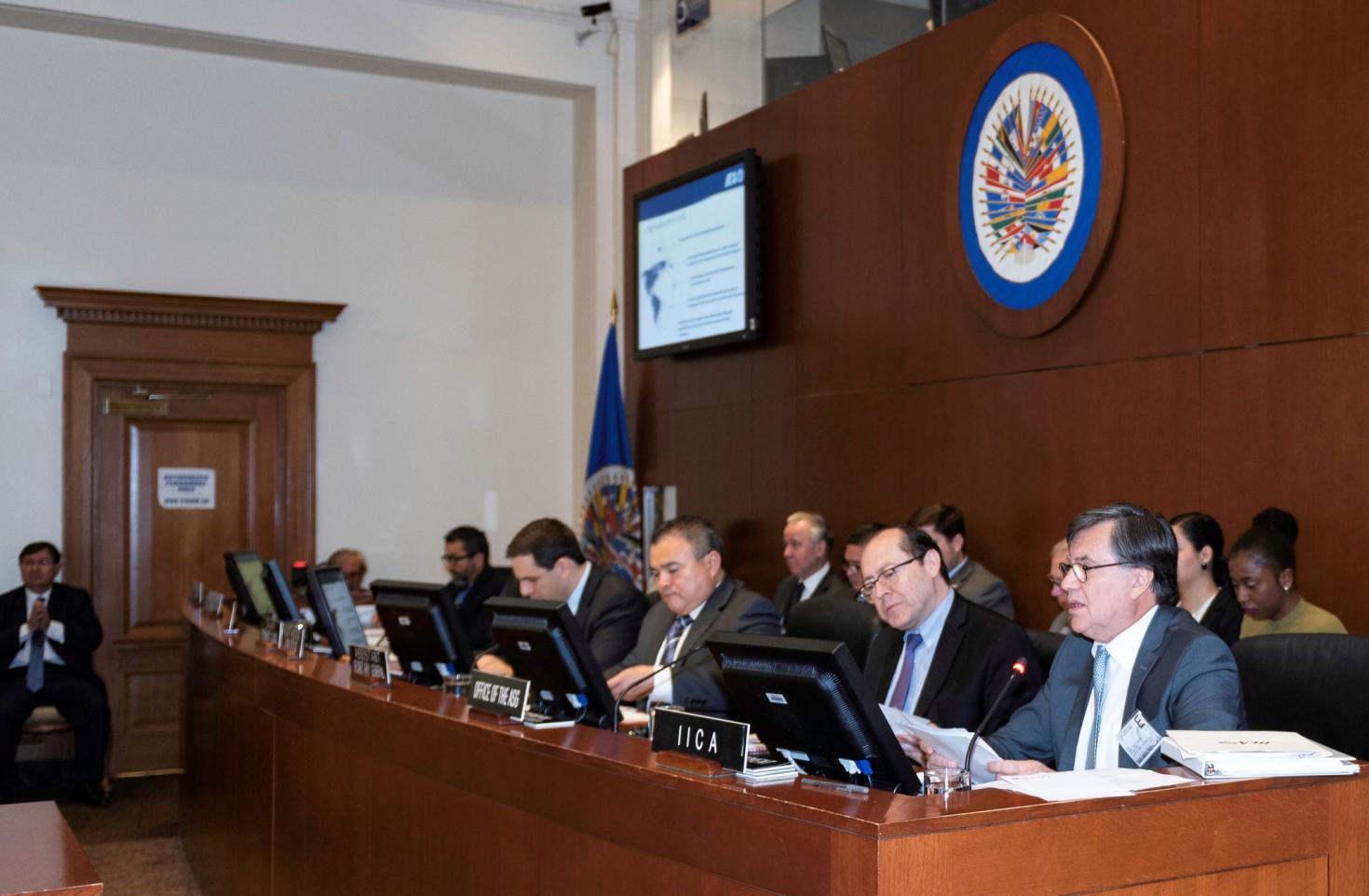
Washington, 16 May 2019 (IICA). The Ambassadors and High-level Representatives to the Organization of American States (OAS) of Argentina, Bolivia, Canada, Costa Rica, the Dominican Republic, Jamaica, Paraguay, the United States and Uruguay, among other nations, praised the work of the Inter-American Institute for Cooperation on Agriculture (IICA) in Latin America and the Caribbean. Pointing up the organization’s contributions to development in the region, they applauded the modernization of its technical cooperation model and the work program it is promoting, which is focused on the intensive use of technology and targets issues such as productivity and inclusion.
The comments were made following the presentation by the Institute’s Director General, Manuel Otero, of IICA’s Annual Report for 2018 to the Permanent Council of the OAS. The document contains a summary of his administration’s main achievements since he took over the helm of the specialized inter-American agency in January of last year.
In his presentation, Otero explained the priorities that his administration had outlined for the modernization of IICA’s operations and its technical cooperation model, designed to ensure that the agriculture sector in the Americas realizes it full potential. He also described the main goals set and the actions carried out by the agency in the five regions of the Americas into which it channels its work.
“Argentina wishes to acknowledge the excellent job being done by Manuel Otero on behalf of the institution’s 34 member countries. IICA continues to work tirelessly to ensure that agricultural production, an activity that is so crucial for our region’s economic and social development, receives the attention and recognition it deserves,” observed Argentina’s Ambassador to the OAS, Paula Bertol.
“This agency is currently promoting a policy of internal modernization in order to achieve technical cooperation that is both more efficient, and more relevant and useful to all the States. Areas such as biotechnology, foreign trade, technological innovation, humanitarian assistance, migration, women, and rural youth, among others, underpin this new approach to the implementation of technical cooperation,” she added.
Ivanna Bracamonte Guillén, a member of Bolivia’s mission to the OAS, emphasized the importance of IICA’s technical cooperation. “We wish to place on record the fact that the technical cooperation that IICA provides in Bolivia is being directed towards highly important projects in different areas. One of the most important of these is family farming, with efforts focusing on technological innovation and the generation of production for food security and sovereignty,” she remarked, highlighting the work in support of the re-registration of farmers and the implementation of differentiated policies for family farming.
Canada’s Ambassador to the OAS, Jennifer May Loten, then applauded “IICA’s efforts to strengthen women’s agricultural productivity, increasing their economic empowerment and their role as decision-makers in agriculture.” She also singled out for praise the Institute’s “commitment to youth.”
At the meeting of the Permanent Council of the OAS, the Chair of the body, U.S. Ambassador Carlos Trujillo, observed that “Today we see the private sector actively participating in IICA, connecting with governments, science and academia to bring innovation and progress to the rural sector, showing a renewed face of the agriculture sector in Latin America and the Caribbean.”
Paraguay, through its Ambassador to the OAS, Elisa Ruiz Díaz, highlighted IICA’s cooperation for work such as reforestation, training and the promotion of local banana production.
Costa Rica and Jamaica also expressed “satisfaction” with Otero’s report.
“Costa Rica recognizes the importance of the rural sector for integrated development, and also acknowledges the importance of IICA and its mandate. We would like to emphasize the broad spectrum of actions carried out not only from its Headquarters in San Jose, but across the Americas, supporting the organization’s 34 Member States. Some of the projects worthy of special mention in Costa Rica are the promotion of the bioeconomy, the design of the agro-tourism plan in the country’s central-southern region, the development of national plans for the reactivation of the cacao and avocado subsectors, as well as the Central American technical regulations for organic farming. These and other efforts are vital to improve the state of agriculture in Costa Rica and our partners in the region,” noted Costa Rica’s Ambassador, Montserrat Solano Carboni.
The Alternate Representative of Jamaica, Deon L. Williams, explained that “a great deal has been achieved in 2018 (…) under Dr. Otero’s leadership. Without a doubt, the long relationship between Jamaica and IICA has brought major benefits. We hope to continue this partnership going forward for the good of our people, as it has brought us many improvements in the agriculture sector and we are really grateful for that.”
Honduras, Uruguay, El Salvador, Venezuela, and the Dominican Republic also acknowledged the Institute’s achievements.
In his message, Otero pointed up agriculture’s enormous contribution to the economic activity of the Latin American and Caribbean countries, emphasizing its importance as a sector that creates jobs, generates income and drives innovation. He also gave details of the active identification of opportunities for cooperation with the private sector, and IICA’s role as a knowledge management platform, providing concrete solutions in the rural territories of the Americas.
More information:
Institutional Communication Division.
comunicacion.institucional@iica.int