Representatives of the public and private sector and international organizations defined strategies to provide stimulus to a promising new player.
San José, 30 July 2018 (IICA). The interoceanic canal and real estate development, related to banking, trade and other services, have been the key drivers of the Panamanian economy for several years.
However, development has not been homogeneous nor has it impact been felt across the entire country, and therefore, the public and private sectors and international organizations have defined a strategy to provide stimulus to a promising new player: agriculture.
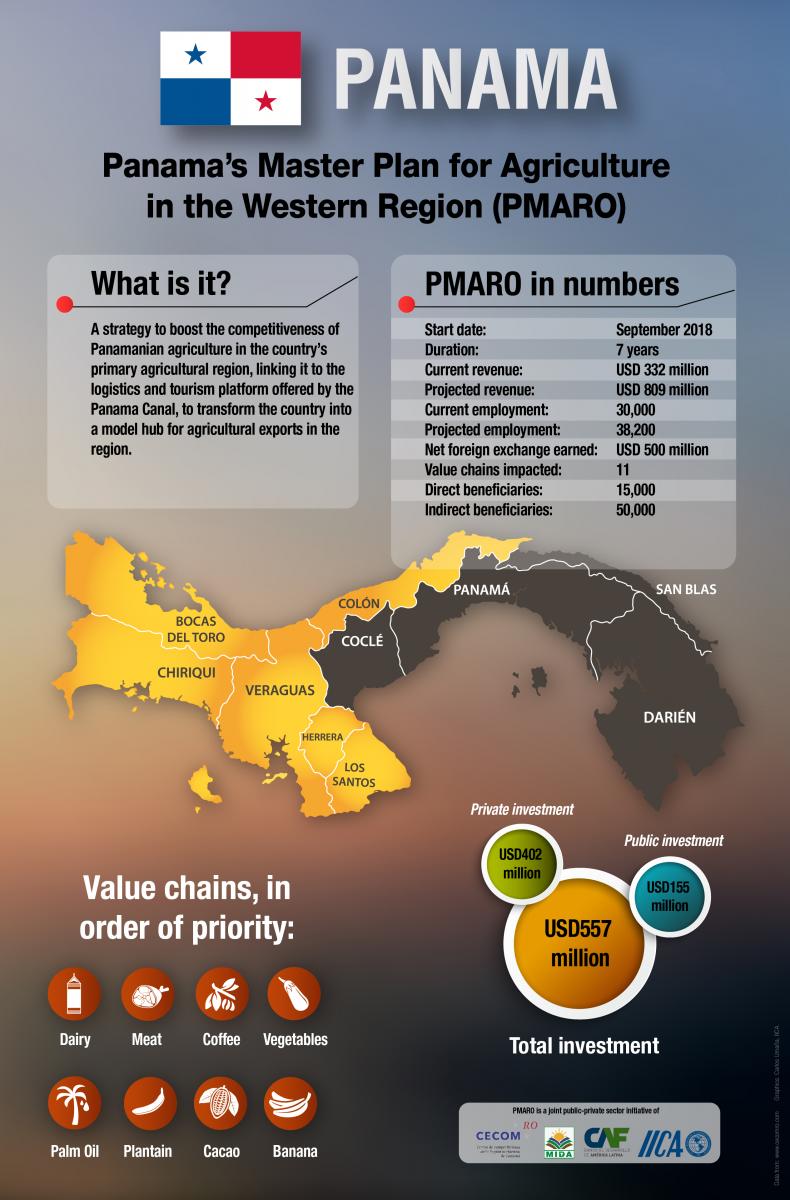
The seven-year program, known as the Master Plan for the Agriculture Sector of the Western Region (PMARO), seeks to strengthen the installed capacity provided by the canal and its related services, to enable approximately 15,000 agricultural producers to guarantee the country’s food security and to access national and international markets, enjoying greater benefits.
The premise of the Master Plan, which will come into effect sometime between August and September, is to provide 557 million dollars of public and private investment, with a view to enhancing productivity, diversification, production chains, job creation and tourism development, leading to a drastic reduction in inequality (see diagram below).
Susana Pinilla, Panama’s Country Director of CAF – the Development Bank of Latin America, indicated that, “CAF is collaborating with the State and the local private sector to drive integrated territorial development by financing public investments in the Western Region, such as the Agricultural Master Plan”.
Pinilla commented further that, “We are supporting local organizations to exploit opportunities for investment, development and the inclusion of Panama’s regions to allow them to share in the growth and major projects of the Capital City”.
Eighty percent of Panama’s wealth is concentrated around the canal, which is a situation that CAF recently warned may lead to social conflicts in the long-run.
The Master Plan will link the local agricultural sector to the logistics and tourism platforms offered by the canal, in a bid to transform the Central American country into a model hub for agricultural exports in the region.
One of the major outcomes of these initiatives, that were launched a little more than two years ago, has been the Agricultural Master Plan, which has made significant strides. They have also led to the creation of three regional competitiveness centers, which are private sector initiatives to identify concrete investment opportunities and develop public policy proposals in the Azuero, Colón and Western Regions.
In the Western Region, that encompasses the Provinces of Chiriquí, Bocas del Toro and Comarca Ngabe Buglé, long-term vertical programs have been designed for select value chains, such as dairy, meat, palm oil, vegetables, coffee, plantain, banana and cocoa, to which other crops, such as tubers and root crops, rice and potato, could be added.
“In the Azuero region, which includes the provinces of Herrera, Los Santos and the southern Veraguas, we will work to revitalize products such as milk and meat, as well as crops such as rice, corn, industrial tomato, sugar cane, melon, cantaloupe, yam, and dasheen, which are commodities for which cultivated areas and per hectare yields have declined in recent years”, assured Gerardo Escudero, Representative in Panama for the Inter-American Institute for Cooperation on Agriculture (IICA), which is providing technical support for the Plan.
Escudero added that, “In the Azuero region, the program is being spearheaded by the competitiveness center, with a mission to increase the efficiency of Grade C milk production, an activity on which more than 6 thousand small farmers are dependent”.
“Panama satisfies all the conditions to become an agrifood hub because we are the most connected country in the hemisphere. The objective is not just to develop logistical facilities, but to provide Panama entry into the value chain, establishing manufacturing processes, taking advantage of the network of trade agreements and rules of origin, as well as special regimes such as free zones and MHQs, in order to increase our exports”, indicated Felipe Rodríguez, President of the Competitiveness Centre of the Western Region.
For the initial two-year phase of the Western Region Agricultural Master Plan, a 27.6 million dollar loan agreement was signed with CAF, which will provide support to the Ministry of Agricultural Development (MIDA) to generate installed capacity and to address the needs of some 2,500 producers.
In the Western region alone, is it projected that, in addition to maintaining and improving the quality of the 30,000 existing jobs, approximately 10,000 new positions will be created.
Entrepreneurs from Mexico, Nicaragua, Costa Rica and Spain are already approaching, having recognized the opportunities for trade between countries, including, the provision of technology, intelligent systems for market information and trade opportunities and advanced irrigation systems.
More Information:
Gerardo Escudero, IICA Representative in Panama