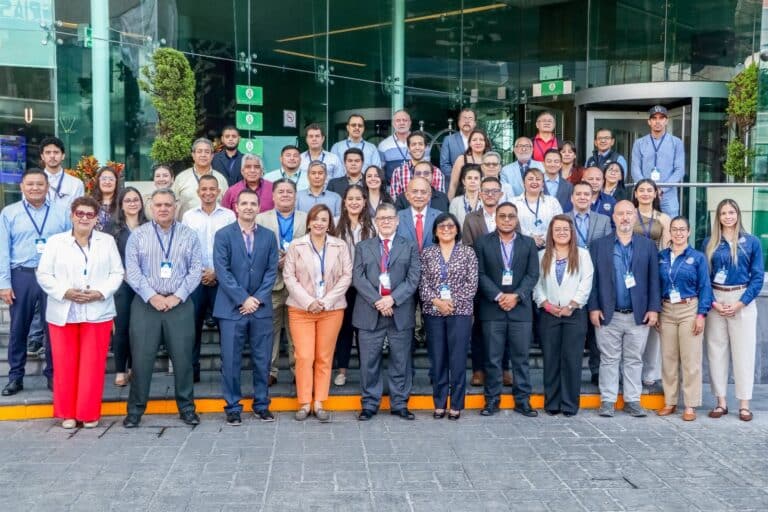
The second stage of a program aimed at building capacities needed to develop agriculture in the countries of Central America and the Caribbean is now under way.
Mexico City, April 16, 2015 (IICA). The Secretariat of Agriculture, Livestock Farming, Rural Development and Food (SAGARPA) of Mexico, and the Inter-American Institute for Cooperation on Agriculture (IICA), have launched the second stage of a program aimed at building capacities needed to develop agriculture in the countries of Central America and the Caribbean.
The program calls for 400 specialists and technical personnel from 21 countries to participate in training courses offered by scientific and educational institutions associated with the agricultural sector of Mexico, aimed at increasing agricultural productivity and encouraging further development in the region via the transfer of technologies and innovations.
The program, which IICA is currently implementing in the Caribbean, will include, in this second stage, six countries of Central America and will offer for the first time virtual training programs, certification courses and international seminars.

During the inauguration, the Secretary of SAGARPA, Enrique Martinez y Martinez, noted that agrifood trade between Mexico and the countries of Central America and the Caribbean is greater in terms of both volume and total value than trade with the European Union.
Therefore, he indicated, it is necessary to increase productivity in the region and take whatever actions are needed to maintain or expand current trade levels. “Let’s take the interests we share and focus them on the pursuit of our common goal: the development of agriculture and livestock farming” he said.
IICA Deputy Director General Lloyd Day stated that the cooperation being offered is possible thanks to the capacity of the research and educational institutions of Mexico, and to the talent of Mexican experts who are willing to share their experience and, in this way, improve agriculture in neighboring countries facing similar challenges in terms of production and productivity.
He added that new topics will be addressed in the second stage, such as plant and animal health protection services in seaports, airports and land border crossings, with the participation of SENASA; rainwater harvesting, with the Mexican Water Technology Institute (INTA); and biotechnology and genomics, with the Irapuato Unit of the Center for Advanced Research and Higher Education of the National Polytechnic Institute (CINVESTAV).
In addition, the Open and Distance University of Mexico will offer two virtual programs: a Master’s Degree program in Agrifood Safety and a certification program in innovation for the agrifood sector.
According to Day, specific actions will be taken in the Caribbean focused on improving Black Belly Sheep production, with support from the Autonomous University of Chapingo (UACH), and on the in vitro cloning of tropical plants in Trinidad and Tobago, with support from the Scientific Research Center of Yucatan (CICY).
Under Secretary for Food and Competitiveness of the SAGARPA, Ricardo Aguilar Castillo, stated that the goal for the first stage had been exceeded; with 295 specialists, rather than the 140 originally expected, receiving training in 15 countries of the Caribbean.
This program is one of the outcomes of the technical cooperation agreement signed in 2014 in Yucatan during the Third Mexico-Caribbean Community (CARICOM) Summit, held by SAGARPA and IICA.
The countries participating in the program are Antigua and Barbuda, Bahamas, Barbados, Belize, Costa Rica, Dominica, El Salvador, Grenada, Guatemala, Guyana, Haiti, Honduras, Jamaica, Nicaragua, Panama, Dominican Republic, St. Kitts and Nevis, St. Vincent and the Grenadines, St. Lucia, Suriname and Trinidad and Tobago.
The goal of this initiative is to address the specific needs of the participating countries, offering short training courses aimed at increasing the productivity and economic impact of their agricultural sectors.
The program also receives support from the Secretariat of Foreign Relations of Mexico, the Mexican Agency for International Cooperation for Development (AMEXCID), educational and research institutions of the agricultural sector, the Ministries of Agriculture of the participating countries, international organizations and institutions involved in training.
Más información:
gloria.abraham@iica.int