
«In our capacity as governing body of the National Statistical System, and under the conviction that, knowing the reality from a statistical perspective, we can articulate better plans and make better decisions»
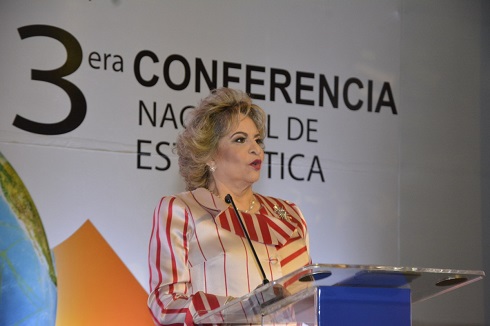
Santo Domingo, Dominican Republic, June 2019 (IICA). The National Statistics Office (NSO) celebrated the 3rd. National Conference of Statistics, in which it addressed as its central theme the «Data Ecosystem for Innovation and Competitiveness», key elements for the planning and sustainable development of the national economy, according to the words of welcome from its director, Alexandra Izquierdo.
Three lectures were delivered in the activity: (1)»Innovation and competitiveness within the framework of the National Development Strategy (NDT)» presented by Mr. Isidoro Santana, Minister of Economy, Planning and Development (MEPyD). (2) «Innovation in the framework of official statistics», presented by Mr. Miguel Coronado, Representative of the Inter-American Development Bank (IDB). (3)»Why is the Dominican Republic Innovative and Competitive?” By Mr. Rafael Paz, Executive Director of the National Competitiveness Council (CNC).

In the activity, two panels were carried out. (1) «Impact of data on Innovation» presented by Mr. Alejandro Patiño, Expert of the Innovation and New Technologies Unit, Division of Productive Development and Companies of the Economic Commission for Latin America and the Caribbean (ECLAC). (2) «The production of data to facilitate innovation» exposed by Mr. Arturo Muente Kunigami, Senior Specialist in State Modernization of the Inter-American Development Bank (IDB). Representatives of public and private institutions present in the event analyzed both panels.
In the analysis carried out, the actions for the systematization and simplification of the processes for obtaining the goods and services offered by the institutions of the State of the Dominican Republic were highly valued. This indicates facilitates to the citizen in the request of documents and fast answer to the needs of information; as well as the use and confidence of statistical information for the design and analysis of public policies and development projects by the different cooperation agencies existing in the country.
More Information: Héctor Garibaldis Pérez, Agribusiness Specialist, hector.perez@iica.int