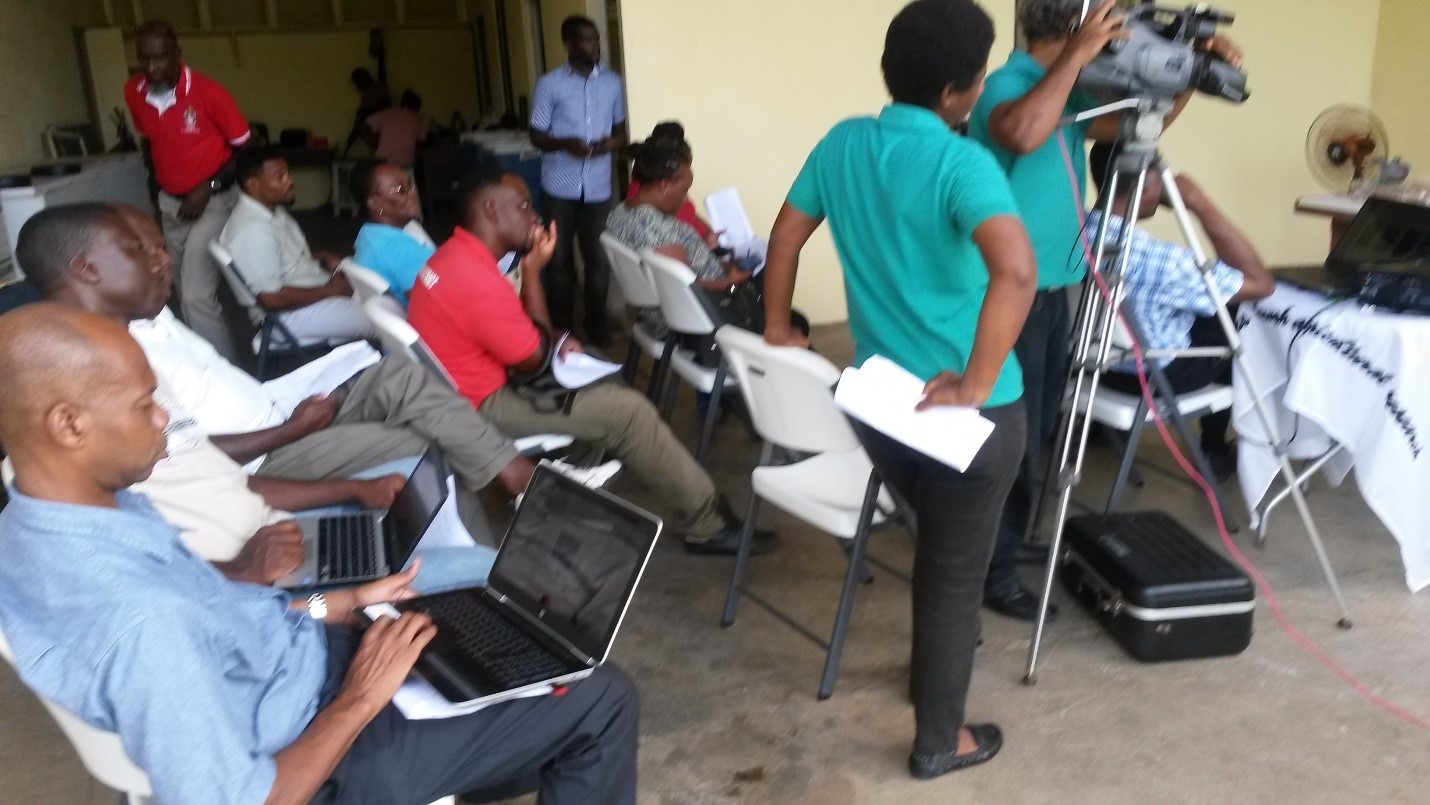
Farmers, extension officers and input suppliers benefited from the training.
Grenada August 01, 2018 (IICA). The Agronomy and the Livestock Divisions of the Ministry of Agriculture in collaboration with the Caribbean Agriculture Research and Development Institute (CARDI) and IICA conducted a Workshop on the rapid multiplication of cassava plants.
The Workshop aimed at strengthening the technical capacity of extension officers and cassava farmers on the rapid multiplication and nursery management of new improved, high yielding and Beta-fortified cassava varieties. The International Centre for Tropical Agriculture (CIAT) in Colombia produced those nine varieties of sweet cassava that are resistant to several strains of viruses including the Cassava Mosaic Virus, the Frog skin Disease.
This one-day Workshop was held at the CARDI Field Station on July 31. Fourteen participants including farmers, extension officers and input suppliers benefited from the training.
Troy Augustine, Agronomist at the Ministry of Agriculture, was the main facilitator at the Workshop. Rapid cassava multiplication aims at increasing the availability of planting materials to farmers. The techniques involved preparation of the cassava stem and nursery management practices for effective rooting of the stem.
The Livestock Division gave an overview on the importance of cassava and its byproducts as animal feed. Nugent Bernard (Livestock Officer) commented that the region needs to embrace the opportunities for using local forages and alternative sources of plant protein for feeding livestock, while Tara Brizan (Assistant Livestock Officer) demonstrated the different cassava byproducts that can be developed from cassava as feed for both monogastric and polygastric animals.
Reginald Andall, CARDI Representative in Grenada, summarized their activities on the utilization and marketing of cassava being undertaken in Grenada. CARDI is the only supplier of cassava mash, the main cassava product used in the production of composite cassava-wheat flower for commercial bread making.
Daniel Lewis, Chief Agriculture Officer in the Ministry of Agriculture in his remarks implored the participants to follow his footsteps and develop the taste for locally grown foods like cassava. This will help in reducing on Grenada’s high food import bill.
Derek Charles, National Specialist at IICA remarked that ‘Notwithstanding, the many constraints of production, processing and marketing of cassava there are opportunities including the policy to increase the production of cassava as a staple crop under the Food Security Programme and the Zero Hunger Program that was launched by the Government, is focussing on cassava production and consumption.’
Farmers will be given the new varieties of cassava plants and will be working in collaboration with the Agronomy Division to establish trial plots with all nine cassava varieties to test their productivity and acceptance by the farmers. Further work will involve different approaches and methods of multiplication of cassava plants and to examine forms and uses of the cassava crop in the development of products as alternative livestock feeds.
About IICA
IICA is the specialized agency for agriculture in the Inter-American system, with a mission to encourage, promote and support its 34 Member States in their efforts to achieve agricultural development and rural well-being through international technical cooperation of excellence.
More information:
jose.alpizar@iica.int