A potentially hazardous material can be used as compost.
Grenada, June 28, 2018 (IICA). The Inter-American Institute for Cooperation on Agriculture (IICA) collaborated with the Ministry of Agriculture of Grenada (MOA) and conducted a workshop for farmers and extension officers at the Chinese Agriculture Mission at La Sagesse, aimed to promote the use of alternative materials, among them Sargassum seaweed, that can be used for composting, the methods of composting and the measures to be taken to reduce food safety risks when using compost on covered crops.
The senior extension staff from the Ministry of Agriculture and the National Specialist at IICA identified emerging and applicable farm technologies and practices and demonstrated how to best transfer such technologies and practices to farmers.
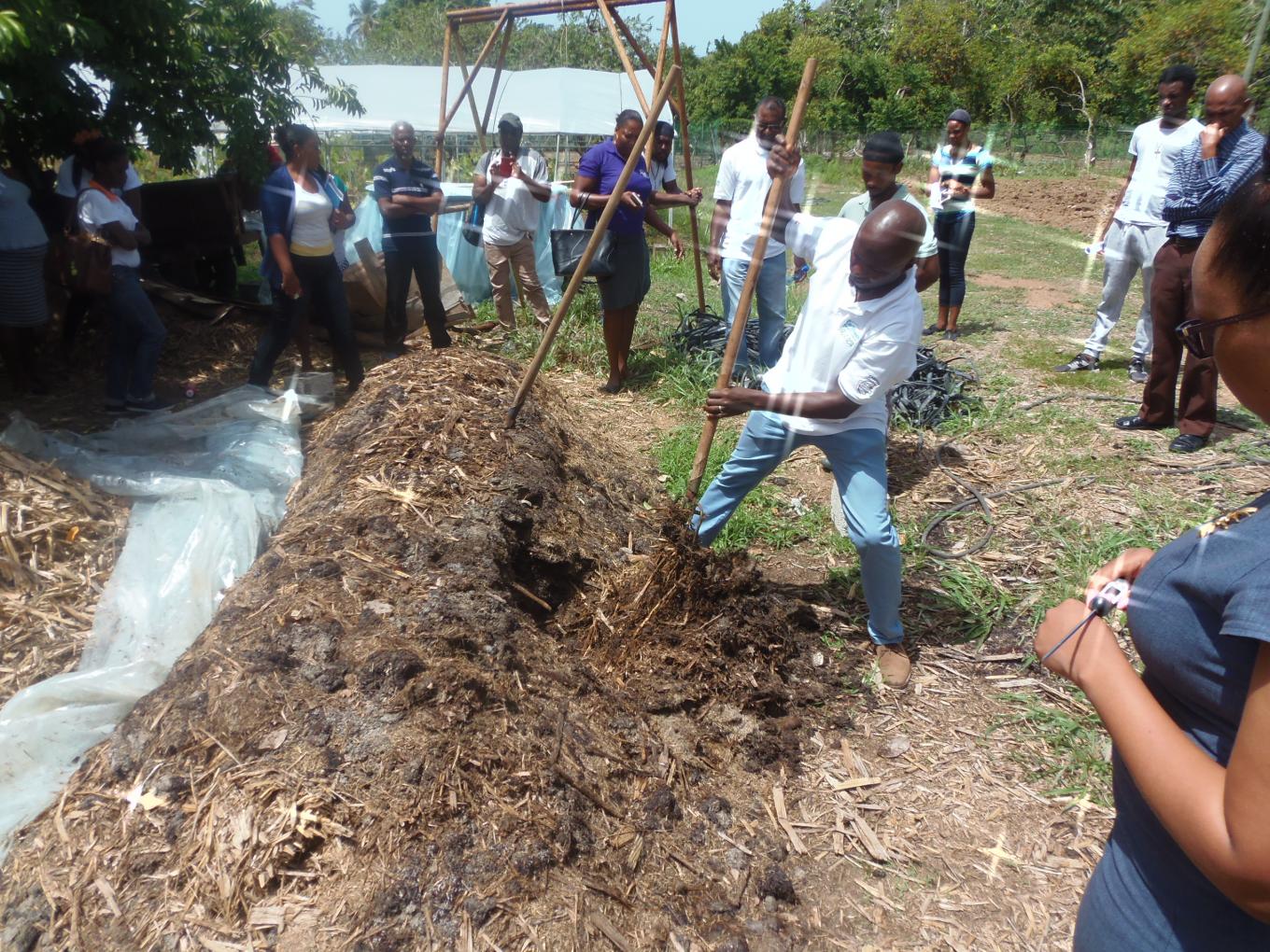
The Sargassum seaweed which is strewn along the shores and beaches of Grenada is a potential hazard due to its pungent odor and other associated negative effects to the tourism and fishing industries and recreational activities. This seaweed was used together with other organic materials to generate compost for use on the farms. This was an example of a result demonstration where the extension officers were exposed to the theoretical and practical aspects of producing compost using seaweed. The idea was to demonstrate visual positive message of organic materials being composted. The extension officers will then converse with the farmers using appropriate extension methodologies on how best to produce compost on their farms.
A total of 40 extension officers, farmers and agriculture trainees assigned to the Chinese Agriculture Mission in Grenada benefited from this workshop, facilitated by Troy Augustine, Agronomist at the Ministry of Agriculture, and Derek Charles, National Specialist, at IICA. The workshop consisted of both theory and practical on-farm sessions where participants observed first-hand the conversion of organic materials to compost. In addition, the Head of the Chinese Agriculture Mission in Grenada, Li You Liang, provided valuable information based on his experience in the use of seaweeds on vegetables in China.
Equally important, two farmers shared their positive results when using compost that comprise Sargassum seaweed, among them longer shelf life of fruits and vegetables, firmer and heavier vegetables and generally pristine vegetables.
Although this was not the first workshop on incorporating the Sargassum seaweed with other organic materials to produce compost, the large turnout of farmers and extension officers signals a desire to learn and transfer information to the farmers who were not present. Some of the farmers also tided with the idea of setting up a business to convert the seaweed to other useful agricultural products.
About IICA
IICA is the specialized agency for agriculture in the Inter-American system, with a mission to encourage, promote and support its 34 Member States in their efforts to achieve agricultural development and rural well-being through international technical cooperation of excellence.
More information:
Dereck Charles, National Specialist at IICA Delegation in Grenada