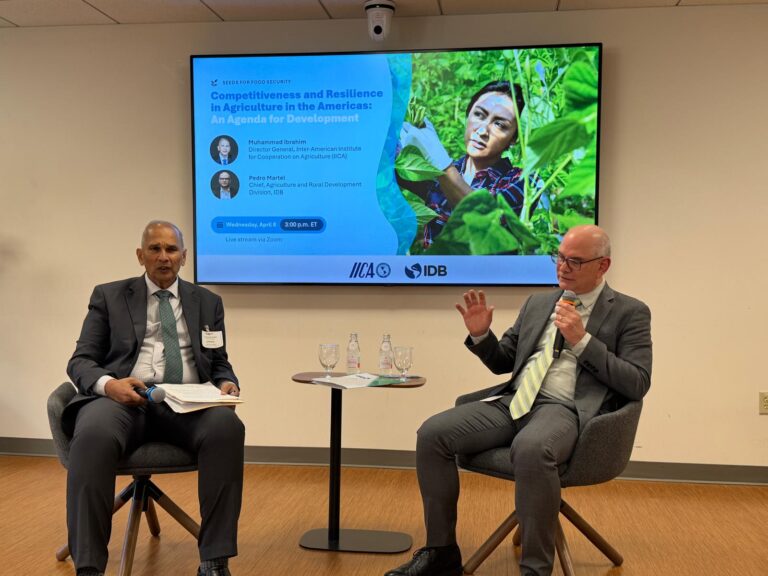
IICA is proud to serve in the Advisory Council on Forging Innovation Pathways to Sustainability.
By Dr. Priscila Henríquez, Specialist in the Management of Technological Innovation, IICA, priscila.henriquez@iica.int
Research and innovation are key elements for job creation and increase productivity. Well-funded research programs seek to bring the benefits of discovery and innovation from the farmers’ fields to every family.
In the US, the Foundation for Food and Agriculture Research (FFAR), a new mechanism for supporting agricultural research, is collaborating with the private sector and a wide range of actors for research impacts. FFAR is a nonprofit created through bipartisan congressional support in the 2014 Farm Bill to complement the scientific work of the USDA.
The FFAR vision is that of a world in which ever-innovating and collaborative science provides every person access to affordable, nutritious food grown on thriving farms.
FFAR works by creating unique partnerships to support innovative science addressing key food and agriculture challenges. The $200M funding allocated by the federal government is being matched by an equivalent investment from non-federal sources, strategically linking the private and public sectors and doubling the original taxpayer investment in the Foundation. Eventually, the Foundation will deliver more than $400 million to innovative research projects.
Based in Washington D.C., the Foundation is governed by a Board of Directors with representation from universities, foundations, agri-food companies, farmers and think tanks. Its programs and initiatives are guided by stakeholder input. Not only scientists, but also producers, consumers and the industry put their minds together to formulate strong initiatives for impact. In addition, more than 60 industry leaders, farmers, producers, scientists and non-profit organizations serve on FFAR’s Advisory Councils, to guide the scientific opportunities. IICA is proud to serve in the Advisory Council on Forging Innovation Pathways to Sustainability.
FFAR support research in seven challenge areas in to achieve relevant impacts: (1) food waste and loss, (2) healthy soils, thriving farms, (3) overcoming water scarcity, (4) protein challenge, (5) making “my plate” your plate, (6) urban food systems, and (7) forging the innovation pathway. The FFAR model is flexible and agile; the research funding is awarded by competitive grants, direct contracts or prizes and challenges.
For instance, the Crops of the Future Collaborative is an initiative that brings together public and private partners in a new consortium that will accelerate crop breeding to meet future global food demand. The consortium will hone in on how a crop’s genetic information can yield traits needed to meet global nutritional demands in a changing environment. FFAR’s initial $10 million commitment is expected to leverage significant additional investment from partners.
In a recent development, FFAR allocated a $1 million Seeding Solutions grant to the Foundation for Agronomic Research to quantify the impact of nutrient management practices on crop yield, soil health, nutrient use efficiencies, and nitrogen losses. The 4R Research Fund for a total $2 million investment in practical data aims to understand nutrient runoff to improve soil health and water quality. Eight additional Seeding Solutions grants will be announced in the coming weeks.
Another program called Rapid Outcomes from Agricultural Research –ROAR offers opportunities for rapid deployment of funds for research and development, and extension to prevent and mitigate damage caused by agricultural pests and pathogens. Three grants have already been allocated to three consortia investigating such varied threats as swine and cattle brucellosis, cherry fruit flies, and bacterial leaf streak in corn.
In her recent Senate Agriculture Committee testimony, FFAR Executive Director Dr. Sally Rockey stated that more robust funding of research would allow the U.S. to maintain its science prominence and give US producers opportunities to apply cutting-edge research results and technologies in their operations. The FFAR model will serve the community well as the foundation works to drive innovation and grow the funding pool for agricultural research, she indicated.
Since it started functioning last year, FFAR has leveraged and awarded $58 million in funding and is expected to grow that number to nearly $200 million by the end of 2017. Thirty six grants have already been awarded.
The goal of FFAR-funded research is to yield actionable outcomes. To make an impact research findings must make economic, social, and environmental sense. FFAR is working towards that goal.
More information: priscila.henriquez@iica.int and Lucyna Kurtyka (lkurtyka@foundationfar.org)
Website: https://foundationfar.org
*This post appears in the IICA Delegation in the USA Newsletter – July – August 2017