IICA Representation Dominican Republic culminates Execution FonCT Project on Evaluation, Registration and Post-Registration Control of Commercial Bio-inputs for Agricultural Use
IICA Representation Dominican Republic culminates Execution FonCT Project on Evaluation, Registration and Post-Registration Control of Commercial Bio-inputs for Agricultural Use
Within the IICA’s Technical Cooperation Funds (FonCT), the project “Desarrollo de la Institucionalidad del Sector de los Bioinsumos Comerciales de Uso Agrícola (inoculantes y plaguicidas biológicos) para Favorecer una Agricultura Menos Contaminante en Paraguay, República Dominicana y Guyana” has been implemented.
In the Dominican Republic, the National Center for Agricultural Research (CONIAF) served as a counterpart to the project, which was supported and monitored by the IICA Delegation in the Dominican Republic in coordination with Dr. Pedro Cussianovich, Project General Coordinator and with the technical assistance of Mr. Mario Andrés Van Strahlen.
The main products programmed to be obtained with the execution of the project in the country, in addition to the technical training, was the preparation of the Proposed Draft Regulations and the Manual of Procedures for the Evaluation, Registration and Post-Registration Control of Agricultural Bio-inputs for agricultural use in the Dominican Republic. During the implementation of the project in the country, both the regulation and the procedure manual were elaborated and widely discussed with the participation of all the official and private sectors involved, resulting as final products consensual proposals that were already submitted to the Ministry of Agriculture.
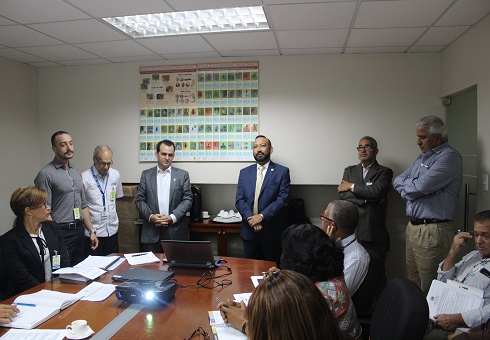
On July 27th – 28th in order to complete one of the pending activities of the project, a specialized course was held for the technical staff of the Department of Plant Protection (DPP) of the Ministry of Agriculture, which works on a daily basis process of evaluation, registration and control of the commercial bio-inputs of agricultural use in the country. A group of 15 participants from the DSV Pesticide Registration Division received the specialized training program, and the activity was carried out within the DSV facilities.
Previously, on July 26, a formal delivery of the documents (Regulation and Manual of Procedures) generated by the project to the Ministry of Agriculture was carried out, which were deposited in the person of the Deputy Minister of Extension and Agricultural Training, Eng. Leandro Mercedes, who for the occasion invited the department directors of the Deputy Ministry that heads: Department of Extension, Training Department, Department of Plant Protection, Department of Agri-Food Safety and Department of Organic Agriculture;so that everyone was aware of the strengthening process for the evaluation, registration and post-registration control of commercial bio-inputs for agricultural use that has been working in the ministry, in this case with the support of IICA.