The IICA Delegation in Suriname and the Centre for Agricultural Research in Suriname (CELOS) have formalized their collaborative framework for the benefit of agricultural development.
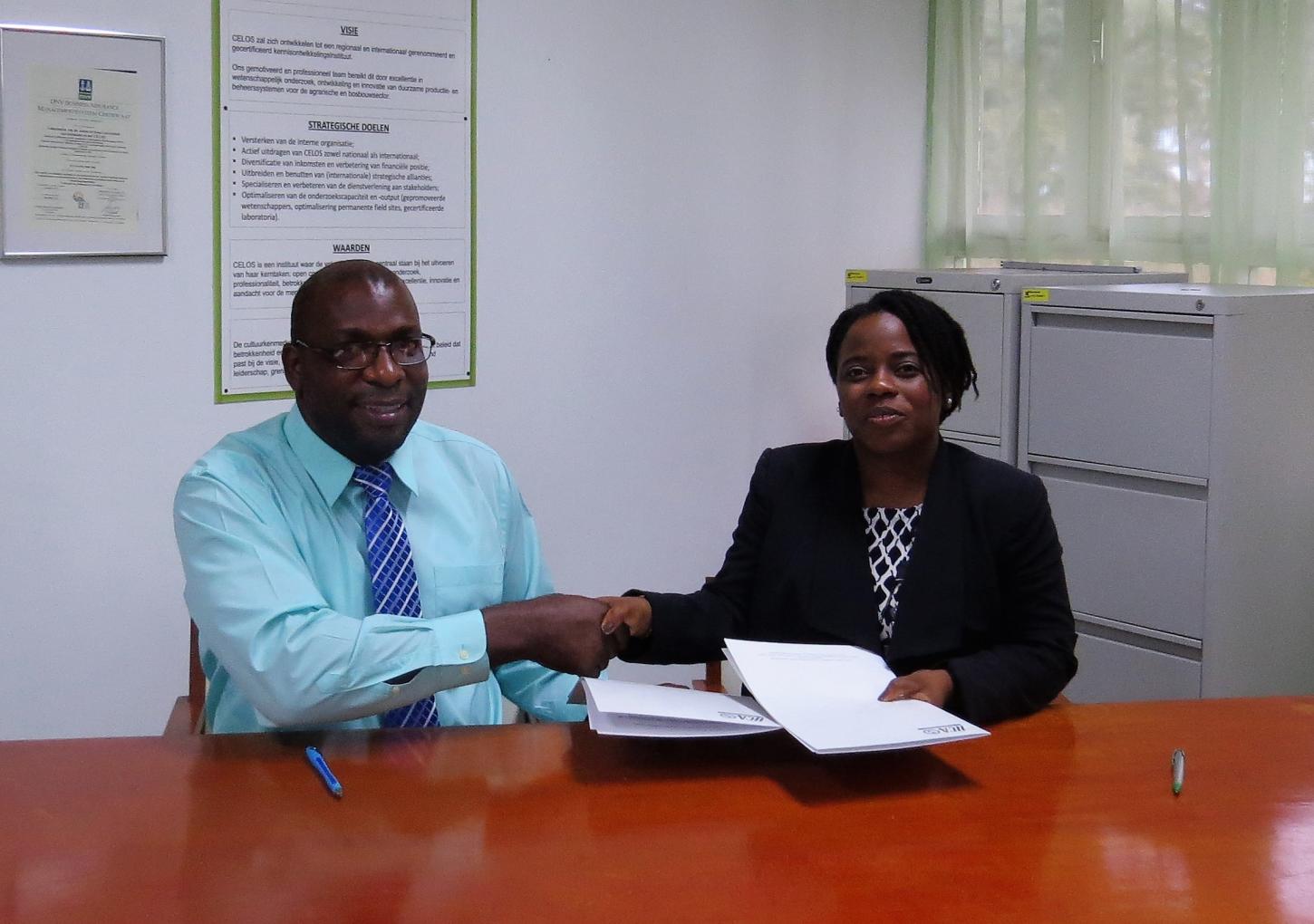
Paramaribo, July 4, 2017 (IICA). The Delegation in Suriname of the Inter-American Institute for Cooperation on Agriculture (IICA) and the Centre for Agricultural Research in Suriname (CELOS) have signed a memorandum of understanding (MOU) to collaborate and undertake agricultural development interventions and formalize their long-standing working relationship in agriculture.
The agreement, signed by the IICA Representative in Suriname, Curt D. Delice, and the Director of CELOS, Inez Demon is intended to promote actions which emphasize capacity building of human resources and management of the governmental and non-governmental institutions, agencies, organizations, and producers engaged in the agricultural sector in Suriname, on the basis of mutual understanding and in accordance with the internal laws, regulations and strategic objectives of both parties.
The MOU allows the IICA Delegation in the country to improve its technical cooperation interventions by capitalizing on the role of CELOS as the state institution responsible for the implementation of research and validation in the areas of agriculture and forestry in Suriname.
CELOS focuses on research that allows for developing and/or adapting technology that optimizes the use of Suriname’s resources, while ensuring economic and environmental sustainability, reducing poverty and contributing to enhancing the quality of life for all Surinamese nationals.
“Agriculture remains the dominant economic activity of many of the rural communities in Suriname that IICA engages to promote their sustainable development. There are many issues facing agriculture in Suriname, many of which require a profound understanding of their causes as well as the development and/or validation of viable solutions to address them; applied research is critical to achieving this objective”, stated the IICA Representative in Suriname Curt D. Delice.
The MOU allows the agencies to collaborate towards strengthening interventions for sustainable development of the agricultural sector in Suriname through scientifically validated technologies and information.
CELOS was responsible for the implementation of targeted interventions for Suriname of the European Union funded 10th EDF Agriculture Policy Programme executed by IICA, in collaboration with the Caribbean Research and Development Institute (CARDI).
More information:
Curt Delice, IICA Representative in Suriname, curt.delice@iica.int