The Institute´s input into the strengthening of businesses and associated capabilities of vulnerable groups, particularly women and youth, was underscored as a valuable contribution.
Antigua and Barbuda, 28 April, 2017 (IICA). The Delegation in Antigua and Barbuda of the Inter-American Institute for Cooperation on Agriculture (IICA) held its annual accountability seminar, at which IICA presented the activities carried out in the country during 2016, and presented its plans for 2017.
The Minister of Agriculture, Lands Fisheries and Barbuda Affairs (MALFBA), Arthur Nibbs, stressed IICA’s contribution to strengthening the business and associated capabilities of vulnerable groups, particularly women and youth, which has led to a strengthening of the dialogue among them and greater involvement in agriculture.
“With IICA’s support, I am looking forward to the agricultural sector improving its institutional capacity, to enhance our agricultural health and food safety system. The government of Antigua and Barbuda will continue to pursue foreign direct investment, ensure market-led approaches to production, strengthen possibilities and build an enabling environment”, he said.
During the presentation of his report, IICA National Specialist, Craig Thomas, reflected on some of the main challenges affecting agriculture and stated that there was a need for more private and public partnership among stakeholders.
He also highlighted the continuous collaboration that exists between IICA, the Caribbean Agricultural Research and Development Institute (CARDI) and the Food and Agriculture Organization of the United Nations (FAO), which allows the institutions to execute more activities with synergies at the local level.
“During a number of activities coordinated with the Institute in 2016 the inclusion of private stakeholders played a strategic role in contributing to the building of sustainable agriculture practices, linking agro-processing SMEs to markets, improving capacities in food safety standards and productivity and supporting the establishment of agro-cooperatives”, he emphasized.
Thomas listed the actions implemented by the Delegation during 2016, including:
- Family Agriculture: innovation and extension towards sustainable production and food security of family agriculture
- Resilience in Agriculture: Caribbean Climate Smart Agriculture Forum and capacity building process through the Training of Trainers module to enhance the management of organic matter in order to recover degraded soils.
- Agriculture Policy Programme (APP)
- Sanitary and Phytosanitary (SPS) Project
He also presented some of the country’s focuses for 2017, which are: webinar sessions on climate smart agriculture, agri-business and governance work with youth and women.
The Minister congratulated the Institute on celebrating 75 years of contribution to agriculture and rural development within the hemisphere, and pointed out that 2017 marked 30 years since the formal opening of the IICA Delegation in Antigua and Barbuda.
The seminar was attended by the Permanent Secretary of MALFBA, Sharon Peters, representatives of NGOs and international organizations such as CARDI and FAO, line ministries, educational and research entities and youth, women, private sector representatives and community based organizations.
Our commitment, results
The IICA Delegation presented a copy of the Delegation’s Annual Report 2016, which highlights its achievements locally and regionally.
The collaborative work among the technical cooperation institutions was commended for ensuring that a unified technical package was delivered to the stakeholders in some instances, thus reducing duplication and costs.
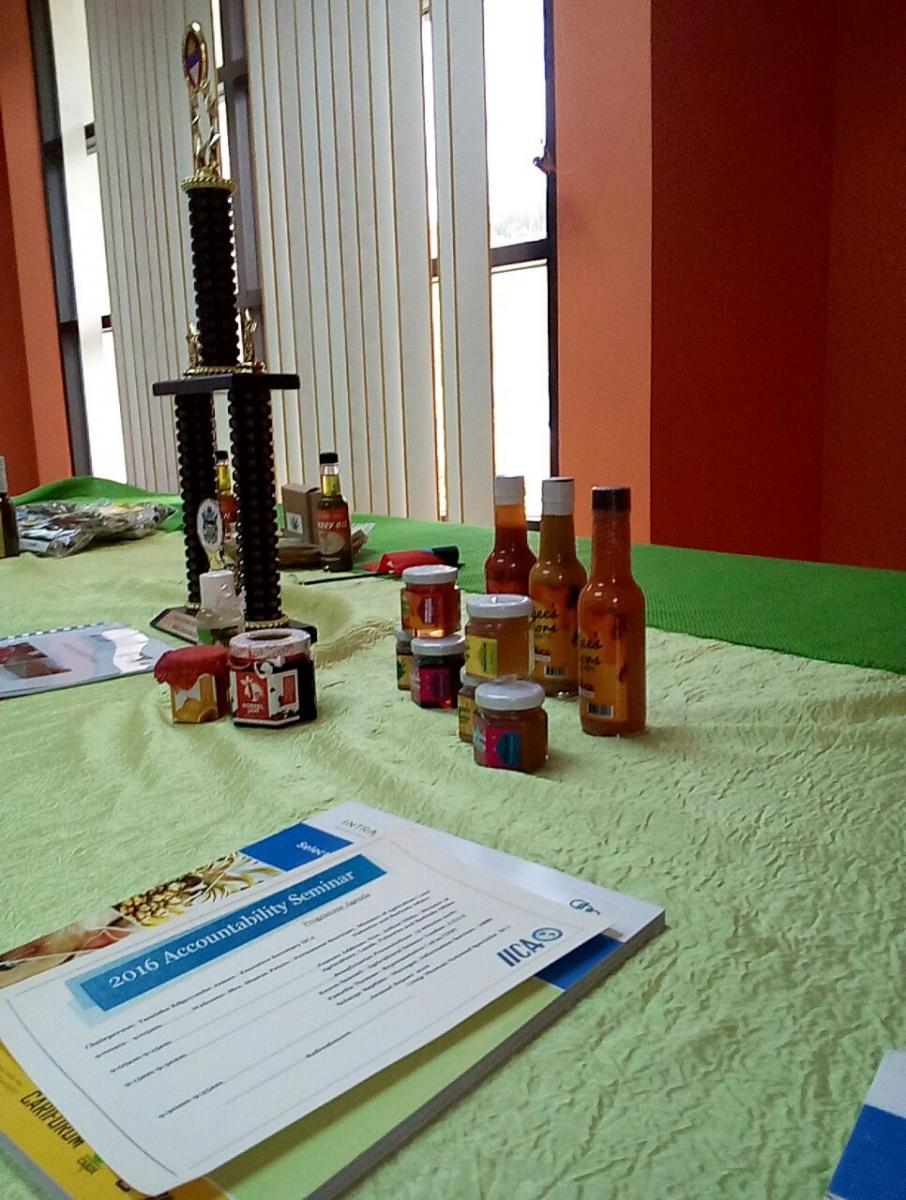
An exhibit by the Antigua and Barbuda Network of Rural Women Producers/Agro-Processors (ANBNROP) was one of the main features of the Delegation’s accountability seminar. IICA supports this group through training, knowledge and dialogue.
The rural women mounted an impressive display which included, for the first time, agricultural produce and agro-processed items. The objective of the display was to give greater visibility to the group, and to assist them with marketing and linkages to new markets.
More information:
Craig Thomas, National Specialist of the IICA Delegation in Antigua and Barbuda.