Inter-American Institute for Cooperation on Agriculture

Agricultural Health Agriculture Food safety Trade

Safe pesticide management and use being addressed in the Caribbean

Tiempo de lectura: 3 mins.

Twelve countries from the CARIFORUM Region met at the 21st Meeting of the Coordinating Group of Pesticides Control Boards of the Caribbean (CGPC) in Belize to discuss responsible pest and pesticide management in the Sub-region. 
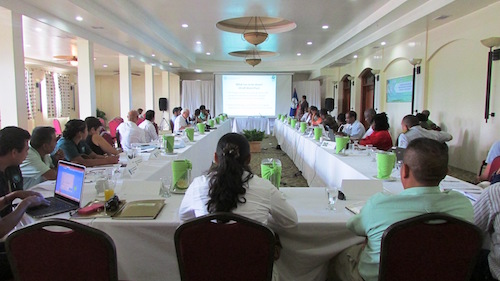
Participants of the 21st Meeting of the Coordinating Group of Pesticides Control Boards of the Caribbean (CGPC) listen attentively to one of the presentations.

(Bridgetown, Barbados. June 16, 2016) – The 21st Meeting of the Coordinating Group of Pesticides Control Boards of the Caribbean (CGPC) was held in San Ignacio, Belize under the theme: “A changing climate! A changing world! Responsible pest and pesticide management – our responsibility”. 

The Meeting, which was held  6 – 10 June, 2016, was funded by the 10th European Development Fund (EDF) Sanitary and Phytosanitary (SPS) Project, which is being implemented by the Inter-American Institute for Cooperation on Agriculture (IICA)  and the Food and Agriculture Organization (FAO) of the United Nations. 

The Meeting’s proceedings included a 3-day planning workshop for the implementation of activities under a project funded by the Global Environmental Facility (GEF) titled “Disposal of Obsolete Pesticides including Persistent Organic Pollutants (POPs), Promotion of Alternatives and Strengthening Pesticides Management in the Caribbean” and Phase II of an EU-funded project titled “Capacity Building related to Multilateral Environmental Agreements (MEAs) in African, Caribbean and Pacific (ACP) countries – Clean-up of obsolete pesticides, pesticides management and sustainable pest management.” This project is being implemented by FAO.

During the CGPC Meeting, several decisions and resolutions were taken including a decision to assess several pesticides which have potentially harmful effects to humans, animals  and the environment. The results of the assessment will be shared among member of the CGPC for further action at the country level.

The CGPC is comprised of representatives from the Pesticides and Toxic Chemicals Boards or Authorities of the countries of the Caribbean, and associate members representing other stakeholders. The group meets annually in one of the Member countries. The 21st Meeting of the CGPC was attended by representatives from twelve CARIFORUM countries.

For more information, please contact: carol.thomas@iica.int
Share

Related news​

San José, Costa Rica

May 29, 2026

IICA Director General receives overwhelming support in presenting the key pillars of the Institute’s work for the next four years, with a focus on strengthening the agriculture sector of the Americas

Member countries of the Inter-American Institute for Cooperation on Agriculture (IICA) expressed support for a presentation by Director General Muhammad Ibrahim during a meeting of the Special Advisory Commission on Management Issues (SACMI), where he outlined the key areas of focus of the organization’s work from now until 2030.

Tiempo de lectura: 3mins

San José, Costa Rica

May 28, 2026

Latin America and the Caribbean develop shared agenda for sustainable dairy farming with support from IICA, CAF, and regional partners

Producers, technical specialists, and institutions in different areas of Latin America and the Caribbean are taking part in a coordinated effort to develop a regional agenda for sustainable dairy farming. The initiative is spearheaded by the Inter-American Institute for Cooperation on Agriculture (IICA), CAF-Development Bank of Latin America and the Caribbean, the Pan-American Dairy Farming Federation (FEPALE) and Chile’s Dairy Consortium.

Tiempo de lectura: 3mins

San José

May 27, 2026

IICA and CIRAD renew strategic partnership to promote agroecological innovation and more sustainable agrifood systems in Latin America and the Caribbean

The work will prioritize initiatives that form part of a comprehensive approach to agroecological transition and agricultural health in areas such as agroforestry and forest management, resilient and competitive tropical agriculture, science, technology and innovation, bioinputs that reduce dependence on agrochemicals, integrated crop management and regenerative agriculture, precision agriculture, animal and plant health, soils and ecosystems, public policies for sustainable agrifood systems, governance, and institutional coordination.

Tiempo de lectura: 3mins