35 leading producers in Central America have installed these technological models, thus improving the processing of their coffee for the 2019-2020 harvest season, enhancing the quality of the bean, and in turn boosting their income through better sale prices, the total capacity of the dryer is between 14 and 15 quintales.
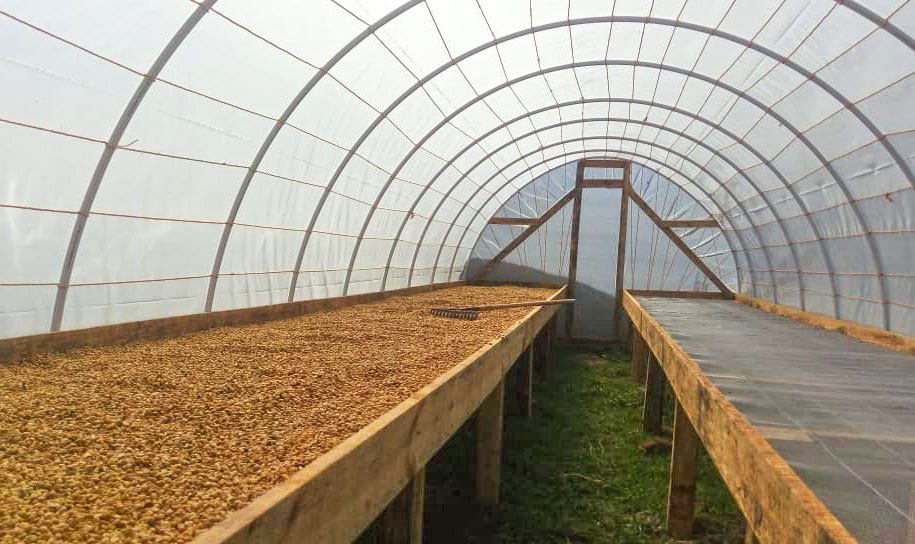
Tegucigalpa, March 17, 2020 (IICA). – In order to offer small-scale producers in the region a low cost alternative with minimal environmental impact, the Central American Program for Integrated Coffee Leaf Rust Management Program (PROCAGICA) is promoting the use of solar coffee dryers, which is an alternative that relies on natural resources, such as solar radiation and air.
According to PROCAGICA, an initiative that has been implemented in Central America by the European Union (EU) and the Inter-American Institute for Cooperation on Agriculture (IICA), coffee quality depends on the correct selection of mature and healthy fruit and on good practices during processing, among other things.
Drying is a critical phase to reduce the moisture content of the bean to the required optimal level (10-12%), in order to preserve the body, taste and aroma of the coffee and to prevent oxidation.
This is not a general practice among small-scale coffee producers, since they usually lack the necessary infrastructure for mechanical or patio drying, as it requires an investment that it is beyond their reach.
“We have been able to personalize the design of the solar dryers for the producers, by looking at the cultivation areas that they have and tailoring the design to suit this. This initiative has been well accepted by producers, researchers and foreign buyers, who recognize that it enables better care and cleanliness in handling the bean”, explained Oscar Bonilla, Assistant Extension Officer of the Honduran Coffee Institute (IHCAFÉ, Spanish acronym) who is working in Marcala, Honduras, in coordination with PROCAGICA.
The drying structures are low cost and easy to use. They do not require a great deal of space and can be built by hand, using local labor. The standard model is 1.20 meters wide by 10 meters long. It can accommodate two beds or platforms with a 70-centimeter passage in the middle, from which the producer can operate.
Since each bed or platform has a capacity of 7 quintales of coffee, the total capacity of the dryer is between 14 and 15 quintales. The lifespan of the dryer can be as much as 10 years when the mesh on the platforms are replaced.
Bonilla added that, “Traditionally, drying is done on concrete patios, which a process that requires sunlight. However, since it is cold during the harvest season, the solar drying technology has been readily accepted. It is also economical, because it can be done with materials that are readily available to the coffee producer, such as wood, PVC pipes and mesh”.
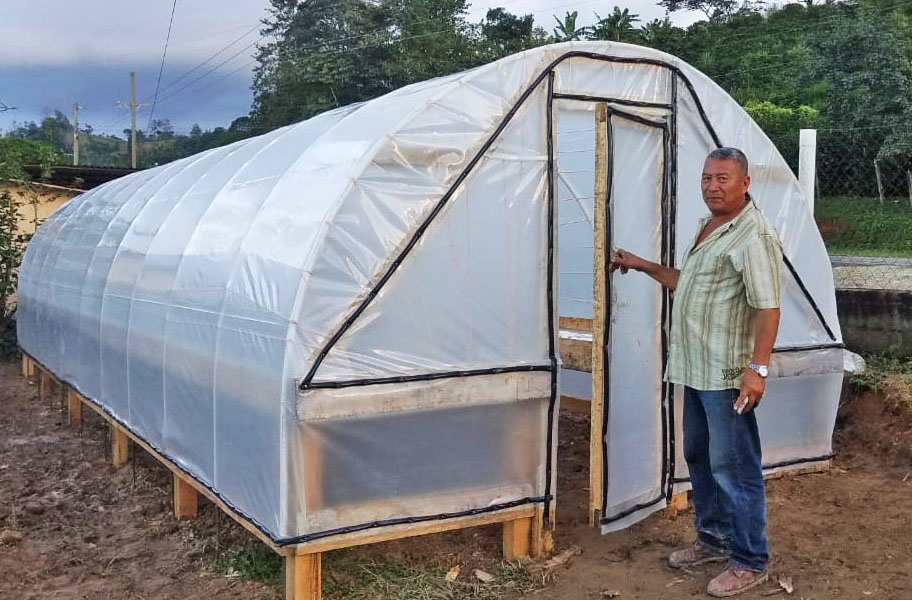
Currently, a network of 35 leading producers in Central America have installed these technological models, thus improving the processing of their coffee for the 2019-2020 harvest season, enhancing the quality of the bean, and in turn boosting their income through better sale prices.
PROCAGICA continues to invest in significant efforts aimed at production transformation and innovation in coffee cultivation in a participatory manner, directly benefitting 7,000 producers in Central America. This is taking place through the implementation of an integrated strategy to strengthen the resilience of small-scale producers.
Thirty-eight percent of the 7,000 beneficiaries are women and twenty-four percent are women under the age of thirty.
The EU-IICA Program has promoted the use of solar dryers among small-scale Central American coffee producers, since it is more efficient and cheaper than traditional drying methods, thus having a better impact on the final quality of the coffee. Furthermore, fluctuating climate patterns have created the need for this alternative.
More información:
Harold Gamboa, Coordinator of PROCAGICA.