IICA took part in a videoconference with the secretaries and ministers of Agriculture of Honduras, El Salvador, Costa Rica, Guatemala, Mexico, Nicaragua, Panama and the Dominican Republic, who proposed the creation of an inventory of available agricultural products.
San Jose, 3 April 2020 (IICA). The Ministers and Secretaries of Agriculture of Mexico, Central America and the Dominican Republic took part in a videoconference to devise an action plan to guarantee food production and distribution amidst the pandemic triggered by the Coronavirus. The Director General of the Inter-American Institute for Cooperation on Agriculture (IICA) attended the meeting.
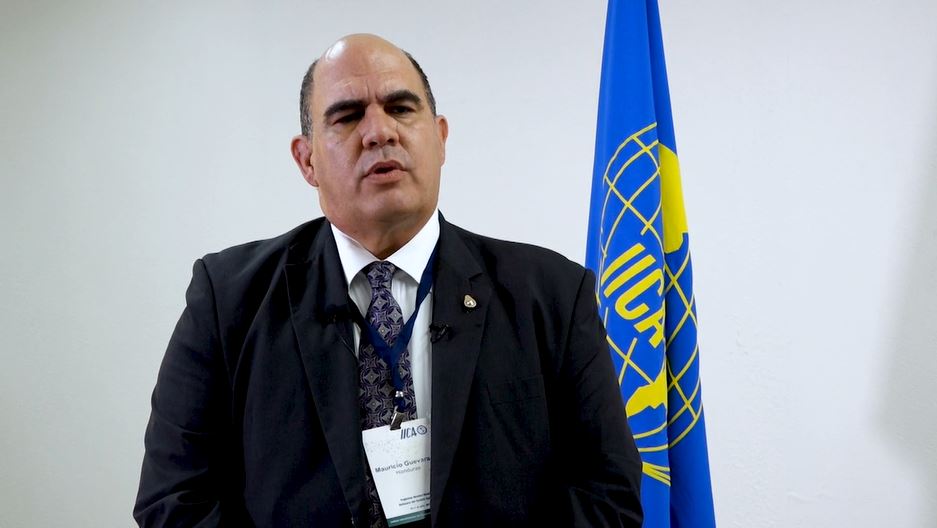
Mauricio Guevara, Secretary of Agriculture and Livestock of Honduras, in his capacity as President Pro Tempore of the Central American Agricultural Council (CAC), convened and presided over the meeting.
During the videoconference, the secretaries and minsters of Honduras, El Salvador, Costa Rica, Guatemala, Nicaragua and Panama; their counterparts from Mexico and the Dominican Republic, as well as the Director General of IICA, discussed the impact of the global crisis on food security, addressing issues related to production and trade in the sectors, as well as sanitary and phytosanitary risks.
Guevara had convened the meeting to devise a regional strategy to share surplus products and thereby guarantee the availability of food for the population of these nations.
In the online meeting, IICA’s Director General, Manuel Otero, indicated that the agriculture and rural development specialist agency is promoting the activation of regional and subregional mechanisms for inter-ministerial consultation.
He also proposed that an online meeting be held with high-level representatives of countries producing surpluses, particularly of soya and corn – for example, Argentina and Brazil, which are members of the Southern Agricultural Council (CAS), as well as Paraguay, Uruguay, Chile and Bolivia. A similar meeting had recently been held with Peru.
The secretaries and ministers talked about the need to implement processing strategies for fresh products and to quickly establish contacts with the major chains involved in the food trade in their countries to seek increased and more efficient opportunities for public-private sector coordination.
After sharing their experiences regarding actions taken to deal with the situation, the ministers of El Salvador, Costa Rica, Guatemala, Nicaragua, Panama and the Dominican Republic agreed to exchange information on statistics, with a view to creating and publishing an inventory of surplus products for distribution. It would list those products—for example, vegetables, fruits and meat—that were awaiting export and therefore were available.
They also agreed to create a united front to guarantee the production and supply of food; to ensure the provision of milk products and basic grains, through an efficient communication mechanism; and to strengthen supply chains, by opening up and expediting processes at border crossings.
The next meeting will be held on 15 April.
More information:
Institutional Communication Division.
comunicacion.institucional@