The Government has quadrupled distribution of inputs for agricultural production and intensified technical support to transform the sector, launch a new production cycle and tackle the global food crisis.
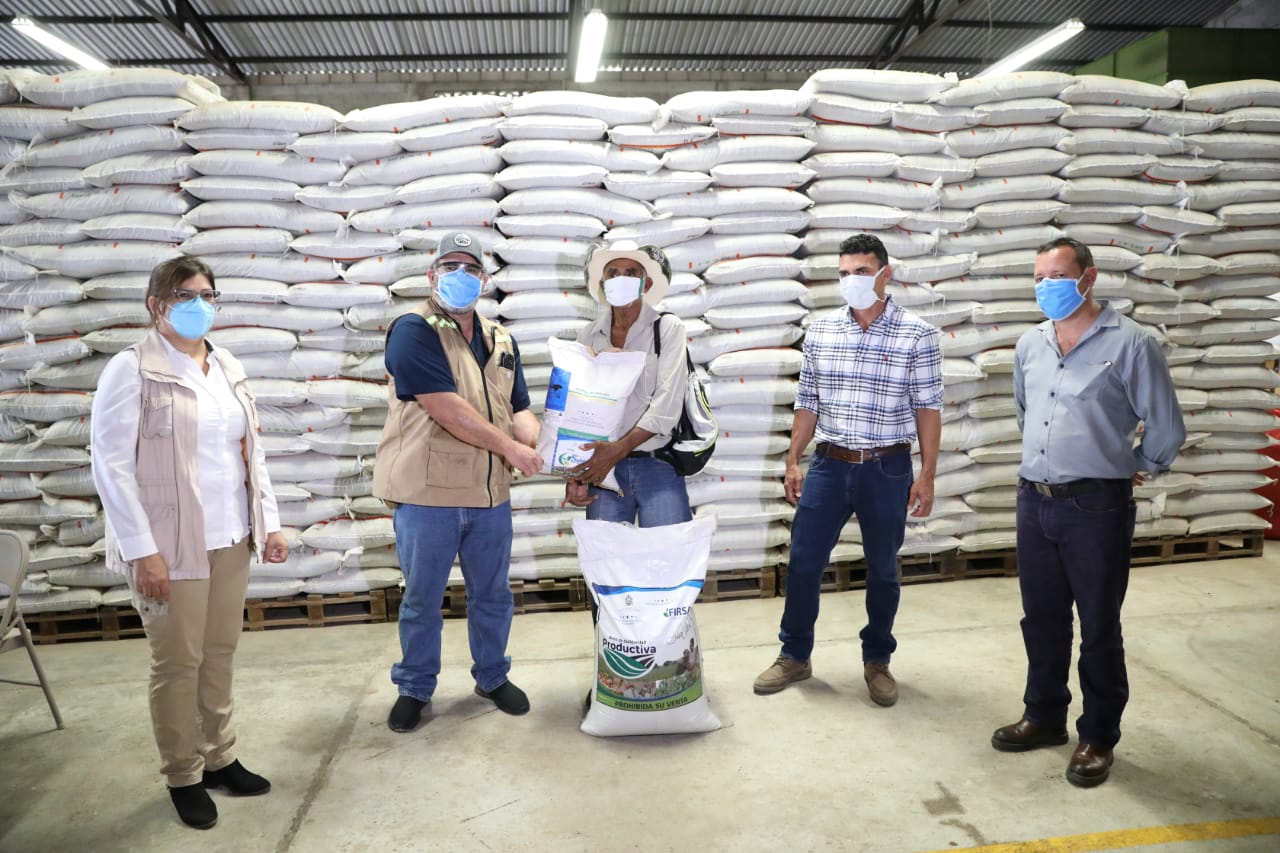
Tegucigalpa, 3 June 2020 (IICA) – Through the Solidarity Production Bonus and the Coffee Bonus, the government of Honduras is seeking to transform the country’s agriculture sector and spur productivity amidst the COVID-19 pandemic.
Authorities have appointed the Inter-American Institute for Cooperation on Agriculture (IICA) to administer and provide technical support for the program, in a bid to ensure transparency and effective execution.
This timely and decisive action by the Honduran Government was prompted by the fact that many producers are fearful of going out to plant in the fields, although a critical time for food production is approaching, with the imminent arrival of the rains after an extensive drought.
IICA, in conjunction with the Secretariat of Agriculture and Livestock (SAG), will coordinate and oversee the distribution of inputs to producers, while also providing technical support through a network of more than 160 specialists in 214 municipalities in the country.
In order to benefit a greater number of farmers, Honduras decided to quadruple the funds earmarked for the Solidarity Production Bonus, which provides fertilizer, improved seeds and technical support to farmers, thereby increasing the resources from 50 to 200 million lempiras (approximately USD 2 to USD 8 million).
The production of biofortified food, through the use of improved seeds, is critical in the government’s strategy to guarantee food security in the country. It is also a fundamental aspect of providing feed for production animals.
“Let this be the first step in transforming our farms and our people”, said Honduran President, Juan Orlando Hernández, “given that it is the most extensive agricultural support program in the country’s history. Other than technical assistance, we need to improve chains and find a way to export”.
The distribution of the Solidarity Production Bonus began during the week of May 20.
Honduras’ Secretary of Agriculture, Mauricio Guevara pointed out that, “Bean consumption is 2.4 million quintals, 1.3 million of which will also be provided by the bonus. Therefore, the government is practically providing more than half of what is being consumed at the national level”.
The program will benefit 140,000 families working in agriculture – a highly strategic sector for food, employment and the generation of foreign exchange.
Franklin Marín, IICA Representative in Honduras, reflected that, “The arrival of the pandemic has served to accelerate the processes that we had been undertaking, in collaboration with the authorities, and has fuelled a more immediate and concrete response.
Stimulus to the coffee sector
Honduras is the leading coffee producer in Central America, despite shortcomings in its productivity.
In order to bridge this gap, the government has placed special emphasis on providing fertilizer and training for farmers, encouraging them to cultivate other crops in addition to coffee, as a means of diversifying income and guaranteeing the availability of food throughout the year.
The new coffee bonus is a 300-million-lempira investment (a little more than USD 12 million) and aims to improve cultivation of the bean, through production modernization and improvements in output. The bonus will be awarded to 91,400 coffee producing families, that is, 87% of the almost half a million people who make a living from this crop.
To complement this strategy, there is a proposal to organize the first international auction of Marcala coffee, as this coffee has received a designation of origin and is recognized for its quality.
The price achieved at the auction would reward coffee farmers for the quality of the bean and the consistency of the crop, while enhancing the image of Honduran coffee in the eyes of the world. The initiative is supported by the European Union-IICA project – the Central American Program for Integrated Coffee Rust Management (PROCAGICA).
More information:
Franklin Marín, IICA Representative in Honduras