This was one of the ideas shared by Ted McKinney, Under Secretary of Agriculture for Trade and Foreign Agricultural Affairs at the United States Department of Agriculture (USDA), during a webinar aimed at discussing the importance of livestock production and animal protein.
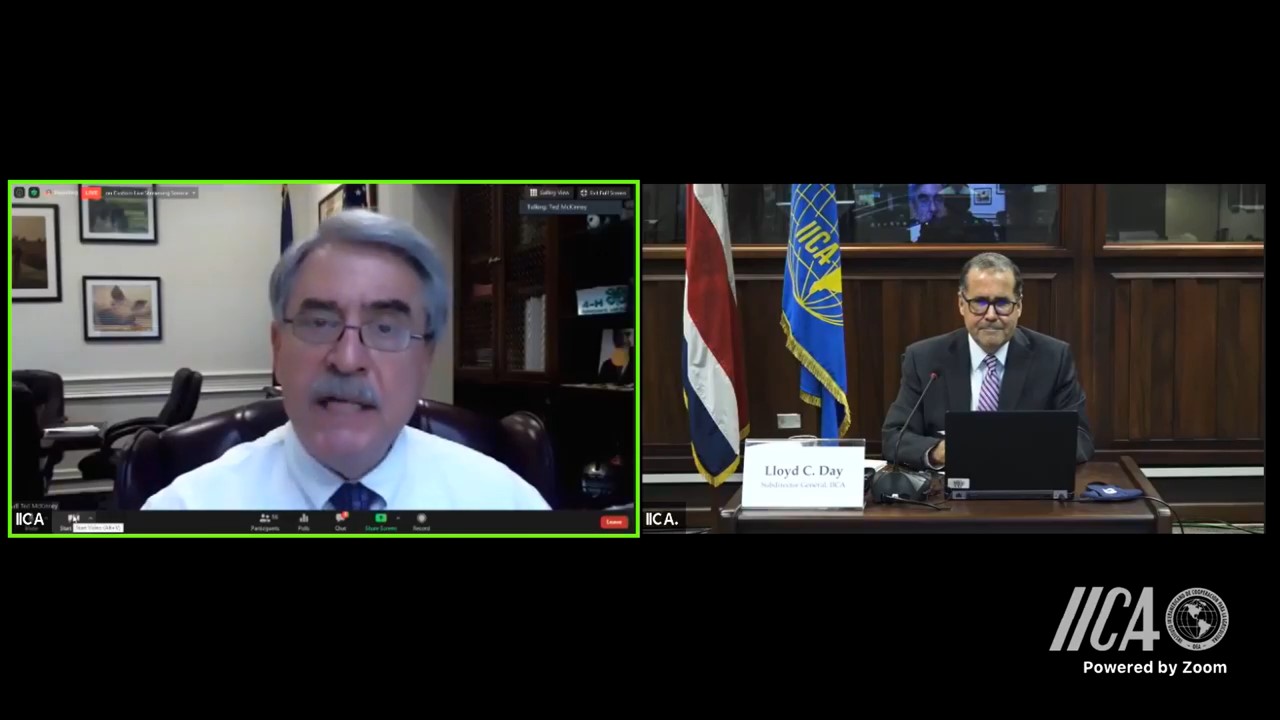
San Jose, 23 October (2020). The agriculture sector in Latin America and the Caribbean (LAC) must turn to innovation to increase efficiency and productivity and, in turn, guarantee safe and quality agrifood systems, remarked Ted McKinney, Under Secretary of Agriculture for Trade and Foreign Agricultural Affairs at the United States Department of Agriculture (USDA).
McKinney made these statements during the webinar entitled “The Importance of Livestock Production and Animal Protein: the Western Hemisphere Perspective”, organized by the U.S. Dairy Export Council (USDEC) and the Inter-American Institute for Cooperation on Agriculture (IICA). The purpose of the activity was to provide specialists with an opportunity to discuss some of the pressing issues facing the sector and to compile their perspectives in a document that will be presented next year at the United Nations Food Systems Summit.
“The Summit is extremely important, and as much as I am very positive, I’m also worried that there are false agendas being advanced that are going to try to take us back to the days of my grandparents, and we must not allow that. That is why this IICA seminar and the work of all the participants is to remind people that innovation, safety, quality, productivity and efficiency are the path that most of the world chooses”, stated McKinney.
The Undersecretary stressed the fact that innovation is key to achieving progress with respect to productive, economic, environmental and social sustainability, adding that the USDA’s agenda is based on that approach.
“It’s that kind of thing that we must chase more and more. The Secretary has the goal of increasing productivity, at least in our country, by 40%, and reducing the load on the environment by 50%”, he remarked.
“The key difference between us and other parts of the world is we’re going to do that through innovation. Our farmers have achieved that; we have reduced the use of fertilizers by 25-35% because we’re dialing back and we have soil sampling. We’re using zero insecticides in our corn fields these days, and that is due to the advent of biotechnology and genetically modified organisms”, he added.
He noted that agricultural innovation is crucial, given that it will enable livestock production and farmers in the region to make a profit and to continue to play a key role in people’s food and nutritional security.
“You can do this through innovation and continue to increase productivity. This includes meats and dairy, which is great, because we must not focus solely on vegetables. We cannot forget about all of the products that come from our livestock and poultry sectors”, he explained.
McKinney argued that science and innovation must go hand in hand, explaining that this will allow for eliminating barriers and obstacles that often arise without a scientific basis.
“I strive to break down these barriers. I believe we have a bright future ahead of us, and we will succeed in meeting our needs for productivity as well as healthy, quality food for those 9 or 10 billion people projected to be on the planet by 2050”, he concluded.
The Under Secretary took advantage of the opportunity to highlight IICA’s role as an international organization, describing the Institute as a model institution due to its leadership in the field of agriculture and in preparing the publication that will be presented at the UN Food Systems Summit.
More information:
Horrys Friaca, International Specialist of IICA’s Agricultural Health and Food Safety (AHFS) Program.
horrys.friaca@iica.int