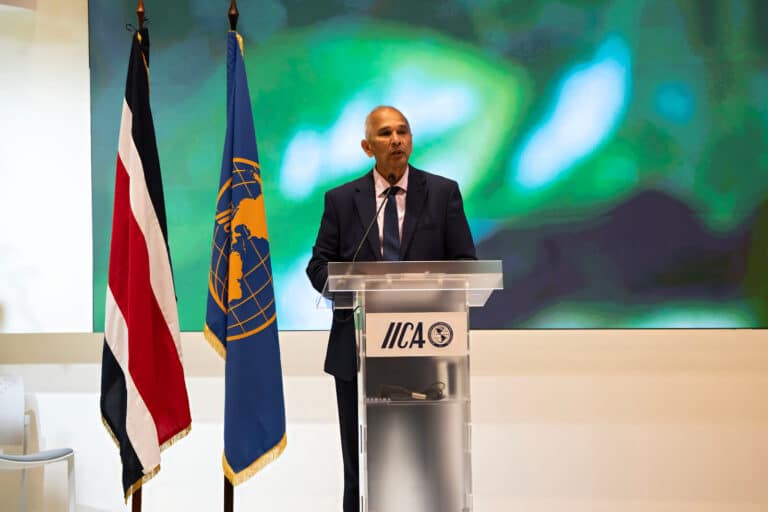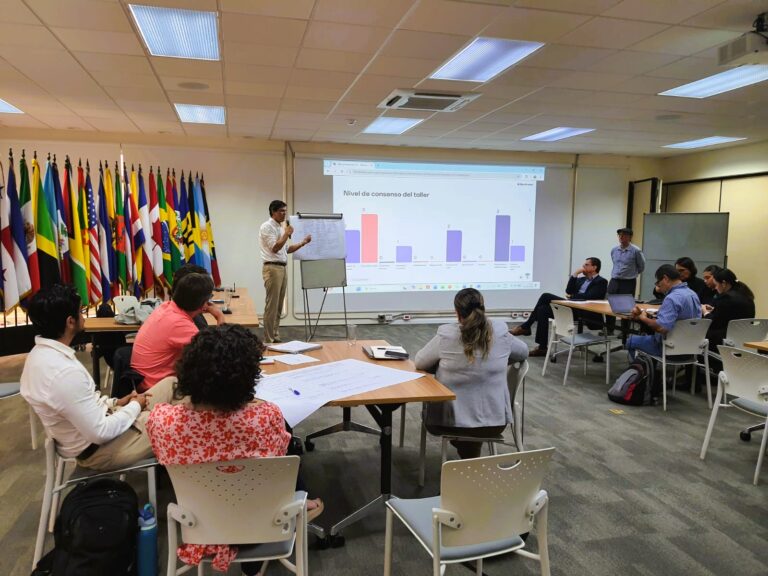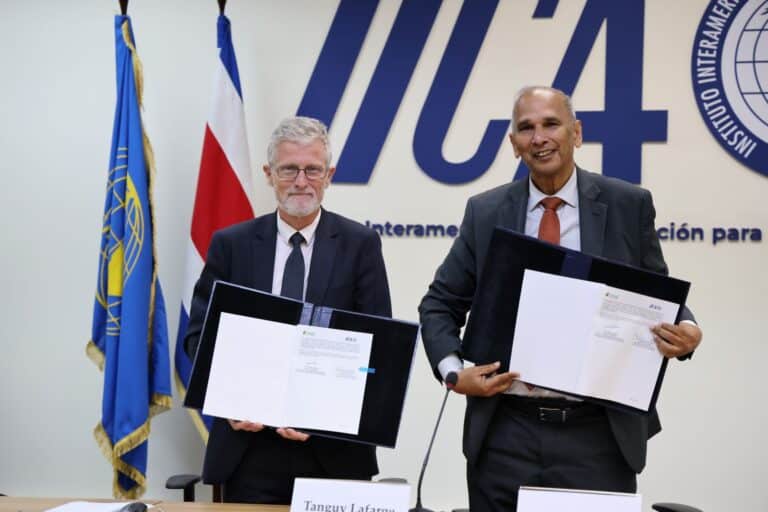
The group includes representatives from the private sector, scientists, state entities, civil society organizations and international bodies. IICA will act as Secretariat for the alliance, which has decided to undertake the fight against a pest that is challenging a key crop for food security.
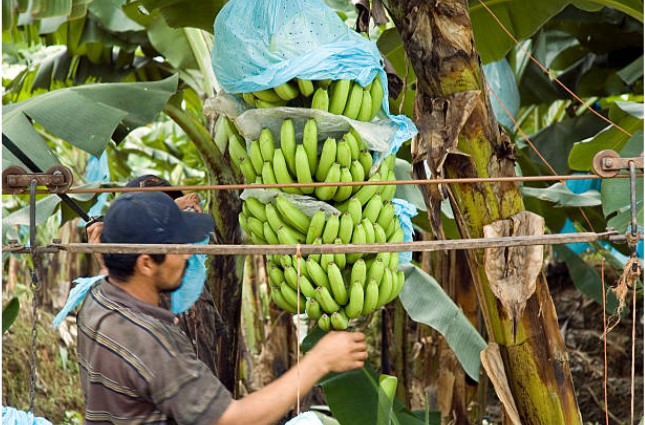
San Jose, 22 February 2021 (IICA) – Representatives from the private and academic sectors, civil society organizations, state entities and international bodies took a major step forward in the fight against a pest that is endangering the continuity of banana production and therefore, the food security of our planet.
The Global Alliance for Cooperation to Fight against Fusarium TR4 was formally established with the ultimate goal of containing the advance of what is considered the “banana pandemic”, and to conduct research and develop plant breeding solutions in the mid- and long-terms.
In response to the pressing need to act promptly, various agriculture sustainability specialists reached an agreement in January 2020 to work jointly to defeat this disease, whether by preventing its spread, investing in genetic development, or educating consumers.
The Alliance was formally established during a virtual meeting that featured the participation of Kenton Dashiell, Deputy Director of the International Institute of Tropical Agriculture (IITA); Jorge Sauma, Assistant Executive of the National Banana Corporation (CORBANA) of Costa Rica; Sara Boettiger, Chief of Public Affairs, Science and Sustainability of the Crop Science Division of Bayer; Ronald Guendel, Global Director of Food Value Chains of the Crop Science Division of Bayer; Andrew Biles, General Manager of Chiquita Brands International; Jeroen Kroezen, Coordinator of International Programs at Red Solidaridad; Ernst van der Ende, professor at the Department of Phytopathology of Wageningen University (Netherlands); and Manuel Otero, Director General of the Inter-American Institute for Cooperation on Agriculture (IICA).
As decided by its members, IICA will act as Secretariat for the Alliance, whose mission is to support the banana sector in the face of the challenges posed by R4T through knowledge development, technologies and mechanisms that will help find a definitive scientific solution to eradicate the fungus.
“Fighting against R4T is a global challenge, and therefore requires global efforts. This is why the work of the Global Alliance against R4T is crucial; it brings together stakeholders from all regions and specialties, and will enable each one of them to contribute their knowledge and resources”, explained Guendel.
Bananas are planted in 135 countries across the five continents. Not only does this crop play a central role in global food security but also constitutes the livelihood of those who cultivate it, transport it and sell it for a living. An estimated 400 million people depend on bananas as a key source of nutrition or income.
The Tropical Race 4 (TR4) strain of the Fusarium fungus is a disease with currently no known treatment, which spreads through soil and devastates plantations.
The fungus constitutes the biggest threat in over half a century for a crop that is especially important for vulnerable populations who derive up to one-fourth of their daily caloric intake from bananas.
Although it originated in Asia, the TR4 has been moving west and was detected in Colombia in 2019. This set off an alarm in tropical areas of Latin America and the Caribbean, where the largest producers and exporters of banana in the world are located.
The only effective way to successfully stop the spread of the disease is to burn the affected lands, which can no longer be utilized as the disease may reappear.
Guendel went on to say that “if we all collaborate, we will have the best shot at saving bananas, and hence the livelihood and nutrition of countless people across the world”.
Furthermore, the Director General of IICA, Manuel Otero, stated that “we are strongly motivated to work with the Alliance to find a solution for a disease that has spread across the world in recent years and which has strong economic and social impacts, since bananas are strongly tied to global food security”.
TR4 attacks the Cavendish variety of bananas, which constitutes half of the global production, accounts for 95% of exports and has the highest market share in Latin America and the Caribbean.
The Cavendish variety was the solution found about 70 years ago due to its natural resistance to another Fusarium fungus called Race 1. During the first half of the 20th century, this strain killed the Gros Michael species, which was dominant up until that time.
The Alliance will carry out various activities, including scientific research and publication of reports and studies, technology transfer and consulting services for producers, training through seminars and courses, and dissemination of information through books, magazines, newsletters and conventional and digital media.
The coalition will have three permanent working groups: the Training and Prevention group will focus on early detection of the disease, hygiene measures and eradication of infected plants to limit contagion.
The Genetics and Cultivation group will seek to develop new varieties resistant to TR4, with the goal of ensuring the health of the banana industry in the long term.
Finally, the group focusing on Chemical and Biological Control Methods will work on the creation of innovative crop protection products that will favor plant health by activating their natural defenses, in order to fight against and cure infections and eliminate insects and other vectors for diseases.
The Alliance will seek financial support from international donors to carry out an indispensable task and guarantee the continuity of banana cultivation as we know it, thus strengthening food security and ensuring the livelihood of millions of people across the world.
More information:
Institutional Communication Division of IICA.
comunicacion.institucional@iica.int