The decision was reached through a resolution adopted at the IICA Executive Committee meeting, where Member State representatives heard a presentation by the Argentine scientist Raquel Chan on the importance of science, technology and innovation in agriculture.
San Jose, 22 July 2022 (IICA)— Gathered at the Headquarters of the Inter-American Institute for Cooperation on Agriculture (IICA), countries of the Americas asked the specialized agency to boost its support for the design of public policies aimed at fostering and developing innovation, science and technology in the agriculture sector.
The decision was reached through a resolution adopted during the meeting of the IICA Executive Committee, where Member State representatives heard a presentation by prestigious Argentine scientist Raquel Chan on the importance of science, technology and innovation in agriculture.
Raquel Chan is an Argentine biochemist specializing in plant biotechnology who led the development of the HB4 gene from sunflowers that confers drought tolerance to wheat and soy.
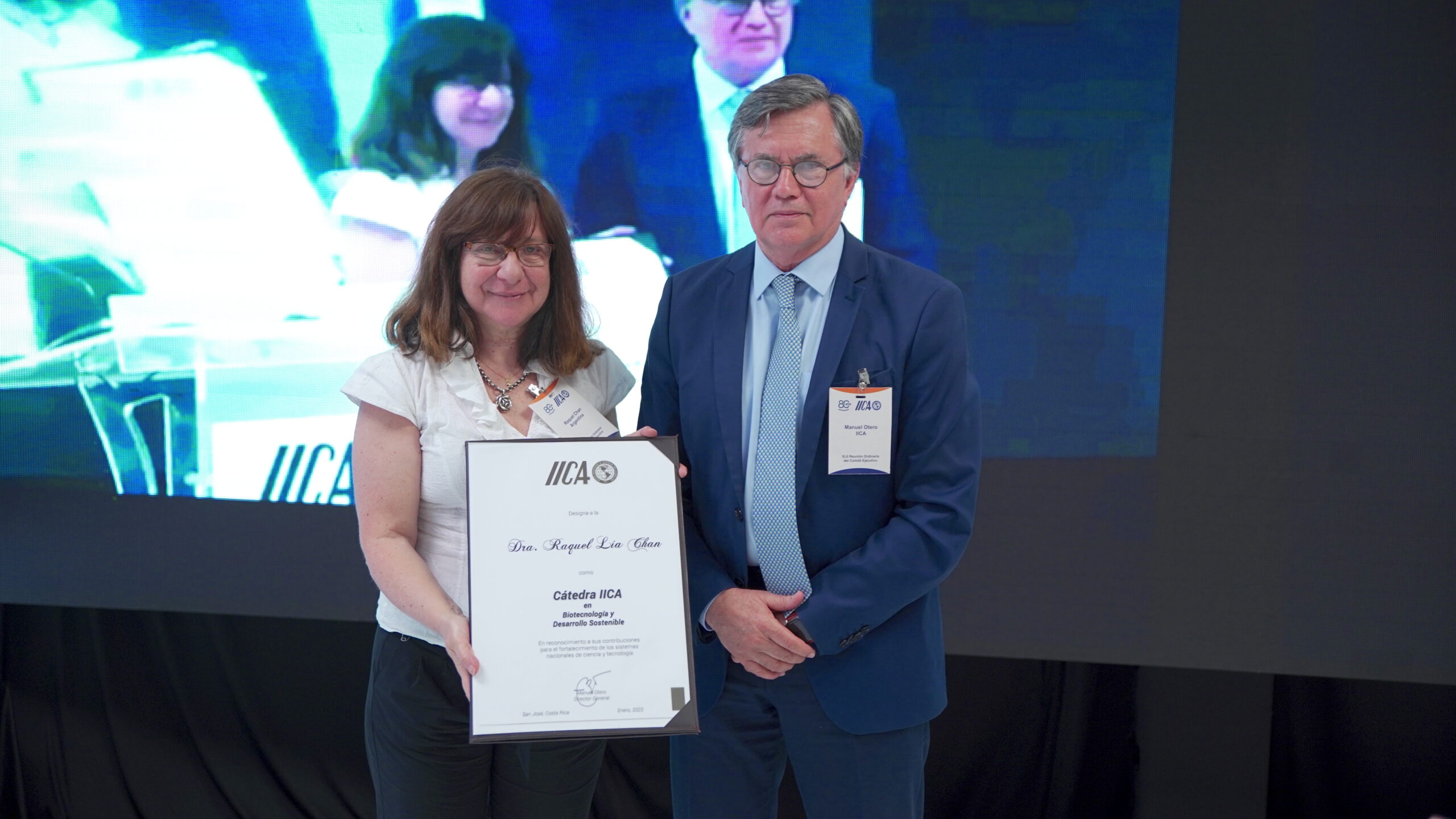
Chan, whose career was recognized during the meeting, received the title of “IICA Chair in Biotechnology and Sustainable Development”, due to her contributions to strengthening national science and technology systems.
The request made to IICA, expressed in a resolution adopted by the Committee, one of the governing bodies of the Institute, asked that increased support be verified at the national, regional and hemispheric level and that it should reflect the particular characteristics and specific needs of the member countries of the Institute.
The request was made with the understanding that the development of innovation, science and technology in the agriculture sector is the right way to ensure that agrifood systems are increasingly productive, sustainable and inclusive.
The governing body of the Institute considered that advances in biology, information and communication technologies, nanotechnology and engineering have consolidated their standing as tools for tomorrow’s agriculture.
In particular, the Executive Committee highlighted the advances of the so-called “new biology” that has allowed research and development to have more accurate and reliable processes, applicable to practically all fields of agrifood activity, which, in turn, has resulted in a greater understanding of natural resources and ecosystems.
Science to produce more food
In her presentation, Chan said that it is the duty of science and scientists to ensure there is enough food available for the growing world population. “When we look at the investment in science and technology by the different countries of the world, we see that there is a correlation between those that invest more and the wealth and well-being of those societies”, she said.
Chan, a researcher for the Argentine National Scientific and Technological Research Council (CONICET) working at the Institute of Agrobiotechnology of the Litoral (Instituto de Agrobiotecnología del Litoral) in the Argentine province of Santa Fe, said that of all the climate disasters, it is drought that causes the greatest losses to agricultural production.
The scientist gave a detailed account of the work she has done for several years with her team to transfer to other plants the HB4 gene from sunflowers, which confers drought tolerance.
“Science is based on asking questions. And we asked ourselves if all plants adapt equally to the environment. Sunflowers are highly adaptable. So, in 1992, we decided to work with sunflower genes”, she said.
Chan described the efforts involved in scientific work and said, in this regard, that there were 37 field trials with HB4 wheat. “It was a long road from the first results until we had a crop of agricultural interest that could generate better yields than conventional ones”.
In Argentina, she said, there are 62 genetic modification events approved by the Ministry of Agriculture, of which only three are from Argentina and the rest are developed by foreign or multinational companies. The three Argentine ones are HB4 wheat and soy and a variety of transgenic potato.
Chan recognized that transgenic crops generate controversy and was prepared to debate on this. Regarding the use of agrochemicals, she said that these are substances that are not friendly to the environment, but they are the best option available for agricultural production. “We scientists have to do research to reduce the use of agrochemicals and replace them with biological products. That requires serious work that isn’t done in one day”, she warned.
Chan also highlighted the importance of the State’s role in the development of biotechnology. “I work for the State, which has funded my research and holds the patents for HB4 wheat and soy. The license belongs to the private company Bioceres, which also played a very valuable role”.
Chan concluded her remarks by quoting the Argentine Nobel Laureate for Medicine Bernardo Houssay, who said that rich countries are rich because they assign money to scientific and technological development and poor countries continue to be poor because they don’t. “Science is not expensive; ignorance is expensive”, she said.
The participants at the Executive Committee meeting valued the importance of Chan’s presentation.
María de Lourdes Cruz Trinidad, General Coordinator of International Affairs of the Secretariat of Agriculture and Rural Development (SADER) of Mexico, considered that science and innovation are essential for addressing the challenges of producing more food and protecting natural resources. “The story that Dr. Chan told us is exciting. It would be ideal if all countries made developments like that”, she said.
Maximiliano Moreno, Director of International Relations of the Argentine Ministry of Agriculture, Livestock and Fisheries, said that for his country it is a privilege to have Raquel Chan and highlighted the positive experience of public-private synergy, which has enabled the development of HB4 soy and wheat.
“With a growing population”, he said, “and the need to produce more with less, we are convinced that science is the way, and that biotechnology is one of the solutions”.
More information:
Institutional Communication Division