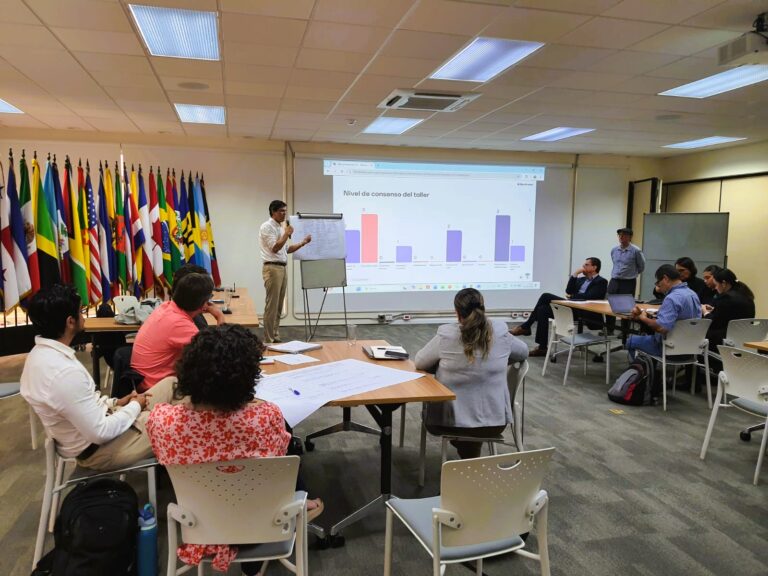
Network of 20 AgTechs (technology companies whose services are geared towards the agriculture sector) in the Americas, established by IICA in 2022, issues recommendations to consolidate the ecosystem for this industry in the region.

San Jose, 25 August 2023 (IICA). Strengthening work in networks and promoting regional forums for dialogue and close collaboration between AgTechs, policymakers, public and private funding agencies, producers and research and development (R&D) institutions is key to strengthening the generation of digital technologies and their application in the agriculture sector of the Americas.
This was one of the priority actions identified by representatives of 20 leading AgTechs – technology companies whose services are geared towards the agriculture sector – in the Americas that are working to foster the development of these types of firms and the use of their technological proposals. AgTechs currently offer many of the digital solutions available in the hemisphere, which are beginning to demonstrate valuable productive, environmental and social benefits.
Consensus in this regard was reached during a meeting of the Network of AgTechs in the Americas, established by the Inter-American Institute for Cooperation on Agriculture (IICA) as a result of Digital Agriculture Week, an annual event it has held since 2022.
The purpose of the network is to consolidate the region’s AgTech ecosystem, as well as foster and accelerate the digital transformation of agriculture. The network is comprised of AgTechs that participated in the 2022 and 2023 editions of Digital Agriculture Week.
Participating in the meeting were the companies Ucrop.it, Agroconsultas, Gbot, Appi.AR, AgriRed, Wiagro and DeepAgro of Argentina; Tarvos and AgroDataSat of Brazil; Bloomspal, Visualiti, Incluirtec and AgrodataAI of Colombia; Green Xpo of Costa Rica; Neltume of Chile; AgTechApps of Guatemala; TheFarmBox of Mexico; Zafrales and Indata of Uruguay; and Siagrica of Venezuela, in addition to other special guests.
The AgTech representatives agreed that there should be widespread recognition of the key role they have assumed in the new innovation and technological development systems, in building digital skills and in facilitating the use of their technologies in the countryside.
“It is important to acknowledge the leading role that AgTechs have played in spearheading the digital revolution in agriculture, by translating academic and scientific knowledge into practical solutions adapted to each region’s unique challenges, thereby accelerating technology adoption among producers and beneficiaries”, remarked Oriana Gómez, of Colombian company Visualiti.
With respect to the adequate development and operation of AgTechs, they underscored the need for venture incubation and acceleration programs, early-stage funding and tax incentives for the developers and users of these solutions. They also highlighted the importance of organizing and facilitating access to events where they can promote their technological solutions for use in agriculture and establish linkages with farmers and policy makers, among other stakeholders.
They recognized the need for forums in which they can engage in dialogue with producers, governments or other stakeholders to prioritize issues to be resolved through the use of technologies, as well as technology validation systems overseen by national and international technical institutes.
“We must also reach out to governments, to explain what AgTechs are and figure out how we can collaborate to increase agricultural productivity and digitalization in the immediate future”, added Erick Cuellar, of AgtechApps, Guatemala.
Model farms and youth inclusion
Regarding pending actions to foster the development and use of digital AgTechs, the network representatives commented on the urgent need for pilot cases related to digitalization in different agricultural chains. They explained that this would allow for raising awareness of the potential of new technologies, fostering their co-development, and facilitating their use and replication. To that end, they proposed creating model farms as a way to give greater visibility to, as well as test and validate technologies.
“It is important for agricultural and business institutions to engage in coordinated work to validate and promote AgTechs”, considered Mauricio Pintado, of the Uruguayan company Zafrales.
The participants concluded that it is necessary to generate initiatives to disseminate new technologies among youth, such as through rural and technical schools that can build their capacity to utilize these technologies as well as foster rural retention and youth participation in the countryside.
The establishment of the Network of AgTechs in the Americas and its operation, as well as the organization of forums for dialogue and events such as Digital Agriculture Week, are part of the actions implemented by IICA’s Hemispheric Program on the Digitalization of Agrifood Systems, which the Institute created as part of its 2022-2026 Medium-term Plan. These efforts reflect the relevance of this topic as well as the commitment of the agency specializing in agricultural and rural development to addressing the issue.
“As technology providers, AgTechs are well aware of the barriers that hinder their use. Our network is an ideal forum to analyze and propose strategies and actions to foster technology use in countries of the Americas, as well as to strengthen the AgTech ecosystem in the region”, said Federico Bert, who leads the Digitalization of Agrifood Systems Program at IICA.
“Digital technologies are a concrete, promising tool for improving agrifood systems. Although we have a growing number of digital technologies, the great challenge we face is how to expand their use, particularly in small-scale agriculture”, he concluded.
More information:
Federico Bert, leader of IICA’s Digitalization of Agrifood Systems Program.
federico.bert@iica.int