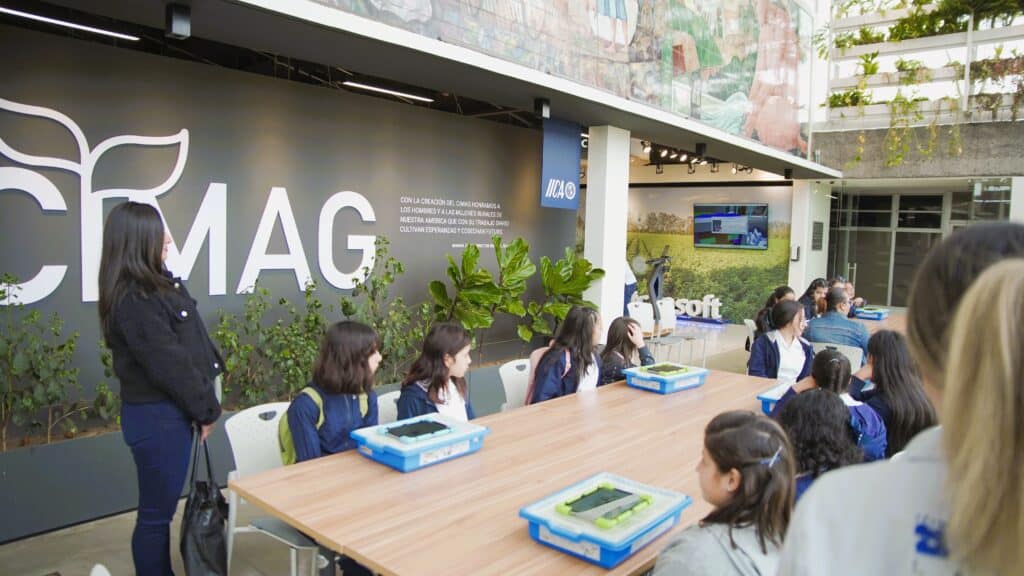
The initiative will encourage the use of digital technologies (in this case, the Minecraft video game) to develop creative and innovative solutions to real-world problems. High school students wishing to take part must register online between June 12 and 24.
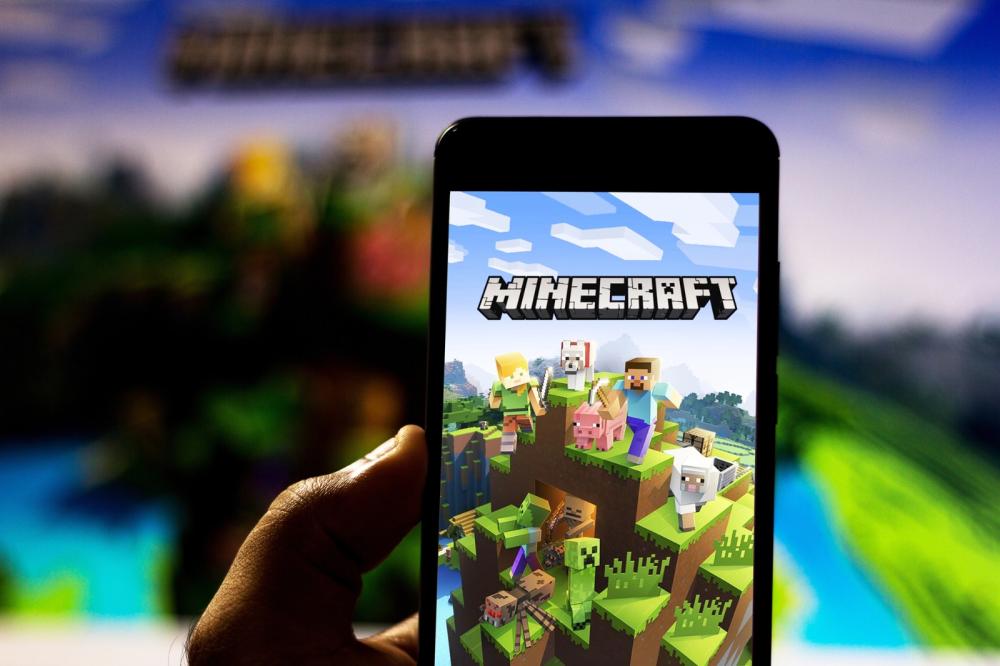
San José, 10 June 2024, IICA. Microsoft and the Inter-American Institute for Cooperation on Agriculture (IICA), together with the Cedes Don Bosco social organization and the Netafim corporation, are launching the second edition of the Minecraft Education Challenge for Agriculture, in Costa Rica, focused this year on developing global solutions in answer to the question: how can we promote water conservation and sustainable agriculture in our communities using innovative technology and practices?
The challenge is targeted at Costa Rican high school students between the ages of 12 and 18, who must propose, in the Minecraft video game world, ways of tackling the real, current and global challenge of strengthening water management and sustainability.
Participants will be required to find solutions to challenges such as efficiency in irrigation, the use of technologies for that purpose, good practices for water conservation, the use of bioinputs, the restoration of forests and soils, and the application of sustainable agricultural practices to boost income.
In order to participate, three or four students must form a group and register at https://forms.office.com/r/pKGRNwTzKv. The registration period is from June 12 to 24, 2024, or until 50 teams have registered.
The 2024 Minecraft Challenge, which this year is being supported by IICA’s Hemispheric Water and Agriculture Initiative, will enable students to develop both soft and STEAM skills (STEAM = science, technology, engineering, art and mathematics).
During the challenge, between June and October 2024, participants will receive training in agricultural topics, AgriSTEAM, water, the development of communication and effective writing skills, and the use of Minecraft Education, all with the aim of designing the best solutions to the proposed challenge.
Students will then use the knowledge acquired and their own research to develop a solution to the problem selected for this edition of the challenge.
According to Margarita Morera, Microsoft Director of Education for Central America, Minecraft Education is a tool that combines gaming with learning to offer an immersive environment that significantly improves educational results.
She also explained that the structure and open nature of Minecraft Education allows for its flexible application in various educational areas, in settings ranging from science and technology to language arts and history.
“Among the various possibilities that Minecraft Education offers us is the great opportunity to encourage creativity and innovation in students, helping them to propose different solutions to current challenges, such as sustainability and efficient water use,” Morera added.
Manuel Alfaro, Strategy Manager at Netafim Central America, emphasized the importance of educating young people in new technologies to guarantee the sustainability of water resources in the future, and for that reason the 2024 Minecraft Challenge was a great opportunity for growth and teaching.
“Technical irrigation, such as drip irrigation and the use of micro-sprinklers, optimizes the use of water in agriculture. These systems allow precise control of the amount of water applied, improving efficiency and reducing the water footprint. These are examples that young people can take into account in their proposals,” Alfaro said.
Ana Carolina Hernández Solano, a psychologist with the Soft Skills Development Unit (UDCB) of CEDES Don Bosco, pointed out that the Minecraft Education Challenge allows young participants to acquire technological skills and test their technical and academic abilities, but also to engage in real social interaction.
Hernández said that CEDES Don Bosco was delighted to be part of this process, and to collaborate in life skills training on topics such as high-impact presentations and the importance of power skills.
“All the young people who take part are already winners for accepting the challenge of believing in themselves and for affording us the opportunity to discover their abilities and talents,” concluded Hernández.
Emmanuel Picado, Manager of Information and Communication Technologies and Digital Agriculture at IICA, explained that this second technological challenge based on water resources will focus on encouraging young people to provide solutions for effective water management.
“It will also help develop collaborative and critical thinking skills. The students will apply innovation, science and technology to develop alternatives to protect natural resources such as water, a vital resource for environmentally sustainable agriculture,” Picado added.
The teams selected to participate in the challenge will receive detailed instructions during each stage of the 2024 edition of the Minecraft Education Challenge for Agriculture.
More information:
Institutional Communication Division.
comunicacion.institucional@iica.int