San José, 10 October 2025 (IICA). Involving rural communities, producers, the private sector, governments and scientific entities in theconstruction of sustainable public policies for the agrifood sector is essential to transform Latin American and Caribbean (LAC) agrifood systems, and thus promote not only higher production, but also more efficient and higher quality production.
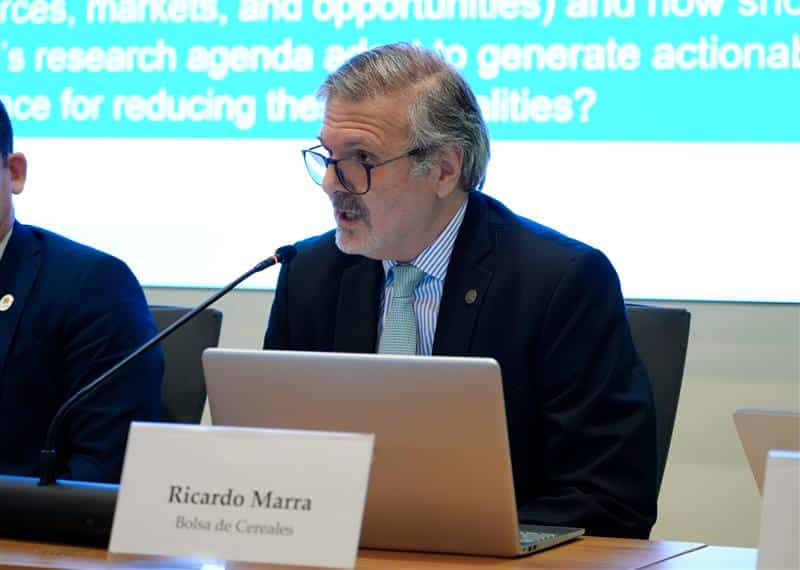
The point was emphasized by Argentinian Ricardo Marra, President of the Buenos Aires Grain Exchange, during the two-day hemispheric dialogue “Transformative and scalable experiences for a new generation of public policies for agrifood systems, held at the Headquarters of the Inter-American Institute for Cooperation on Agriculture (IICA) in San José, Costa Rica.
The event was organized jointly by IICA, the Alliance of Bioversity International -the International Center for Tropical Agriculture (CIAT), the World Bank, the Inter-American Development Bank (IDB), the CAF-Development Bank of Latin America and the Caribbean, the Economic Commission for Latin America and the Caribbean (ECLAC), and the International Food Policy Research Institute (IFPRI).
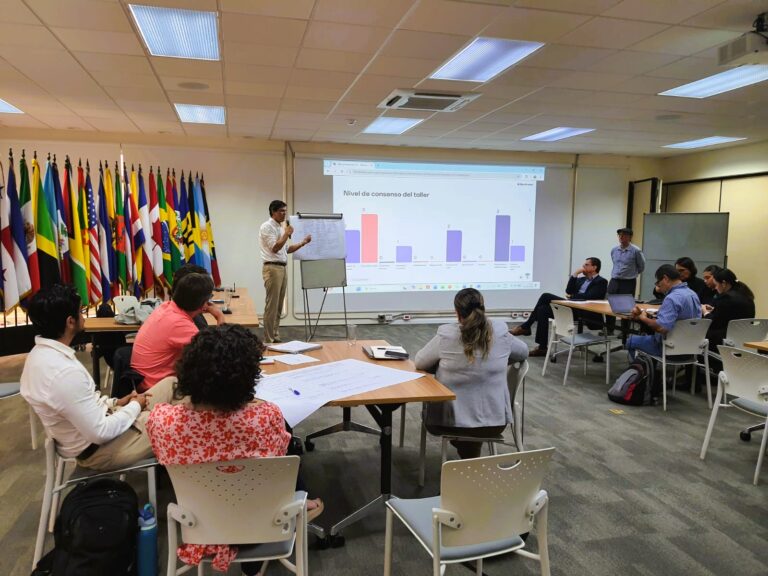
The more than 85 participants included senior government officials, experts, and representatives of the private sector, international organizations and academia, who discussed and shared transformative experiences regarding public policies for the agrifood sector that promote public goods, coordinate stakeholders and levels of government, and incorporate innovative mechanisms for the implementation and sustainability of the policies concerned.
“Public policies are important not only for achieving higher production, but also for achieving better production, integrating the efforts of rural communities, producers, and the private, public, and scientific sectors. When policies are developed and agreed upon by the public, private, and scientific sectors, and producers, theyare more sustainable over time”, Marra said.
The President of the Buenos Aires Grain Exchange, a 171-year-old institution that represents the entire Argentine agroindustrial chain, also expressed his appreciation for the opportunity to share experiences with other countries in the region, noting that multi-sector meetings make it possible to identify common problems and shared solutions that can be applied in different contexts.
“When you travel abroad, you leave your own country’s issues behind and see the challenges faced by other nations in the region. You see that we have many things in common, and solutions may emerge which we can develop together. And there are other things that may not be an issue in your own country, but which should be borne in mind. I believe that all these multisectoral meetings, involving all the countries, are always positive”, he added.
In his role as a representative of an agroindustrial entity, he emphasized that the participation of all the stakeholders—from seed and input producers to intermediaries and processing plants—makes it possible to build a consensus that benefits the entire sector in the long term.
Marra also underscored IICA’s role in promoting sustainable, inclusive, evidence-based public policies. The Institute facilitates coordination among countries, fosters technical cooperation, and contributes to the adoption of innovative practices that transform agrifood systems.
“IICA plays a key role. Supporting the agenda of these oft-neglected issues ensures that both the public and private sectors continue to bear them in mind, and develop them further”, the agronomist added.
He then commended the administration of IICA Director General Manuel Otero, whom he described as a person who is “highly regarded by all the stakeholders in the agroindustry and the countries of the region”. He noted that the involvement and participation of many different economies in the definition of public policies have played a key role in recent years, and that Otero’s efforts have brought about significant changes in hemispheric cooperation.
“What IICA has doneunder this administration in recent years has marked a very significant change, one that is greatly appreciated by all sectors of the region’s agroindustry. It has meant the participation of other smaller economies, the involvement of all the countries in the issues to be addressed, always seeking consensus and ensuring everyone feels involved”, Marra concluded.
In August 2025, Otero was honored at an event held at the Buenos Aires Grain Exchange, Argentina’s oldest business institution, founded in 1854, for his defense of the core values of agriculture and his international vision.
More information:
Institutional Communication Division.
comunicacion.institucional@iica.int