
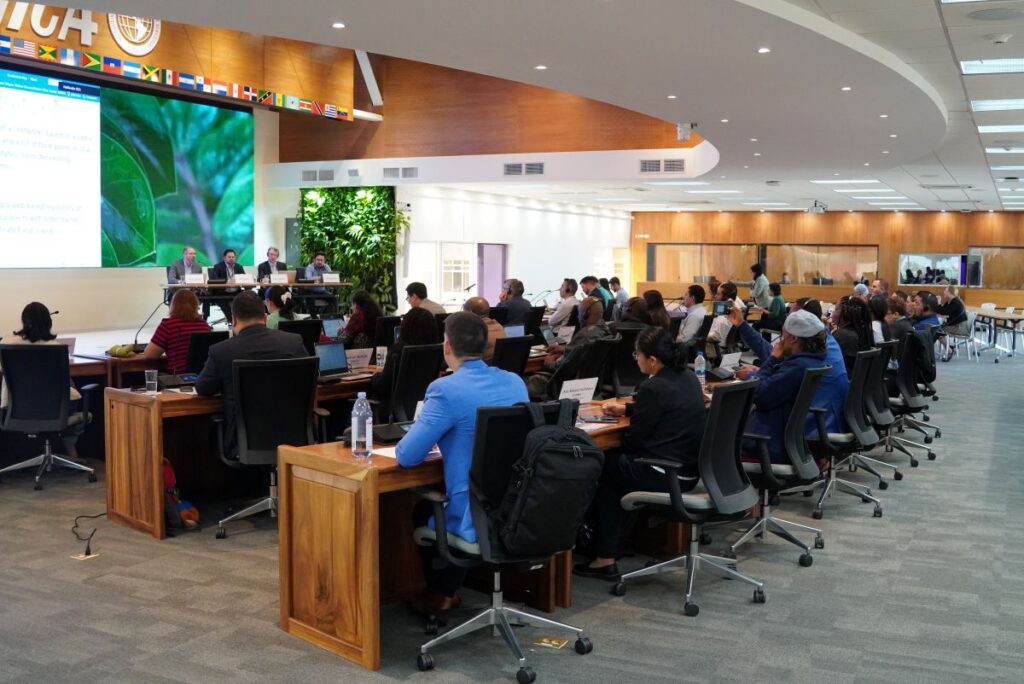
San José, 2 December 2025 (IICA). Senior officials and representatives of agricultural health services from 24 countries in the Americas, along with specialists from cooperation agencies and private sector stakeholders, analyzed the impact of artificial intelligence (AI) on efforts to strengthen animal and plant health systems, with a view to broadening its use to streamline agricultural trade in the region and make it safer.
The meeting was part of the technical workshop “Harnessing AI for safe trade in Latin America and the Caribbean (LAC): innovations for the transformation of animal and plant health,” organized by the Inter-American Institute for Cooperation on Agriculture (IICA) and the Standards and Trade Development Facility (STDF).
The three-day event, which took place at IICA Headquarters in San José, Costa Rica, permitted the more than 50 experts taking part to learn about specific initiatives and advances in the use of smart and digital technologies designed to help to detect risks, prevent diseases,and modernize animal and plant health systems.
AI is speeding up risk detection in agricultural health and food safety (AHFS), improving early responses to outbreaks of pest and disease, and making inspection and traceability processes more efficient, thereby facilitating betterinformed decision-making and increased transparency between countries. This in turn results in safer and more reliable and streamlined agrifood trade in LAC.
“Artificial intelligence is no longer a futuristic idea; it is already transforming our AHFS services. AI-based applications are already producing concrete results, more accurate epidemiological models, automated data analysis, and more efficient border controls. The region is ideal for driving these innovations, thanks to its dynamic agricultural trade and growing innovation ecosystems,” commented José Urdaz, manager of IICA’s Agricultural Health, Food Safety and Quality program.
The Deputy Head of the STDF, Peter Donelan, pointed out that Latin America and the Caribbean is on the cutting edge in adopting innovative solutions aligned with globally developing ethical and governance frameworks, which are already improving risk management and cutting costs. He stressed that integrating innovation into policies and capabilities, along with collaboration among governments and international partners, are key to broadening their impact.
“Digitalization and AI are transforming how we manage food safety and facilitate safer, more sustainable trade. Innovation only has a real impact when it is intentionally integrated into policies, systems, and capabilities. No country can tackle these challenges alone; working together will allow us to build systems that protect health, open markets, and transform lives,” Donelan said.
The Standards and Trade Development Facility (STDF) is a global partnership that helps developing countries improve their animal and plant health and food safety capabilities to facilitate international trade. It does so by supporting the implementation of international standards related to the WTO SPS Agreement and promoting the use of best practices.
Initiatives and successful cases
The workshop included sessions featuring presentations of initiatives implemented in Argentina (through its National Agrifood Safety and Quality Service – SENASA), Belize, Brazil, Canada, Chile, Ecuador, Peru, Saint Kitts and Nevis, and Uruguay, countries that are already using AI to improve health surveillance in crops¾including bananas, potatoes, and avocados, citrus fruits and weed seeds¾through the use of apps, predictive platforms, drones, satellite images and algorithms for early detection of pests and diseases. AI is also being utilized to strengthen traceability; automate processes; and better direct inspection efforts.
SENASA’s Director of Strategy and Risk Analysis, Esteban Sampietro, presented his agency’s Plan for the control of residues and other contaminants in animal-based foods (CREHA), which is designed to protect the health of consumers and guarantee the opening up of, and continued access to, international markets.
“We took several existing systems for animal traceability, slaughter declarations, production records, electronic product certification, and the laboratory network, and unified them into SISMU, a single, smart system into which we incorporated many statistical, productive and health parameters, so that it automatically makes recommendations for sampling. This made it possible to design and implement a completely risk-based plan that is more efficient, focused, and transparent,” Sampietro explained.
Also highlighted at the meeting was the case of St. Kitts and Nevis. Kadian Banton, Plant Quarantine Officer at the Department of Agriculture, Fisheries and Forestry explained how AI has become a key for strengthening plant health, allowing the ministry to overcome technical and staff-related constraints.
“There are limited capabilities; we don’t have a diagnostic lab, entomologists, or other resources, and AI has been a game-changer for plant health. It is revolutionizing farming in the country by providing real-time information on soil health, crop conditions, and weather patterns, allowing farmers to optimize resource use and increase production yields, which makes farms more efficient in general,” Banton said.
“There are advances in precision agriculture with predictive analytics, smart irrigation and rapid disease detection, drone-assisted monitoring that allows farmers, technologists and policymakers to make informed decisions that can reduce residues, increase productivity, and promote environmental management,” he added.
The event also showcased regional initiatives in which AI is being used collaboratively to support agricultural health and safe trade, including the Andean Community’s Regional Plant Health Intelligence Center (CRIFCAN) and the virtual classrooms of the Organismo Internacional Regional de Sanidad Agropecuaria (OIRSA).
The first is designed to improve pest prevention and management in Bolivia, Colombia, Ecuador and Peru, especially in relation to Fusarium Tropical Race 4 (TR4) in bananas, through an advanced system of monitoring and information analysis.
The other is a virtual reality technology that generates simulations that are used to train professionals in various areas of agricultural health, allowing them to practice detection, inspection and decision-making procedures in realistic scenarios involving plant health, food safety, animal health, and quarantine issues.
The meeting included a session on financing opportunities and how countries can access resources to implement and scale up AI technologies usedfor animal health and plant protection.
“For regional development purposes, AI calls for institutional complementarity; it can be the catalyst for deeper and more efficient economic integration, it generates value, we have to work together and at FONPLATA we can provide the operational financing,” said Gastón Gómez, head of Sovereign Guaranteed Operations at the development bank.
“We strongly support these initiatives; the agriculture sector is key and must be taken to another level. AI is a challenge for everyone, but also an opportunity to speed up innovation and rethink inclusive, accessible solutions with technical training,” stated Gloriana Jiménez, Financial Institutions and Strategic Programs executive with the Central American Bank for Economic Integration (CABEI).
Vision for the future
The Director General-elect of IICA, Muhammad Ibrahim, a citizen of Guyana, addressed the meeting briefly, emphasizing that “AI and digital tools will become increasingly important” to address agricultural and sustainability challenges, given the rise in pests and diseases that threaten food security.
“Every day we see more outbreaks of economically important pests and diseases that pose a threat to food security and nutrition in the region, such as Fusarium TR4, the screwworm, African swine fever, and moniliasis in cacao. Therefore, we need to boost our capacity to respond to and reduce these problems. Training and capacity building are crucial, an area in which IICA has been working,” he said.
Ibrahim, who will succeed Argentine Manuel Otero as head of IICA in January 2026, said that agricultural health and food safety is one of the main areas on which the inter-American organization intends to focus.
During the event’s closing session, the Institute’s AHFS specialist Horrys Friaca said that “the participants were agreed on the great potential of AI for strengthening AHFS services and optimizing resources in a context of high demand. They stressed the importance of the opportunity to share experiences that allowed them to identify common challenges that IICA and the STDF will follow up on to move towards practical solutions. With regard to financing opportunitiesand potential partners, they highlighted the private sector as key partners.”
More information:
José Urdaz, manager of IICA’s Agricultural Health, Food Safety and Quality Program.
jose.urdaz@iica.int