
Victor Carvajal, Minister of Agriculture and Livestock of Costa Rica; Manuel Otero, Director General of IICA; and Marco Zapata, IICA Representative in Costa Rica.
San José, 4 December 2025 (IICA). With support from the Ministry of Agriculture and Livestock (MAG) and the Inter-American Institute for Cooperation on Agriculture (IICA), Costa Rican rural development specialists enhanced their technical and methodological skills for the design and implementation of agricultural growth plans.
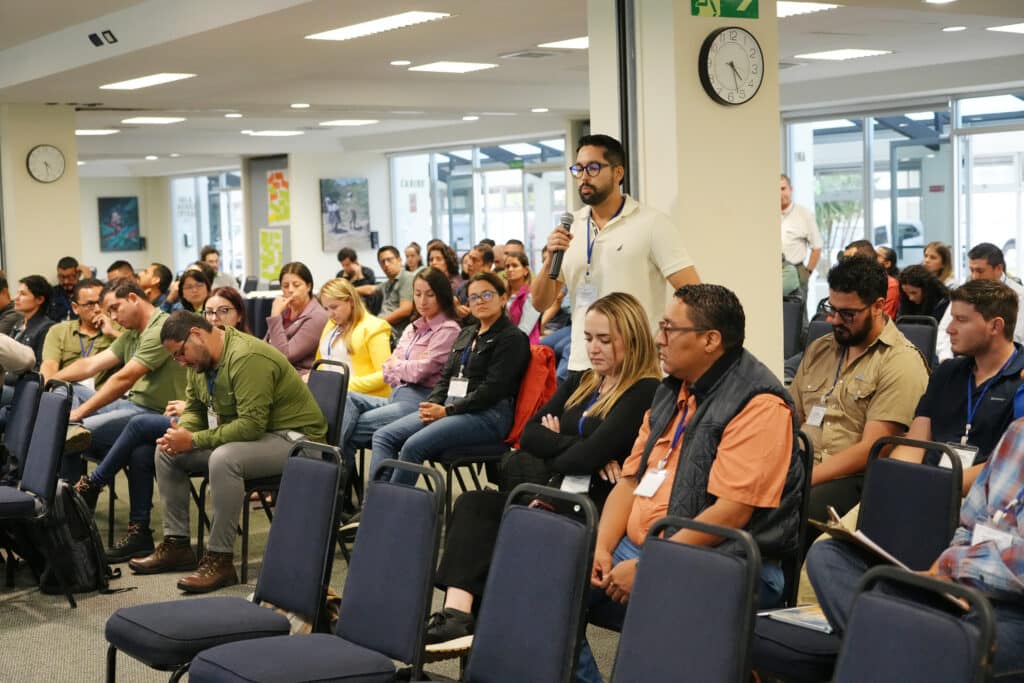
At a workshop held at IICA Headquarters in San José, around 100 rural development specialists from the extension agencies of the Ministry of Agriculture and Livestock (MAG) took part in two days of training. These specialists are responsible for supporting farmers, facilitating the assessment of production units and promoting innovative solutions for the sustainable development of the agriculture sector in the Central American country.
The event focused on the formulation of farm assessments and plans, a key tool for identifying specific problems in production units and designing pertinent technical actions. Participants engaged in technical presentations, case studies, practical exercises, group presentations and team-building.
The activity was also used to promote collaborative work and the sharing of experiences, as well as the development of skills for gathering information on the farm, identifying and prioritizing agricultural issuesand formulating adaptation and mitigation plans to reduce the impact of extreme weather events.
Costa Rica’s Minister of Agriculture and Livestock, Víctor Carvajal, emphasized that working with IICA “allows us to provide support and technical advice to those in direct contact with farmers, facilitating solutions to the challenges facing the sector”.
“Extensionists are the face of the ministry on the ground, and in-service training is key for meeting the real needs of farming families”, he said.
IICA Director General Manuel Otero explained that training for rural development specialists is essential to ensure that technical knowhow reaches food producers, as it has a direct impact on rural life.
“IICA reaffirms its commitment to supporting the countries’ efforts to strengthen their extension services, contributing to the sustainability and resilience of agricultural systems”, he added.
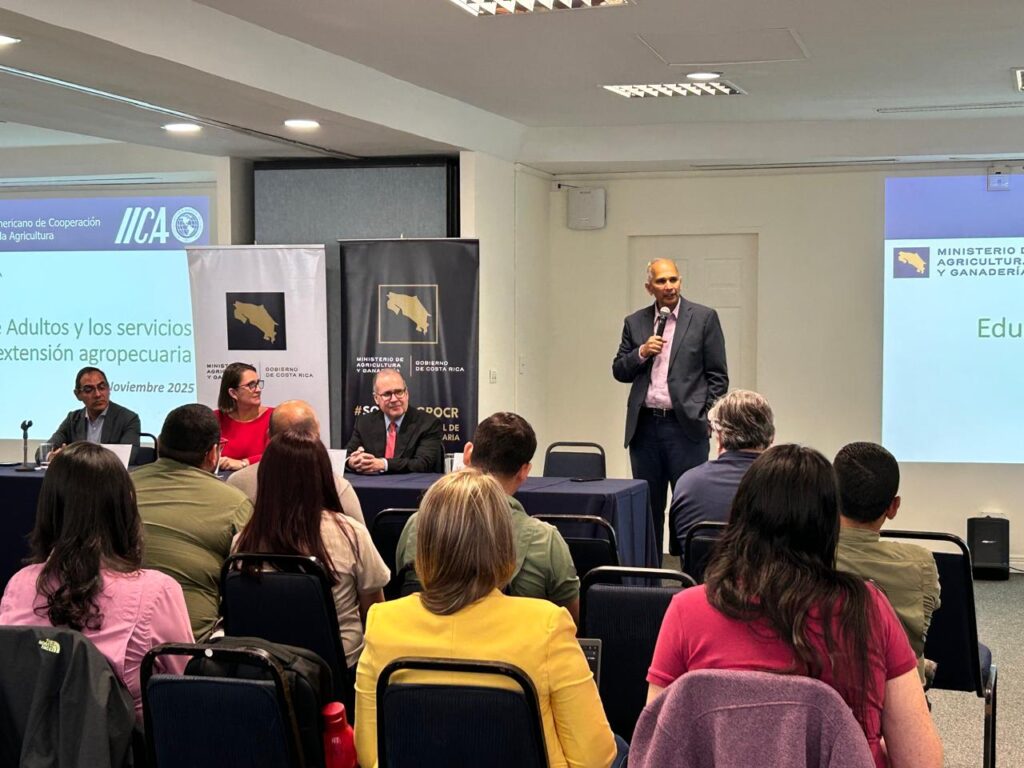
Muhammad Ibrahim, Director General-elect of IICA: “The future of agriculture depends on the ability to innovate and adapt to change. Rural development specialists are agents of change who support producers in this process”.
Muhammad Ibrahim, IICA’s Director General-elect, who attended part of the workshop, highlighted the importance of in-service training: “Training rural development specialists is key to promoting innovation and farmers’ adoption of good practices”.
He emphasized that enabling specialists from different regions of Costa Rica to share their experiences enriches the learning process and strengthens the technical support network in the agriculture sector.
Shoulder to shoulder with farmers to build their trust
During the event, the extension agents strengthened their strategic role in linking public policies to the actual situation of farmers.
Their work involves providing technical and methodological support to producers, identifying and analyzing problems on the ground and facilitating participatory processes for the adoption of innovative solutions.
Their work involves more than knowledge transfer. They strengthen local capabilities, promote self-management and ensure the sustainability of agricultural systems in rural communities.
“Being a rural development specialist means being committed to listening to, understanding and supporting farmers with their daily challenges”, explained José Pablo González, head of the MAG’s Agricultural Extension Agency in San Mateo, Costa Rica.
José Pablo González, Head of the MAG’s Agricultural Extension Agency in San Mateo, Costa Rica.
“Our work is not about providing answers, but about facilitating processes of reflection and self-management in rural communities. Every day, on the ground, we learn new things alongside producers and seek solutions tailored to their actual situation”, he remarked.
The participants shared the ways in which they intend to improve their field work, consolidating the specialist’s role as a bridge between State support and the actual situation of producers.
More information:
Institutional Communication Division.
comunicacion.institucional@iica.int