San José, 22 January 2026 (IICA). The President of the Brazilian Agricultural Research Corporation (EMBRAPA), Silvia Massruhá, highlighted the key role of the Inter-American Institute for Cooperation on Agriculture (IICA) under the leadership of its new Director General,Guyanese citizenMuhammad Ibrahim, in coordinating regional efforts to speed up the process of agricultural innovation and the transfer of technology to rural producers in the Americas.
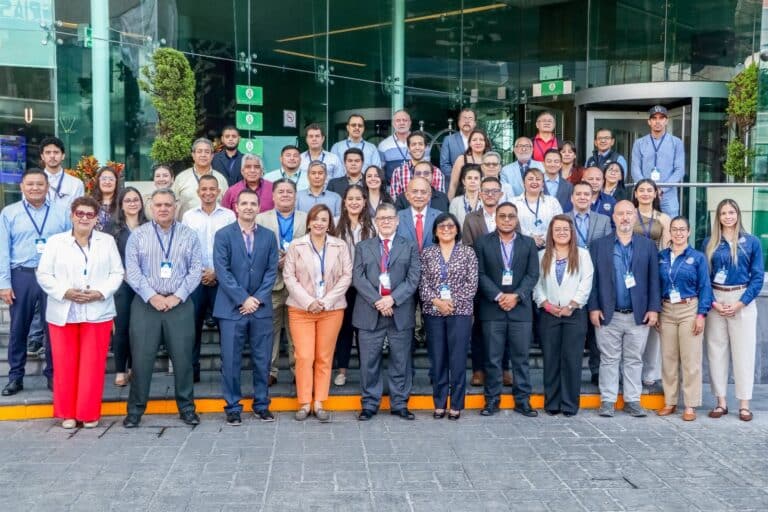
Massruhá was among the high-ranking officials from the agriculture sectors of more than 30 countries who, along with representatives of international organizations, took part in the ceremony held to swear in Ibrahim as the new head of the Institute for the period 2026-2030.
The President of EMBRAPA explained that Ibrahim’s career path and more than 35 years of experience have given him a strategic vision of how to transfer technologies generated by research institutes to rural areas more quickly and effectively.
“We often develop technology and need it to be rolled out more quickly, and he has experience in this area of research and innovation that can help us work together to get that innovation to rural areas more quickly”, she said.
The head of EMBRAPA emphasized that digital technologies are now a fundamental tool for addressing the multiple global transitions that agriculture is undergoing ¾ for example, towards a type of agriculture that ismore sustainable, with better nutritional value and greater traceability and transparency in production systems, through the use of tools such as blockchain to increase confidence in agrifood processes.
She also underscored the opportunities offered by the energy transition, through the use of alternative energy sources, especially for tropical agriculture, and the challenge that extreme weather events pose for agriculture, which calls for the development of varieties resistant to water stress and the simulation of future scenarios for better decision-making.
Furthermore, Massruhá stressed the urgent need to step up socio-productive and digital inclusion for small- and medium-scale producers, who are hampered by bigger investment constraints.
In this regard, she explained that IICA plays a key role in supporting institutions with the adoption of new technologies, training and the generation of innovative business models for rural associations and cooperatives.
“It plays a key role in helping institutions to share these new technologies and provide training, generating new business models for producer associations and cooperatives. It is logical that we have regional differences, whether we are in the Southern Cone or in the North, but today, with the experience that research institutions and IICA possess, we can work together to incorporate and increase this productivity in a sustainable way, using research and innovation”, she added.
To that end, Massruhá expressed her readiness to strengthen cooperation between EMBRAPA, Brazil and IICA to promote the internationalization of agricultural technologies developed in her country, which over the last five decades have enabled it to become a major food exporter instead of a food importer.
“The partnership with IICA is essential in order to share these technologies with other countries and contribute to the development of the planet’s Tropical Belt”, she concluded, emphasizing that she had high expectations for the future of this international cooperation with the Institute during the administration of Muhammad Ibrahim.
More information:
Institutional Communication Division.
comunicacion.institucional@iica.int