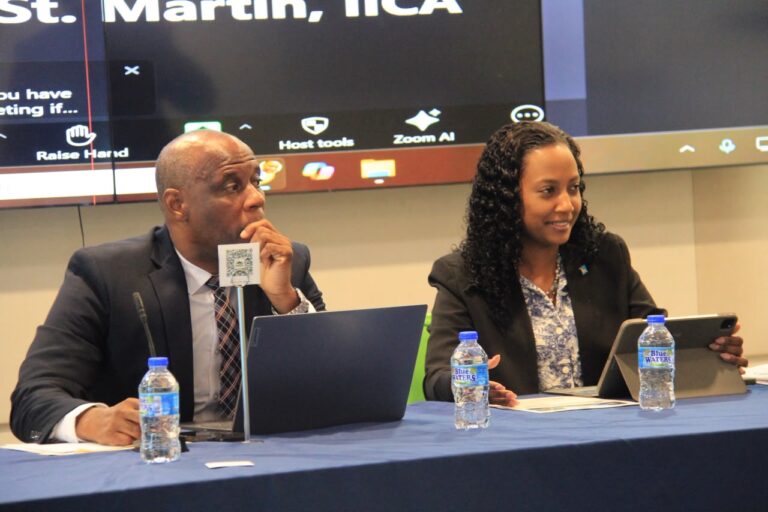

Ronny Rodríguez Chaves, Costa Rica’s Deputy Minister for Energy at MINAE, and Muhammad Ibrahim, Director General of IICA.
San José, 24 March 2026 (IICA). Every sugar harvest and every agroindustrial process in Costa Rica leaves behind tons of agri-food byproducts, but what hitherto has been an environmental challenge could be transformed into a new source of clean electricity that would boost the Central American country’s energy security and reduce its dependence on fossil fuels.
With that objective, Costa Rica’s Ministry of Environment and Energy (MINAE) and the Inter-American Institute for Cooperation on Agriculture (IICA) are making progress with the preparation of a national project aimed at generating electricity from biomass, using agri-food byproducts such as sugarcane bagasse, waste resulting from coffee, palm oil and timber production, and other organic materials.
The initiative will be presented to the Green Climate Fund, the largest international financial mechanism for climate resilience projects, and aims to turn the environmental challenge into a productive and energy opportunity for Costa Rica.
“The country has enormous potential to make more efficient use of the waste generated by its agri-food sector”, said Muhammad Ibrahim, Director General of IICA. “In a context of volatile fuel prices and rising production costs, promoting biomass-based solutions is key to strengthening energy security and the resilience of agri-food systems”.
The project —called Development of adaptive capacities and electricity generation with biomass in Costa Rica through integrated waste management in the agri-food industry— proposes a change of approach: instead of thinking of agricultural byproducts as waste, treating them as inputs for the production of renewable energy and the circular economy.
Ibrahim pointed out that the initiative adopts a comprehensive approach that integrates agriculture, energy, environment and health, and is aligned with the inter-American organization’s new Medium-term Plan for 2026-2030. “The idea is to work closely with governments, the private sector and other key stakeholders to support producers with innovation, technical assistance and concrete solutions to environmental challenges”, the IICA Director General explained.
For MINAE, the project opens a strategic window at a time when the country is having to cope with episodes of water stress that affect the generation of hydroelectricity. According to Ronny Rodríguez Chaves, the Deputy Minister for Energy, biomass can become a key complement to the national electricity grid.
“Generating electricity from biomass allows us to utilize agri-food byproducts, diversify our energy mix and reduce our dependence on fossil fuels, especially in scenarios of environmental pressure”, Rodríguez explained. “This joint effort with IICA aims to lay solid technical foundations for presenting a well-designed project to the Green Climate Fund, aligned with national decarbonization and sustainable development priorities”.
From farm to fuel
The project calls for the implementation of pilot projects for electricity generation using biomass, with a combined installed capacity of approximately 30 megawatts, utilizing agricultural byproducts that currently have limited use or the disposal of which is costly.
The initiative would make it possible to replace some thermal generation, reduce polluting emissions and strengthen circular economy practices in the agri-food industry, while generating economic and environmental benefits for rural areas.
It is estimated that the project could directly benefit more than 27,000 people and indirectly benefit more than 1.6 million, by improving energy security, strengthening productive resilience and promoting more sustainable development in the territory.
A national effort
The preparation of the project involves key national actors such as the Costa Rican Electricity Institute (ICE), the Ministry of Agriculture and Livestock (MAG), productive organizations and research centers, to ensure the proposal is technically viable and aligned with Costa Rica’s priorities.
The initiative is framed within Costa Rica’s Nationally Determined Contribution (NDC) and the Green Climate Fund Country Programme, reinforcing the nation’s leadership in the search for innovative solutions that make use of the country’s own resources to transition towards a resilient, low-emission energy model.
More information:
Institutional Communication Division.
comunicacion.institucional@iica.int