
Washington, D.C., 10 April 2026 (IICA) – Ministers and senior agricultural officials of the Americas called for improving coordination between countries to reduce the vulnerabilities of agrifood systems, mitigate impacts, and capitalize on the opportunities afforded by the current global context of geopolitical and market shocks.
During a high-level meeting convened by the Inter-American Institute for Cooperation on Agriculture (IICA), country representatives highlighted the hemispheric agency’s role in coordinating collective action and fostering the dissemination of new technologies that can improve the response capacity of the region’s agriculture sector.
Among other matters, they underscored the need to reduce the dependence on imports of fertilizers and other agricultural inputs by building up the region’s potential to produce organic fertilizers and bioinputs.
They also agreed on the need to give greater importance to technical cooperation, so that the Americas may further strengthen its irreplaceable role in guaranteeing global food security.
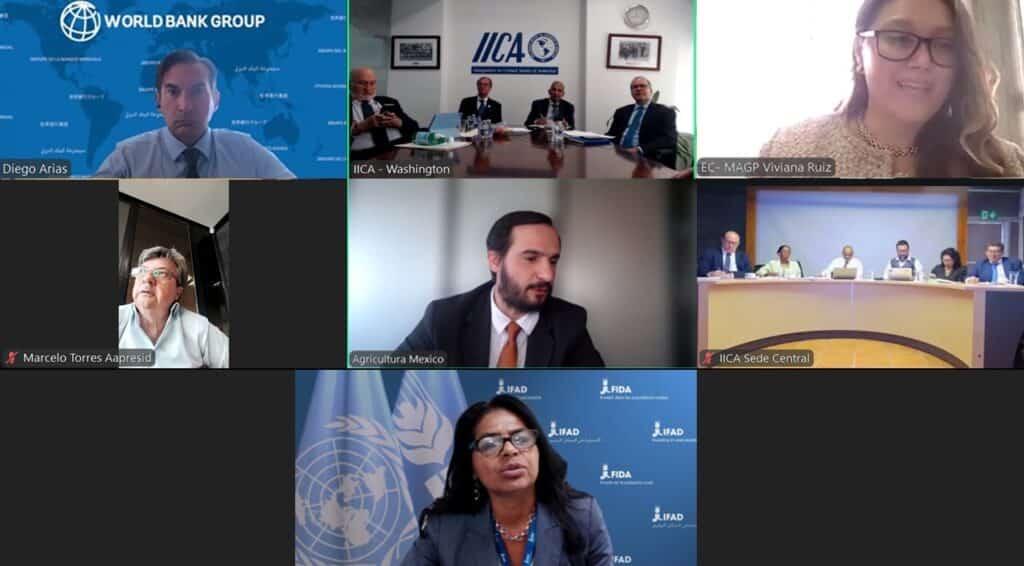
The meeting, attended virtually by ministers and officials, was held within the framework of IICA Director General Muhammad Ibrahim’s visit to Washington, D.C., where he is working alongside officials of the U.S. government and international funding agencies to develop an agenda aimed at strengthening regional agriculture. Representatives of these agencies and of private sector organizations also took part in the meeting.
Kip Tom, one of the most prominent leaders in the U.S. agriculture sector and Vice Chair of Rural Policy at the America First Policy Institute (AFPI), opened the meeting.
“The Western Hemisphere is a leader in global agriculture and feeds billions of people around the world each day. Today, despite global uncertainty, we must serve as a model of strength and continental cooperation,” said Tom, who highlighted the close linkages between food security and national security in the countries.
Tom, who served as the United States Ambassador to the United Nations Agencies for Food and Agriculture in Rome, underscored the need for joint efforts in the hemisphere to achieve trade integration and market expansion. He pointed out that IICA’s role as a bridge between various stakeholders “is more important today than ever before, so that the Americas may grow even stronger.”
Ibrahim, for his part, noted that the impacts of geopolitical and market conflicts on countries in the region are not the result of a temporary crisis but rather of structural vulnerabilities. “We must reduce our dependence on fertilizer imports through alternatives that enable us to have a robust production chain. The issue of nitrogen-based fertilizers is particularly critical, given that nearly 80% of them come from the Middle East. Today, small-scale producers are facing risks and uncertainty for this very reason.”
The Director General stated that IICA is well-positioned to work together with its partners to develop solutions through technological tools, such as those that allow for developing new seed varieties for more efficient crops in terms of productivity and the use of inputs.
Call to action
Zulfikar Mustapha, Minister of Agriculture of Guyana, pointed out that current geopolitical tension due to the conflict in the Middle East serves as a present-day reminder of the impact of external shocks on agrifood systems, particularly in smaller Caribbean countries.
Mustapha explained that Guyana is currently capitalizing on its considerable natural gas reserves by building a fertilizer plant, through which it will seek to supply all Caribbean countries. He added that the country is investing in the development of smart agriculture to improve its resilience to external shocks.
Viviana Ruiz, Undersecretary of Innovation at Ecuador’s Ministry of Agriculture, stated that the current situation highlights the growing interdependence between energy, fertilizer, and food markets. “The production costs of strategic crops are leading to a decrease in the use of inputs. However, the situation also affords an opportunity to transition towards greater sustainability and low-carbon production. Now more than ever, the region must act in unison and adopt a collective commitment.”
On behalf of Julio Berdegué, Secretary of Agriculture of Mexico, Santiago Ruy Sanchez de Orellana, General Coordinator of International Affairs at that government agency, revealed that Mexico imports 75% of its fertilizers and that price pressures are mounting just as producers are preparing to sow.
“Through the state-owned oil company PEMEX, we are expanding local fertilizer production. Mexico is also promoting a bioinputs policy,” said the official. He added that “hemispheric cooperation makes the pursuit of food sovereignty viable while respecting each country’s priorities. Food sovereignty is not in opposition to trade and international cooperation; on the contrary, it needs it.”
For his part, Agustín Tejeda, Undersecretary of Agrifood Markets and International Negotiations at the Secretariat of Agriculture of Argentina, called for avoiding responses that exacerbate the situation, such as export restrictions and other actions that distort markets.
“IICA’s initiative to facilitate the coordination of actions and policies is key. Facilitating trade is essential to mitigate the impact of shocks, as is reducing import tariffs on fertilizers and promoting technologies aimed at optimizing the use of inputs. The response from countries in our region should not be further withdrawal, but rather greater cooperation, greater efficiency, more trade, and more transparent information,” he remarked.
Also participating in the meeting were Diego Arias, Regional Manager of Agriculture and Food for Latin America and the Caribbean at the World Bank; Rocío Medina Bolívar, Regional Director of the International Fund for Agricultural Development (IFAD); and Marcelo Torres, President of the Argentine Association of Direct Seeding Producers (AAPRESID), who emphasized the responsibilities of the Americas in times of pressure on global food demand and expressed the need to protect small-scale producers.
More information:
Institutional Communication Division.
comunicacion.institucional@iica.int