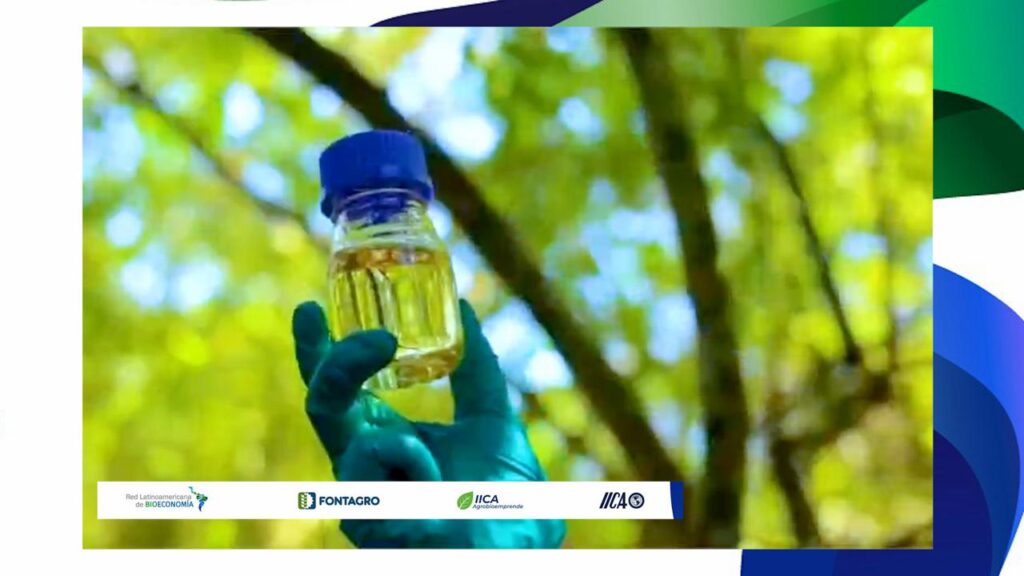
Innovations by the Colombian startup Vita Copaiba positioned it as one of the winning firms in the LATAM 2025 Impact Agro-bioentrepreneurship Competition organized by IICA and FONTAGRO.
San José, 21 May 2026 (IICA) – There is a new generation of rural entrepreneurs in Latin America and the Caribbean that no longer talks only about producing more food. They naturally think in terms of biomass, traceability, bioinputs, carbon capture, biodiversity, and circular economy.
For them, transforming agricultural waste into energy, tracking a product’s journey from the field to the consumer, or developing microorganisms that improve crops is no longer a futuristic or academic concept: it is beginning to form part of a new way of thinking about businesses linked to agriculture and rural territories.
More than 1,100 projects from twenty countries in Latin America and the Caribbean support those statements.
They are the response to the LATAM 2025 Impact Agro-bioentrepreneurship Competition, promoted by the Inter-American Institute for Cooperation on Agriculture (IICA) and FONTAGRO, whose results were revealed in April and which ultimately became a snapshot of an ecosystem far broader than expected.
Far from being a competition limited to agricultural innovation projects, the call exceeded the initial expectations of its organizers and highlighted the breadth of the phenomenon: from bioinputs and biomaterials to carbon capture solutions, bioenergy, and new bioproducts applied to food, health, and cosmetics.
The phenomenon is not limited to the region. The World Economic Forum estimates that the global bioeconomy is already worth close to four trillion dollars and that more than fifty countries have specific strategies for its development, in a process driven by new technologies in synthetic biology, engineering, and decentralized production models.
The new scenario of “smart work”
In different parts of the continent and beyond, that transformation is beginning to be reflected in the daily practices of very young new producers and rural entrepreneurs. During one of the interviews that form part of the IICA series Leaders of Rurality, Mackenzie Fingerhut, a young farmer in Canada, perfectly summarized one of the most interesting aspects of the new rural economy.
There is an “enormous disconnect” between rural and urban areas, with “many people who have never seen how food is produced, and that influences their decisions as consumers.” That is why Mackenzie is committed to traceability and transparency.
“There are projects that allow people to scan a QR code on a package of flour or a bottle of beer and see the full history of the product: where the ingredients were planted, how they were processed, who produced them.” During the conversation with IICA, he emphasized that it is a tool that “builds trust.”
In another interview in the series, the also very young Akiesha Fergus and Ryan Khadou, a couple based in Saint Kitts and Nevis, showed that not even major infrastructure limitations and climate threats stop this new generation. “Our motto is ‘work smart,’” by applying new tools and knowledge. There is no need to “work hard” the way it was done decades ago; now “it is a matter of science and technology, of achieving better crop results,” and “understanding the environment and the land,” Fergus added.
The links within agriculture
This evolution is significantly different from what was observed in sector analyses just a few years ago. In 2019, a report by the IDB Lab titled AgTech Innovation Map in Latin America and the Caribbean had already identified the first signs of an emerging ecosystem, although it was still described as an incipient sector with highly concentrated growth. However, the gap between that diagnosis and today’s reality is remarkable: what the IDB considered an incipient trend back then has now become a wave of maturity that exceeded all initial forecasts.
The fundamental difference lies in the fact that the approach is no longer a “green agenda” or a declaration of intent, but rather a structure of costs and opportunities. For this new generation of rural entrepreneurs, sustainability is not an accessory concept but a financial asset: biomass is no longer managed as waste, but as the raw material for a new business model based on circularity and value addition at origin.
During the presentation of the competition results, the authorities of the promoting organizations validated this paradigm shift. Muhammad Ibrahim, Director General of IICA, highlighted the importance of promoting agro-bioentrepreneurs to “build a world of innovation in rural areas that increasingly integrates young people and women into the sustainable use of biodiversity.”
According to Ibrahim, the competition sought to “contribute to scaling up initiatives that build a nexus between agriculture, energy, health, and environmental care,” demonstrating that the bioeconomy “is not just a theoretical concept, but one that produces concrete products that benefit people.”

A new generation of rural entrepreneurs is redefining agriculture in Latin America and the Caribbean: they naturally think about sustainability, traceability, carbon capture, and circular economy.
Sargassum, biomass and microorganisms
Let us review the cases of some of the young people who were recognized in the IICA and FONTAGRO competition, such as SOS Biotech in the Dominican Republic. Elena Martínez, co-founder and Chief Technology Officer of the company, explained that the project was created to collect and process sargassum — the macroalgae affecting Caribbean coasts — and extract from it “all possible bioactive compounds.”
Through a collection system mounted on artisanal boats that has already trained more than 130 local fishers, the company has managed to recover more than 16,000 tons of algae to convert them, through a “closed process” with no waste, into biostimulants and substrates already used by Dominican farmers.
For Martínez, the invasive proliferation of these algae, although it generated a crisis, represented “a great opportunity for industrial diversification in the region.” With certifications already obtained to enter the United States and Spanish markets, the startup demonstrated that it is possible to replace synthetic and petroleum-derived compounds while mitigating environmental damage, confirming that sargassum is ultimately a tool that “can even help address pollution in different industries.”
Another of the highlighted projects was Carbonlytics, a solution developed by Colombian engineers that uses drones and advanced analytics to measure crop biomass with reliability above 95%. The system makes it possible to quantify captured carbon for credit certification, opening a new source of income for farmers. According to its creators, the objective is to generate a “double impact, social and environmental,” enabling those who work the land to take advantage of the “sustainable solutions generated by their lands.”
From Argentina, another agro-bioentrepreneurship venture recognized in the competition, the startup Prix Biotech, recently achieved a scientific milestone: the genetic editing of commercial biofertilizers to increase the productivity of crops such as soybeans and alfalfa. Nicolás Ayub, lead researcher at the startup, recalled that together with his colleagues he works to “enhance functional characteristics already existing in microorganisms, which allows us to develop more efficient biological solutions, with a lower environmental footprint and greater consistency in the field, achieving faster and lower-cost fertilization processes.”
A Latin American bioeconomy seeking maturity
What appeared on financial radar screens as an incipient trend only a few years ago, has now become a business network where applied science dictates the new rules of competitiveness. The volume of applications and the sophistication of the competition winners confirmed that the region has ceased to be merely an exporter of raw materials and has also become an open-air laboratory for global solutions.
For this generation, success is no longer measured only in tons per hectare, but in the capacity to manage the biological complexity of fields. With an ecosystem already producing measurable results, the Latin American bioeconomy has shown that it is maturing enough to lead the transition toward a productive model where efficiency and regeneration are finally two sides of the same coin.
More information:
Institutional Communication Division.
comunicacion.institucional@iica.int