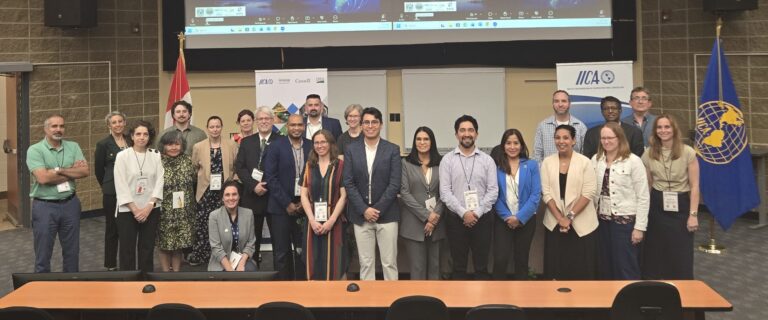
The Mission of the FonTC Cocoa Project lead by the Delegations in Canada, Peru and the Dominican Republic, took place from 22-26 August 2016, at the facilities of RedDom and various cocoa producers in Altamira, Dominican Republic.
Ottawa, ON. In order to allow the interchange of information between members of the cooperatives in the Dominican Republic and Peru and to review, strengthen and validate the “Generic” business model on cacao processing, a mission to the Dominican Republic was carried over the period August 22 to 26, 2016. The mission provided an opportunity to enhance knowledge of cooperative members in diverse areas such as chocolate processing, the importance of maintaining SPS standards, market opportunities and requirements for exporting food to Canada. Knowledge transfer was supported by a two day technical session given by technical specialists of IICA Offices in Canada, Peru and Dominican Republic, REDDOM Agro-business Specialists and a Canadian importer.

Altamira, Dominican Republic.
The exchanges and dialogue between all parties involved during the mission had a very positive impact on the members of the cooperatives in the Dominican Republic (Coop. Chocal) and Peru (Coop. Oro Verde). These interactions stressed the importance of gender equality and advocated the establishment of an organizational structure to support participation of women in cacao cooperatives. The exchange of experiences (facilitated through face to face communication) was considered crucial for obtaining success in the mission. The energy and empowerment displayed by the woman from Chocal encouraged the representatives from Oro Verde to pursue their own cacao processing facility.
A workshop on the generic business model for cacao processing was held during the mission. The objective of this activity was to validate and strength the business model that could be subsequently applied in Peru by the cooperative Oro Verde (as a pilot), as well as other cooperatives in LAC countries. During this workshop, cooperative members from Peru and the Dominican Republic, IICA technical specialists, DR’s Cacao association members, REDDOM’s Agribusiness specialists and other key participants of the cacao value chain provided input to the model and identified key elements for the successful implementation and operation of a SME cacao processing cooperative. The integration of the value chain of cacao through institutional partnerships, an appropriate market-based approach (i.e. product differentiation, price policies, distribution, marketing, product presentation and quality) and production management and planning were considered crucial for succeeding as a small-medium chocolate processing cooperative.
The overall mission was considered a success by all participants and all objectives were achieved by the end of the mission.