Inter-American Institute for Cooperation on Agriculture

Agriculture

New batch of agricultural researchers for exchange program

Tiempo de lectura: 3 mins.

The 2019 Research and Internship Assistance Program (RIAP) closed its call for applications for research assistance. A  Selection Committee assessed the eligible applications coming from diverse parts of the Americas, such as: Canada, Mexico, USA, Brazil, Colombia, Argentina, Paraguay, Ecuador, and Trinidad & Tobago.
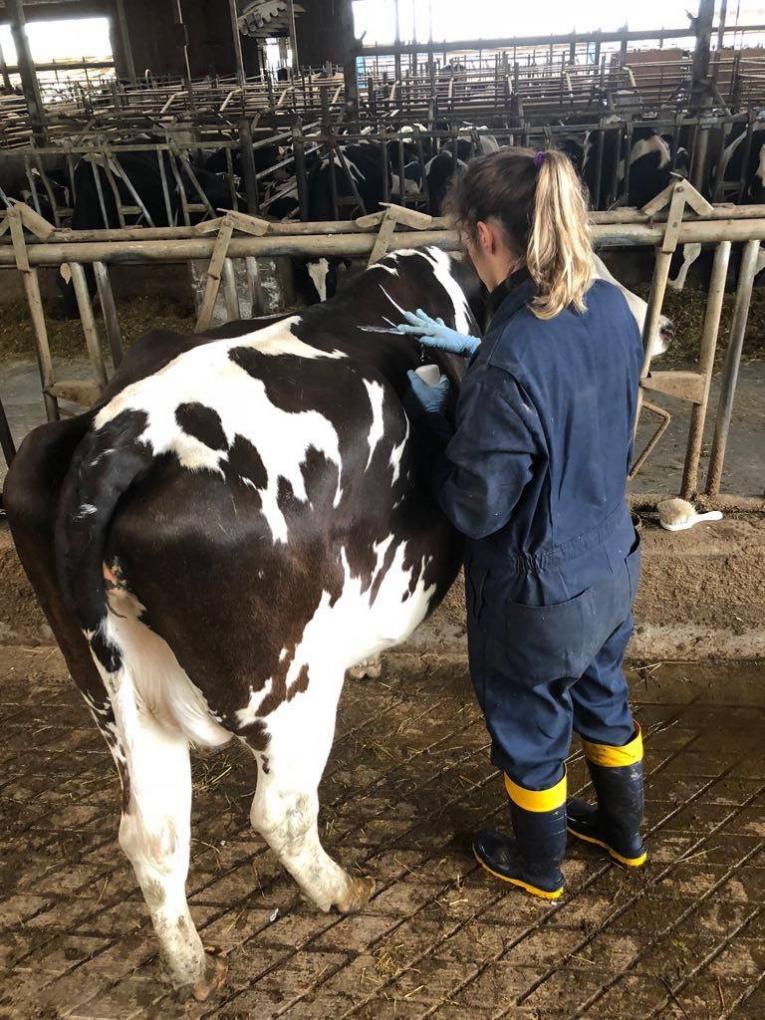
 

Raphaela Woodroffe is a 2018 RIAP participant from Brazil undertook a research project at the University of British Columbia, Dairy Education  and Research Center during the summer.

The 2019 Research and Internship Assistance Program (RIAP) closed its call for applications for research assistance on November 25th, 2018.  A  Selection Committee assessed the eligible applications coming from diverse parts of the Americas, such as: Canada, Mexico, USA, Brazil, Colombia, Argentina, Paraguay, Ecuador, and Trinidad & Tobago. Members of the panel in addition to reviewing the applications, provided insightful observations and great recommendations for this well regarded initiative. IICA Canada is grateful for the in-kind support given by these professionals who contributed quality time in the review and selection process.

IICA Canada was pleased with the high number of applications and projects which aligned with IICA’s strategic objectives. We take this opportunity to thank all candidates for their interest in the RIAP and look forward to the implementation phase!

The objective of the RIAP is to provide an avenue for conducting joint research activities and sharing of experiences between Canada, Latin America and the Caribbean countries, all towards improving agriculture and allied industries in the Americas. Since the RIAP began, IICA-Canada has been able to support more than 250 individuals in their work throughout the Americas. The Program which has 2 components, supports researchers, academics, farmers, and agriculture leaders and administrators to participate in exchanges that contribute to agricultural health and food safety, technology and innovation, trade and agribusiness development, and sustainable rural development in the Americas.

For additional Information on the RIAP, please visit our website at www.iica.int/canada.

Ms. Ysabel Giroux
Ysabel.giroux@iica.int

Share

Related news​

Bahamas

February 5, 2026

Minister of Agriculture of The Bahamas and IICA Representative continue to make progress with distribution of supplies to farmers affected by Hurricane Melissa

The Minister of Agriculture and Marine Resources of The Bahamas, Jomo Campbell, and the Representative of the Inter-American Institute for Cooperation on Agriculture (IICA) in The Bahamas, Mari Dunleavy, and her team, received agricultural inputs for distribution in the district of Exuma to support farmers affected by Hurricane Melissa.

Tiempo de lectura: 3mins

Panama City

February 2, 2026

The IICA Director General  and the CAF President and Vice President discuss the role of financing in expanding the scientific and technological revolution in agriculture of the Americas

In meeting, they analyzed new and better synergies between the development bank and the specialized agency in agricultural and rural development, specifically in issues such as health, soil health and restoration, water resources and specific crops.

Tiempo de lectura: 3mins

Ciudad de Panamá, Panamá

January 30, 2026

On his first international mission, the new Director General of IICA places agricultural development cooperation at the center of the Latin American and Caribbean agenda

The new Director General of the Inter-American Institute for Cooperation on Agriculture (IICA), Muhammad Ibrahim, took part in the International Economic Forum for Latin America and the Caribbean, organized by CAF, where he held meetings with senior authorities from Jamaica, Ecuador, Paraguay, Panama and other international organizations, seeking to scale up programs and projects aimed at underpinning agricultural development, the well-being of rural producers and food security in the region.

Tiempo de lectura: 3mins