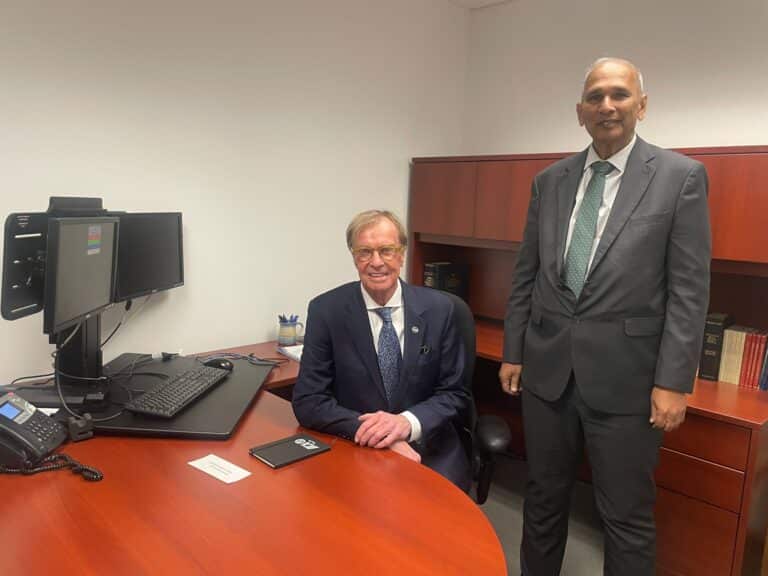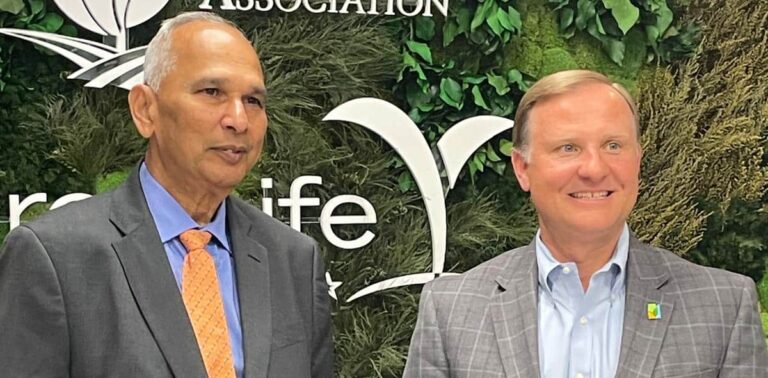
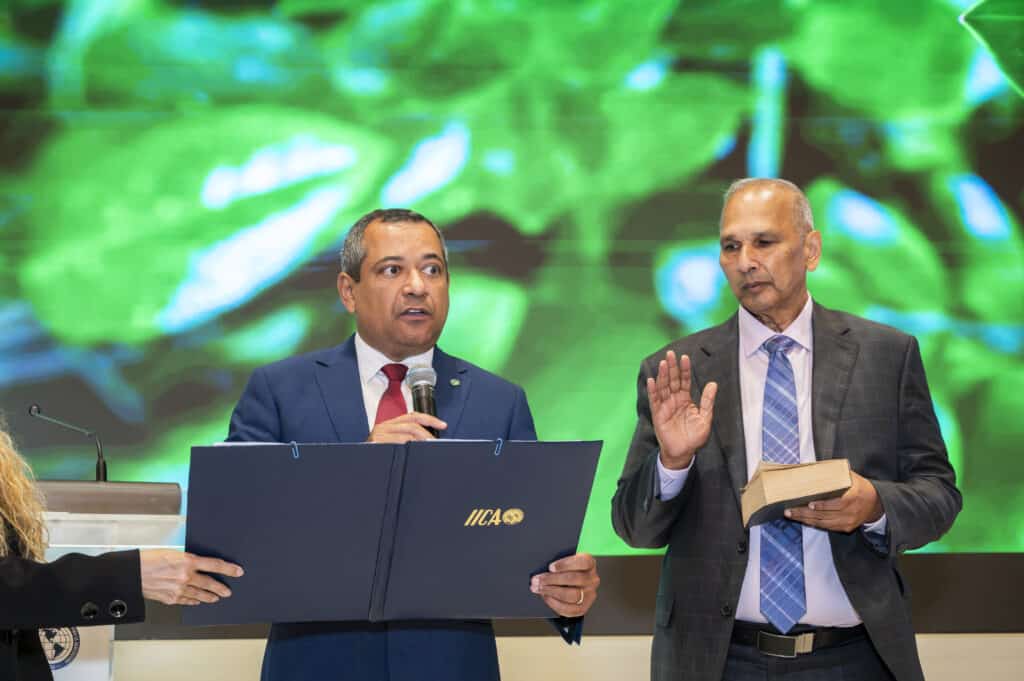
Cleber Soares, Deputy Minister of Agriculture and Livestock of Brazil, and Muhammad Ibrahim, Director General of IICA.
San Jose, 16 January 2026 (IICA). Brazil has very high expectations for Muhammad Ibrahim’s leadership of the Inter-American Institute for Cooperation on Agriculture (IICA), given the new Director General’s extensive experience in managing agricultural development institutions that promote competitiveness through science, technology and innovation, said Cleber Soares, Brazil’s Deputy Minister (Executive Secretary) of Agriculture and Livestock.
The official highlighted Ibrahim’s deep knowledge of the challenges and opportunities facing agriculture in the Americas, and emphasized that Brazil stands ready to work with IICA and other Member States under the new administration.
Ibrahim was sworn in by Soares during a ceremony held in San José, Costa Rica, where Soares deputized for Carlos Fávaro, Brazil’s Minister of Agriculture and Chair of the Inter-American Board of Agriculture (IICA), IICA’s highest governing body.
A Guyanese agronomist, Ibrahim was elected in November by the ministers of agriculture of the Americas for a four-year term at the helm of the organization. He succeeds Argentinian Manuel Otero, who served two terms.
“We are already in talks with the new Director General to support him and to share with other countries Brazil’s experience in aspects of tropical agriculture such as sustainable livestock farming, technological development, innovation, the adding of value, competitiveness and market access”, Soares remarked during his visit to IICA Headquarters.

Cleber Soares, Deputy Minister of Agriculture and Livestock of Brazil, highlighted Ibrahim’s deep knowledge of the challenges and opportunities facing agriculture in the Americas, and said Brazil stands ready to work with IICA.
Sharing experiences
In just a few decades, Brazil went from being a net importer of foodstuffs to becoming one of the world’s leading agricultural powers, thanks to research and technologies that boosted productivity and sustainability by leaps and bounds.
Soares believes one of the key tasks for IICA going forward is to increase the links between large food-producing countries such as Brazil and others that remain heavily dependent on imports, such as certain Central American and Caribbean nations.
“One aspect of this task”, he explained, “is the significant challenge of integrating small farmers through the incorporation of new technologies that would enable them to increase the sustainability of agriculture and add greater value. Our producers need to manage their farms better, to know not only what to produce but also how to sell, how to distribute, how to purchase inputs and how to deal with climate change. This includes emerging issues such as agricultural health, as we are seeing the reappearance of plant and animal diseases thought to have been eradicated. Diseases do not recognize borders, hence IICA has a key role to play in eradication and control”.
Access to credit for small-scale producers and agricultural insurance were also singled out by the high-level Brazilian official as key aspects of farming across the continent.
“Without credit”, he suggested, “it is impossible for producers, especially small farmers, to produce. Agricultural insurance is another key issue, especially in the tropics, where the need to equip producers with a tool to protect them against the risk of losing production is of the utmost importance”.
More information:
Institutional Communication Division.
comunicacion.institucional@iica.int