The Caribbean country is banking on sweet potato- and cassava-based businesses to boost economic activity.
San José, 14 February 2019 (IICA). Antigua and Barbuda is banking on sweet potato and cassava as alternatives that could reduce its high import bill, through value added production in these chains, which will revitalize the economy.
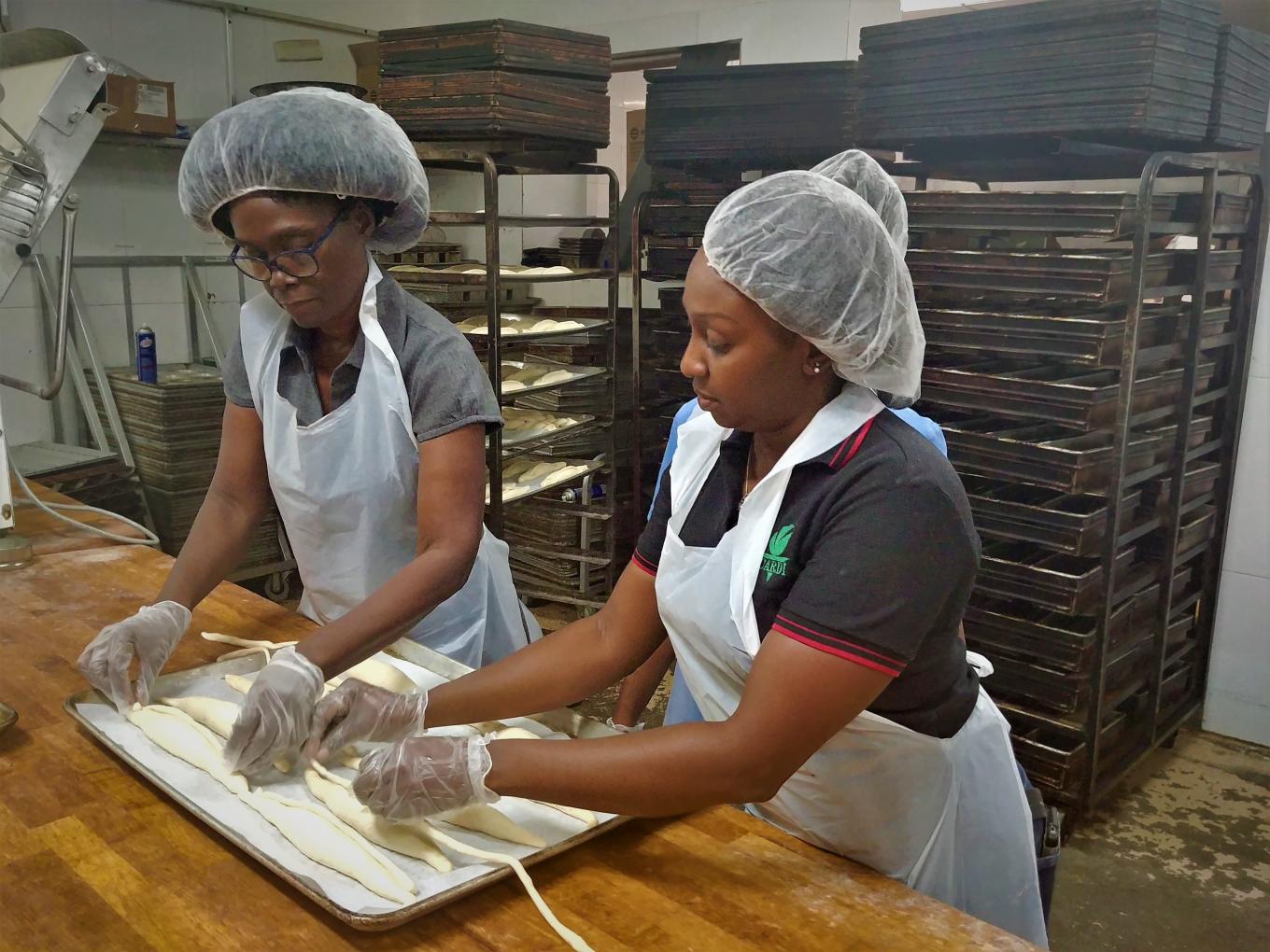
Through a training initiative, nutrition teachers, NGO staff at the national level, staff from the local prison and members of the Ministry of Agriculture, Fisheries and Barbuda Affairs (MoAFBA) of this country were instructed in the preparation of bread, using these two root crops.
The three-day workshop was spearheaded by the Inter-American Institute for Cooperation on Agriculture (IICA), the Caribbean Agricultural Research and Development Institute (CARDI) and MoAFBA, with support from the Epicurean Supermarket.
Sereno Benjamin, Extension Officer from MoAFBA, remarked that “The reason why these two products were chosen is that these types of bread have been made in other countries across the region and the recipes that we are using have been used and tested and have been successful in other countries in the Caribbean. If the project succeeds, the products will replace 40% of the flour in bread, thereby reducing imports and increasing the production of sweet potato and cassava in the country”.
This training is in keeping with IICA’s efforts to guarantee food security in a region with high import levels, and which is seeking to develop a production approach that increases the number of crops grown at the local level.
Craig Thomas, IICA Specialist in Antigua and Barbuda, indicated that this activity was first introduced in this country in 2016, under the Agriculture Policy Programme (APP) an EU funded Project coordinated by IICA. The Institute and CARDI, in collaboration with other stakeholders, have implemented other initiatives to add value to these agricultural chains, thus satisfying specific public and private sector needs.
From his perspective, the Extension Officer from MoAFBA, Mr. Owolabi Elabanjo argued that, “World food security is a topic of discussion, and therefore Antigua and Barbuda intends to limit the utilization of wheat and wheat flour products. Through this project, we have identified two products that can substitute some of the flour that is consumed, and we hope that the public will embrace this new idea and experience better nutrition”.
On the other hand, Paul Lucas, CARDI Representative for Antigua and Barbuda, remarked that “the goal of our organization is to assist farmers to be more productive in the use of these types of crops, and we hope that through these efforts we can see additional uses for commodities”.
Lucas also remarked that the goal of his organization is not only to provide farmers with alternatives uses of these crops, but to enable them to increase production.
More information:
Craig Thomas