
Brasilia, 5 November 2025 (IICA) – Agricultural journalists engaged in a debate with ministers of Agriculture of the Americas to examine how to counter distorted and outdated perceptions about agriculture, to enable the public to gain a thorough understanding of the sector’s essential role in food security, environmental care, economic and social development and the dissemination of new technologies.
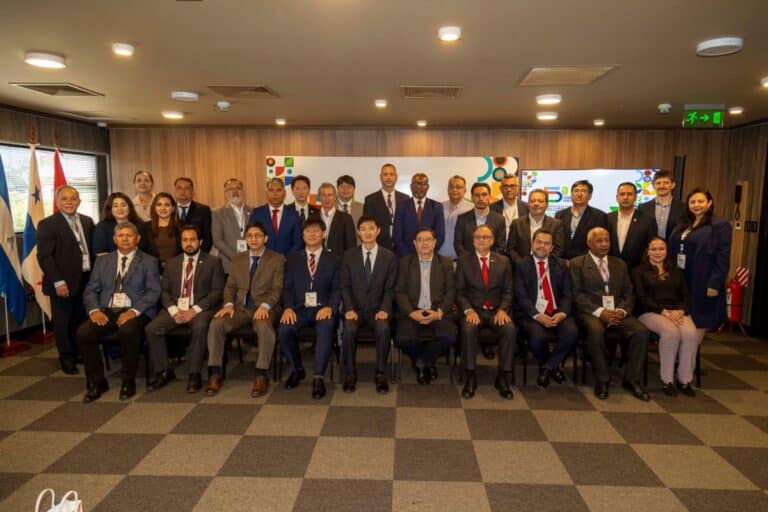
The discussion took place during a segment focusing on communication, as part of the Conference of Ministers of Agriculture of the Americas 2025. The three-day conference in Brasilia was organized by the Government of Brazil and the Inter-American Institute for Cooperation on Agriculture (IICA).
The ministers attending the meeting—that was held under the banner “A New Narrative for Agriculture and Agrifood Systems of the Americas”—considered a discussion on agriculture’s image to be essential, given the global context of misinformation and polarization. They agreed on the need for collaboration among the various agricultural stakeholders to explain to urban populations that although hunger and malnutrition persist in the world, the proportion of individuals affected by these issues is much lower than at any other point in history, thanks to greater agricultural productivity.
“There will be no need to invent anything in order to create a new narrative, because the Americas is creating a new a paradigm for agriculture. After 8,000 or 9,000 years of employing the plow, thereby releasing all the carbon in the soils into the air, in Brazil and Argentina we no longer till the soil. No-till agriculture was introduced some thirty years ago, as a system that allows us to care for the environment, and it has taken over almost completely. Today, agricultural professionals in South America reject practices involving plowing and have developed systems that also make more effective use of machinery and fuel”, said Héctor Huergo, an agricultural engineer and journalist from Argentina who is renowned for his reporting on production, economic and social issues in rural areas. He is also an IICA Goodwill Ambassador.
Huergo described himself as a “militant advocate “for the type of agriculture proposed by the Americas. He considered that good production practices in the hemisphere have not only reduced the environmental footprint of food, fiber and bioenergy production, but are solving problems in other sectors, such as transportation, through the growing development of biofuels.
Ederson Granetto, Editor-in-Chief of Agro +, a Brazilian TV channel dedicated entirely to agricultural news, praised the efforts undertaken by IICA to change the widespread perception of agriculture as an outdated and harmful sector.
“That perception is a source of concern in societies. We must build a new vision that makes it clear that agriculture is not the villain. A lot of people in Brazil associate agriculture with deforestation and global warming, but people who live in cities need to understand that natural fields help to sequester carbon in soils”, he said.
Granetto pointed out that Brazilian law has strict limits on land use to protect native vegetation, based on the biome. “In the Amazon, a landowner can only farm on 20% of his property. And in some parts of the Cerrado, the limit on land use changes is 35%. Few people know this. I don’t think any other major food-producing country has more than half of its territory covered by forests, the way Brazil does”, he said.
Cassiano Ribeiro, a renowned columnist and Executive Editor of Globo Rural, the content hub of Globo, Brazil’s largest media conglomerate, referred to widespread misinformation in society about the contribution and impact of production activities.
Ribeiro considered that the agriculture sector must invest more in communication, not just financially, but also in terms of time. “Those involved in agriculture”, he said, “must be more willing to communicate. People need more information, and today’s digital world provides very easy access. It is important to understand that agriculture is not just about economics. Beyond production and export figures, there are farmers in the countryside who are doing the hard work of planting and harvesting and often have fascinating stories to tell”.
More information:
Institutional Communication Division.
comunicacion.institucional@iica.int