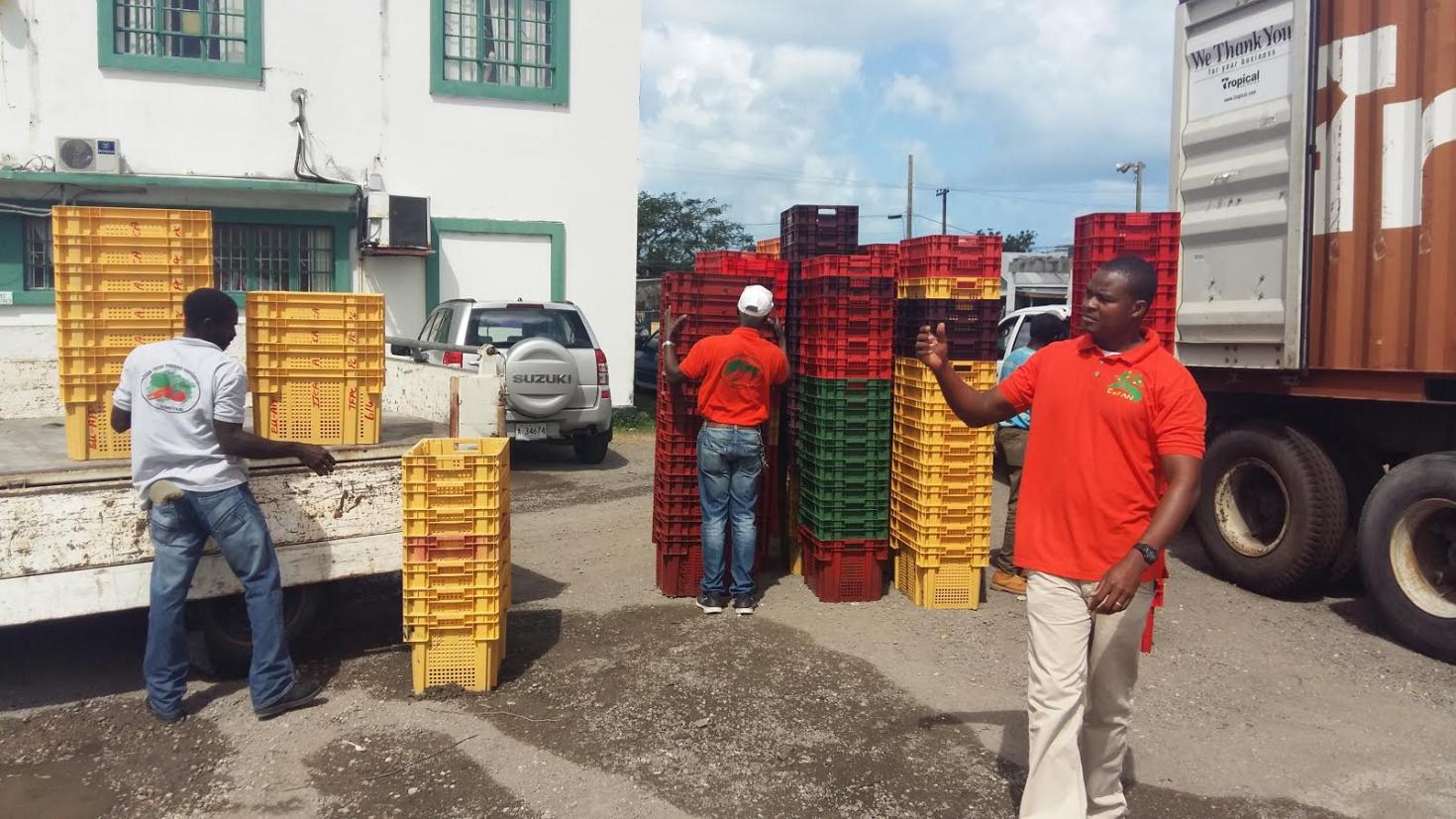
The donation of 850 multi-crates will ensure a constant supply of fresh produce to markets for income generation and for food security. The initiative was carried out by the Intra-ACP Agricultural Policy Programme (APP), executed by IICA and funded by the EU.
Antigua and Barbuda, March 9, 2017 (IICA). In an effort to reduce waste in the local food system, proper handling of produce from harvest to market has taken on added significance in agricultural development efforts. Improved post-harvest handling practices and techniques continue to attract the attention of global food chains, as they seek to cut losses in the transfer of produce from the farm to distribution or processing centres.
Members of the Team Fresh Produce Limited Cooperative (TFPC), a producers’ group that is the local arm of the Caribbean Farmers Network (CaFAN), and Smart Farmers’ Cooperative, received 850 multi-crates to facilitate their post-harvest activities, thanks to an initiative executed by the Inter-American Institute for Cooperation of Agriculture (IICA), within the Intra-ACP Agricultural Policy Programme (APP) funded by the European Union (EU) under the 10th European Development Fund (EDF).
The donation of the multi-crates, is in keeping with the objective of improving the quality and standard of agricultural produce grown by small and medium-sized producers, which will ensure a constant supply of fresh produce to both local and export markets for income generation and food security.
The cooperatives benefitting are specialized in the production of variety vegetables, such as sweet pepper, tomato, sweet potato and cassava for sale to the wider public. Each multi-crate will significantly reduce the time spent by the producers in their traditional manual harvesting practices for vegetables, as well as improve the standardization and quality of the finished products.
The multi-crates will replace cardboard boxes traditionally used by the producers to harvest their crops, and will also contribute to a reduction in the cost of purchasing boxes, which usually are not durable beyond one harvesting cycle.
The handing-over ceremony also provided the opportunity to present to the Minister of Agriculture, the “Directory for selected CARIFORUM food producer groups, buyers and service providers”, a publication produced under the APP project to support efforts at strengthening and inclusion of smallholder’s and SMEs in value chains.
The directory represents a quick reference source of contact information, coordinates of key producer groups, supermarkets, restaurants, traders, exporters, agro-processors and input suppliers involved in two local commodity chains, namely hot pepper and sweet potato.
At the ceremony, the Minister of Agriculture, Arthur Nibbs, indicated that he was “heartened to know that this partnership was encouraged and enabled through a mechanism described as a National Value Chain Facilitator, which acted as an interface between the project and beneficiaries, and through which, the provision of these 850 crates to members of these two Cooperatives was made possible.”
According to the national specialist of the IICA Delegation in Antigua and Barbuda, Craig Thomas, this handover reiterates IICA’s commitment to promoting and making more visible the economic contribution of rural producers to their communities and by extension, the national economy.
“On behalf of the members of our organization, we are very grateful to IICA, CARDI and the European Union for these harvesting crates and directory, because now we will be able to harvest our crops more efficiently, but also carry out post-harvest activities where we will be in full compliance with food safety standards,” said the President of TFPC, Pamella Thomas.
There were 30 stakeholders present at the ceremony, which was supported by representatives of the Ministry for Agriculture, Lands, Fisheries and Barbuda Affairs, Extension Division, CARDI, and the National Information Centre of the Government of Antigua and Barbuda.
The procurement of the multi-crates was financed by the Caribbean Action under the EU Intra-ACP-APP project, with focus on the Caribbean and Pacific. IICA is the executing agency for the APP, and is responsible for Component 3 (Enterprise Development and Market Linkages). The APP, which ended in December 2016, was implemented in collaboration with the Caribbean Agricultural Research and Development Institute (CARDI), and the Caribbean Community (CARICOM).
For more information, contact:
Craig Thomas, National Specialist of the IICA Delegation in Antigua and Barbuda