San José, 24 February 2026 (IICA). The Inter-American Institute for Cooperation on Agriculture (IICA) announces the launch of the first edition of the Diploma Program in Liquid Biofuels, an academic initiative designed to strengthen technical training in a sector that is key to the decarbonization of Latin American and Caribbean economies.
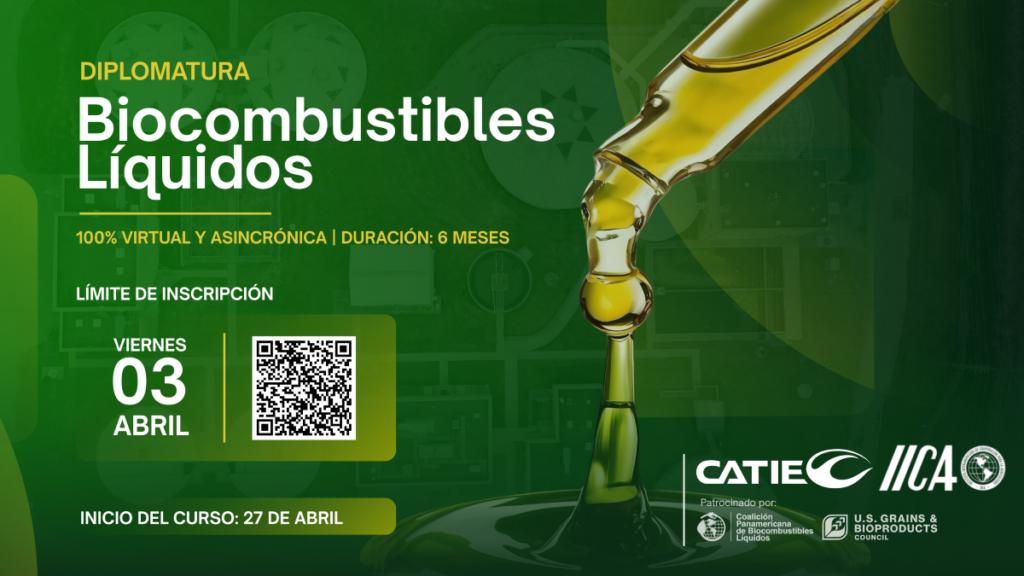
The program will begin on 27 April and last roughly six months. It comprises 120 hours distributed across three content blocks, with a workload of four hours per week. It is academically accredited by the Tropical Agricultural Research and Higher Education Center (CATIE).
The program will be 100% virtual and asynchronous, delivered through IICA’s Virtual Campus, allowing professionals from across the region to participate. There will also be optional synchronous activities and a final integrated project geared to the practical application of the program content.
According to Agustín Torroba, IICA’s international biofuels specialist, “the transition to low-carbon energy systems is one of the most significant structural challenges of the 21st century.”
He suggested that in the Americas the combination of low-carbon agriculture, technological innovation,and science-based public policies positions liquid biofuels as a strategic component for speeding up the decarbonization of land, sea and air transport.
Torroba pointed out that there is still a major gap in the training of specialized human capital, particularly among government agencies responsible for the design, implementation and evaluation of energy and climate policies.
“The limited availability of technical training opportunities for middle management in the public sector is a critical gap that needs to be filled for the development and consolidation of biofuel-based energy transition policies,” he said.
The postgraduate program is designed for public sector professional and technical personnel, especially middle managers and members of technical teams working for ministries, secretariats, regulatory agencies, and decentralized entities related to energy, the environment, agribusiness, and transportation. It is also intended for professionals from cooperation agencies, international organizations, universities, and private sector organizations involved in the design and implementation of public policies for decarbonization and energy transition.
The curriculum is organized into three content blocks. The first block comprises eight mandatory key courses totaling 60 hours, with content such as land-based biofuels, policies and regulatory frameworks, marine biofuels, and sustainable aviation fuels (SAF). The second block consists of elective courses that allow students to delve deeper into specific areas of interest, while the third block is the final integrated project.
Its modular structure, the academic level of the content, and its direct link to global agendas make this diploma program a strategic opportunity for those seeking to influence sustainable development, energy security, and climate innovation in the region.
The diploma program is sponsored by the U.S. Grains and BioProducts Council and the Pan-American Liquid Biofuels Coalition (CPBIO). Online registration is open until 3 April, and you can sign up at: https://forms.gle/FtsaMrgjVXqo1LX47.
For further information, go to Diplomatura or contact cpbio@iica.int.
More information:
Institutional Communication Division.
comunicacion.institucional@iica.int