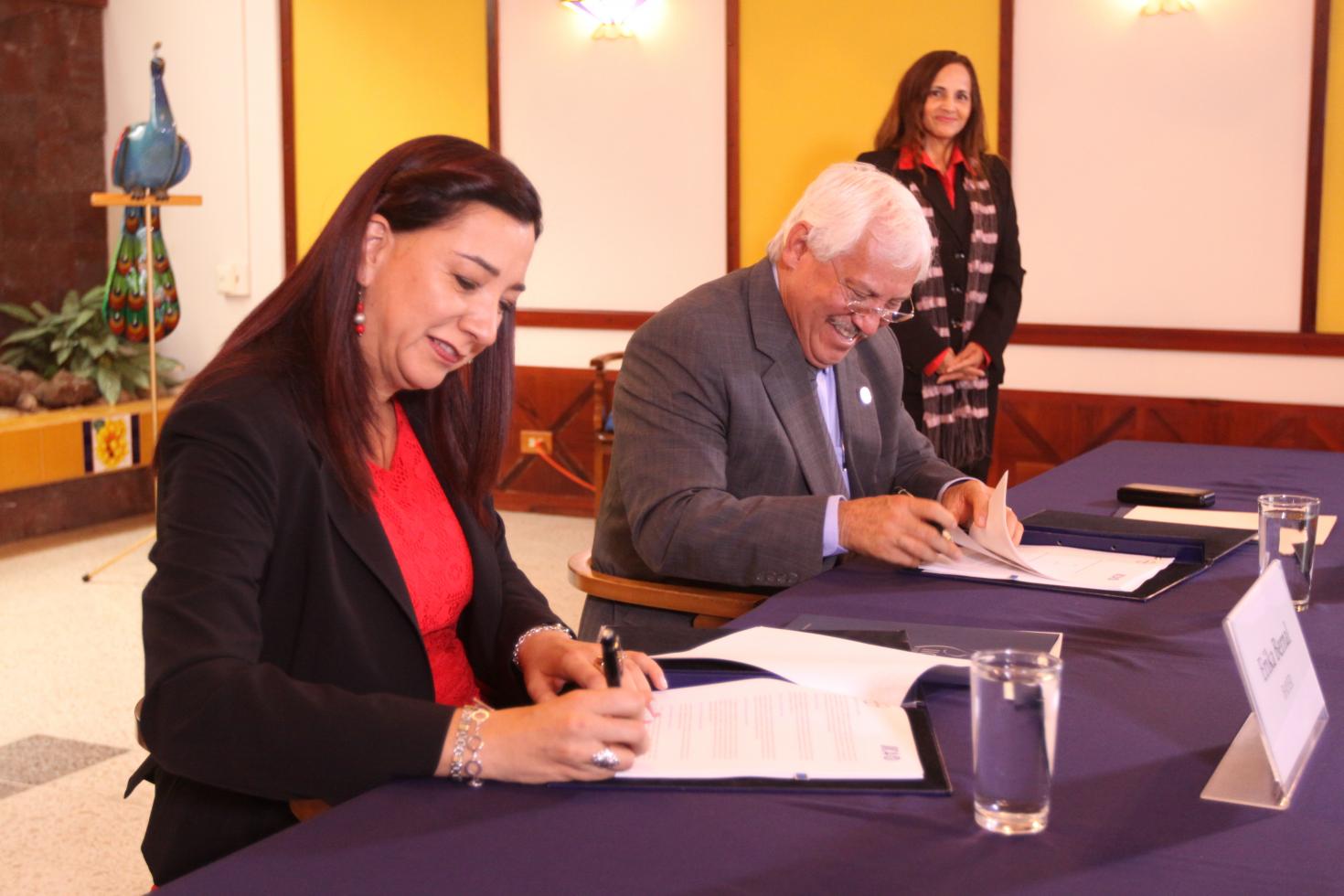
The parties signed a cooperative agreement to develop an online course based on training material created by Bayer. The course will be available on IICA’s virtual campus.
San Jose, 28 July 2017 (IICA). The Inter-American Institute for Cooperation on Agriculture (IICA) will host a manual for training farmers and field workers on its online training platform. The manual, developed by Bayer, promotes a production model that provides economic benefits in value chains.
This project is the result of an agreement on technical cooperation signed this month between Ericka Bernal, President of Bayer for Central America and the Caribbean, and Victor M. Villalobos, Director General of IICA.
Following guidance provided in the manual, producers will be better able to comply with food safety standards, and in particular with the GLOBAL G.A.P protocol. It will also enhance their relationship with local and international markets in ways that are both competitive and sustainable.
In addition, they will be able to disseminate good management practices in agriculture in Central America and the Caribbean, specifically for the export of tomato, bell pepper, fruits, potato, coffee, and vegetables.
“We have an increasing responsibility to provide food to a growing population; that is the responsibility that each professional in agriculture, and those of us who are devoted to this challenge, faces. For this reason, among others, we must foster alliances with strategic and renowned entities that complement our work to achieve the objectives to which we have committed ourselves,” stated Villalobos.
“The growing demand for food requires us to intensify sustainability and responsible agricultural practices to produce food in the face of adverse climates and less and less arable land. For this reason, we have committed ourselves to providing farmers and entrepreneurs with competitive tools to connect production performance along the food value chain,” stated Erika Bernal, who was very optimistic that the agreement with IICA can help strengthen technical capacity in Central America and the Caribbean.
Once complete, the course will be free of charge. Producers, policy makers, private entrepreneurs, universities, research, development and innovation centers, and members of the agriculture, energy and environmental sectors can take advantage of this course.
About the entities
IICA is the specialized organization in agriculture of the Inter-American System. The Institute supports the efforts of its 34 Member States to promote agricultural development and rural wellbeing through international technical cooperation of excellence.
Bayer is a multinational company with exceptional expertise in bioscience and agriculture. With its products and services, Bayer wishes to be of use to humanity and improve quality of life. At the same time, the company strives to create value through innovation, growth, and profitability. Bayer adheres to the principles of sustainability and, as a civic-minded company, acts in ways that are both socially and ethically responsible.
Director General of IICA, Víctor M. Villalobos. (Spanish only)
President of Bayer for Central America and the Caribbean, Erika Bernal. (Spanish only)
More information:
Orlando Vega, IICA Specialist on Renewable Energy – orlando.vega@iica.int
Robert Ahern, Leader of the Agricultural Health and Food Safety Program at IICA –robert.ahern@iica.int
Jose Fabio Morera Ramirez, Stewardship Manager for Central America and the Caribbean, Bayer CropScience – fabio.morera@bayer.com