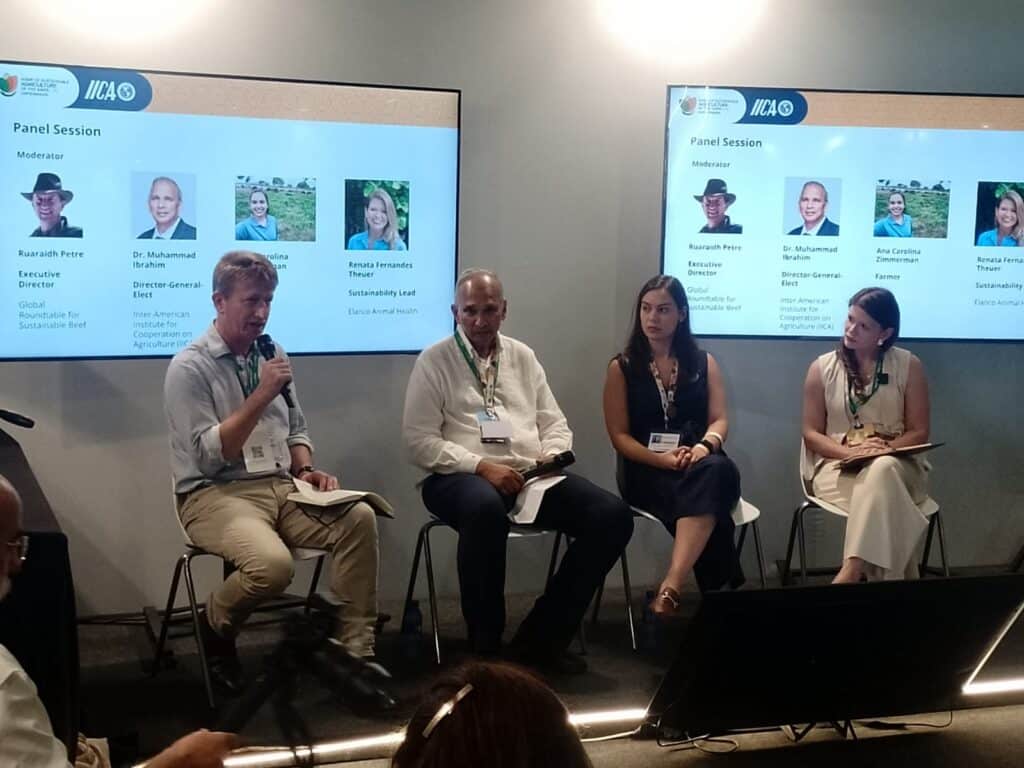
Ruaraidh Petre, Executive Director of the GRSB; Muhammad Ibrahim, Director General-elect of IICA; Ana Zimmerman, farmer; and Retana Fernandes, Sustainability Leader at Elanco Animal Health.
Belém do Pará, Brazil, 20 November 2025 (IICA). The objectives of the Global Roundtable for Sustainable Beef (GRSB) at COP30 were to highlight the importance of livestock farming for food security, report on its work on adaptation to increasingly frequent extreme weather events, and provide concrete data on the relationship between animal health and environmental health.
GRSB Executive Director Ruaraidh Petre visited the pavilion of the Inter-American Institute for Cooperation on Agriculture (IICA) at the conference in Belém do Pará, where he explained how animal production has enormous potential to help address the climate challenges being discussed in this city in Brazil’s Amazon region, where more than 50,000 people have gathered from around the world.
“We want to demonstrate the importance of beef in nutrition and in tackling climate challenges. Our ecosystems are vulnerable and really need domestic animals integrated with crops and forestry systems for adaptation. Although livestock farming emits greenhouse gases, these emissions can be reduced with good adaptation-oriented practices”, Petre said.
Ambitious goals
The Global Roundtable for Sustainable Beef (GRSB) is comprised of a range of stakeholders in the beef value chain, including producers, processors, input manufacturers, industrial operations, exporters and marketers. The network promotes progress in sustainable livestock farming by setting ambitious targets for reducing greenhouse gas emissions and improving land use and animal welfare. It does so by sharing knowledge and fostering a collaborative approach. The GRSB coordinates 12 national roundtables, with over 500 members working in 24 countries. Collectively, GRSB members are responsible for more than two-thirds of cross-border trade in beef.
“All of us who are part of the Roundtable are committed to building an increasingly better and more sustainable beef production and processing sector, and keeping the world informed of the progress we make. We have set seven objectives related to land use, climate, health and animal welfare. We issue reports on what we have achieved every two years”, Petre explained.
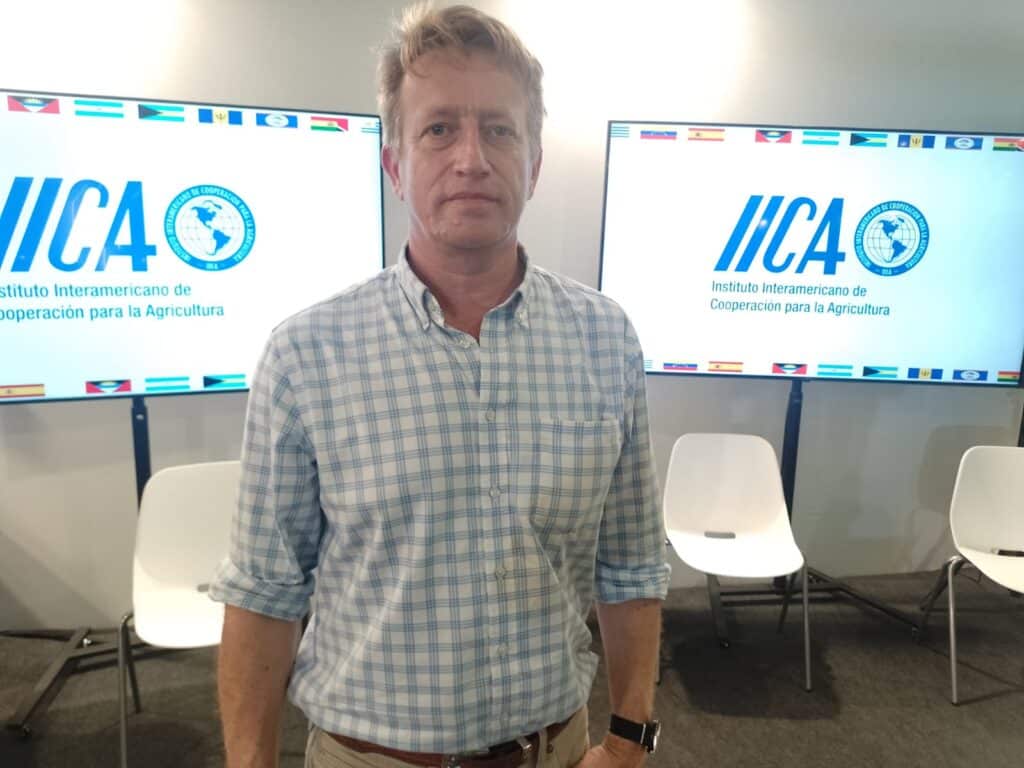
Ruaraidh Petre, Executive Director of the GRSB.
The Executive Director of the GRSB was delighted that holding the COP in Brazil ¾a global agricultural powerhouse¾meant that the agrifood sector was playing a leading role through the AgriZone coordinated by EMBRAPA, although he regretted the fact that agrifood was still not being given its rightful place in the countries’ negotiations.
“The agriculture sector has solutions to climate challenges, and there are already many examples worldwide of productive practices that are working. The IICA pavilionat the COP has showcased many inspiring advances”, he noted.
“Latin America and the Caribbean is a major engine of global food production. That’s key for the whole world, because China, Japan and other densely populated countries don’t produce enough. It’s even happening in Europe. I live in the UK, where we import almost half of our food. So Latin America is feeding the world, and of course, there’s always room for improvement in terms of sustainability. We’re at the COP to learn and discuss all the initiatives that make us more productive, more efficient and better for the environment. We don’t deny that livestock farming emits methane into the atmosphere, but those emissions can be offset by all the positive contributions that animal production makes on pastureland that sequesters carbon and provides the planet with other ecosystem services. We need to move beyond polarization, and to do so, we must share what we’re doing”, Petre concluded.
More information:
Institutional Communication Division.
comunicacion.institucional@iica.int