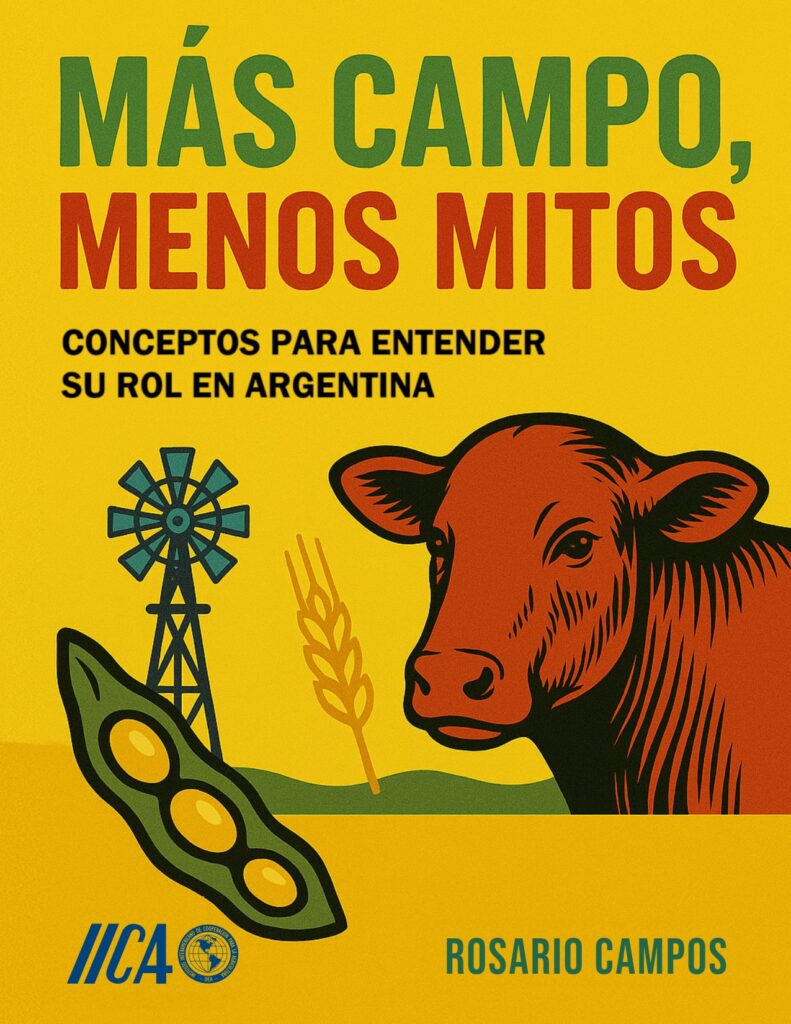
San José, 28 November 2025 (IICA). The book Más campo, menos mitos. Conceptos para entender su rol en Argentina is a new publication from the Inter-American Institute for Cooperation on Agriculture (IICA) that delves into the essential aspects of agricultural production in the South American country, and its influence on the economy, urban life, employment, exports and food.
The publication explains why Argentina’s rural areas are important and how they influence daily life, dealing with everything from photosynthesis to exports, including meat, soybeans, wheat, wine and other agricultural products.
The book dismantles prejudices evident in public discourse, and even in secondary school textbooks, by presenting data that explains how rural areas work and what they contribute to the country.
Its author, Rosario Campos, holds a licentiate degree in economics (magna cum laude)from the University of Buenos Aires and a master’s degree in economics from the University of San Andrés. She also has a postgraduate degree in grain marketing (Catholic University of Argentina and AACREA). She has authored several publications for international organizations such as the Inter-American Development Bank (IDB), IICA, and the FAO.
The book is available for download from the IICA Digital Repository.
Some of the chief myths that the book debunks are the idea that rural areas do not generate employment or added value, that exporting primary products is bad, and that cattle are one of the main causes of climate change.
- The book shows that when forward and backward production linkages are factored in, agro-industrial chains account for nearly one in four private-sector jobs.
- Another common criticism is that the agriculture sector only exports raw materials. This notion of low complexity is contradicted by a sector that adopts technology rapidly and forms a system based on innovation, contract farming and a network of interconnected businesses and services.This system includes biotechnology, AgTechs, no-till farming, agricultural machinery, inputs, innovation and managementcapabilities.
- Agriculture’s role in exports is key: six out of every ten US dollars that Argentina receives for the goods it exports come from the agribusiness sector. The country is a world leader in products such as soybean oil, peanuts, pears and lemon juice.
- The publication shows that the criticisms leveled against livestock farming for its contribution to climate change fail to consider the main causes of greenhouse gas (GHG) emissions, which are activities linked to the use of fossil fuels. Furthermore, the balance between GHG emissions and sequestration in different production systems is crucial. In Argentina,extensive grazing systems predominate, which capture carbon through photosynthesis.
- Myths about genetically modified crops and the use of glyphosate do not take into account the scientific evidence that supports their safe use under good practices,and highlights environmental benefits such as reduced fuel consumption and carbon sequestration.
The book is intended for a broad audience, with simple, easy-to-read language.
The aim is to bring the reader closer to Argentina’s rural areas, introducing key concepts that help us understand how it functions, and dispelling certain myths that have undermined the vision of its role and the public policies that affect it.
More information:
Institutional Communication Division.
comunicacion.institucional@iica.int