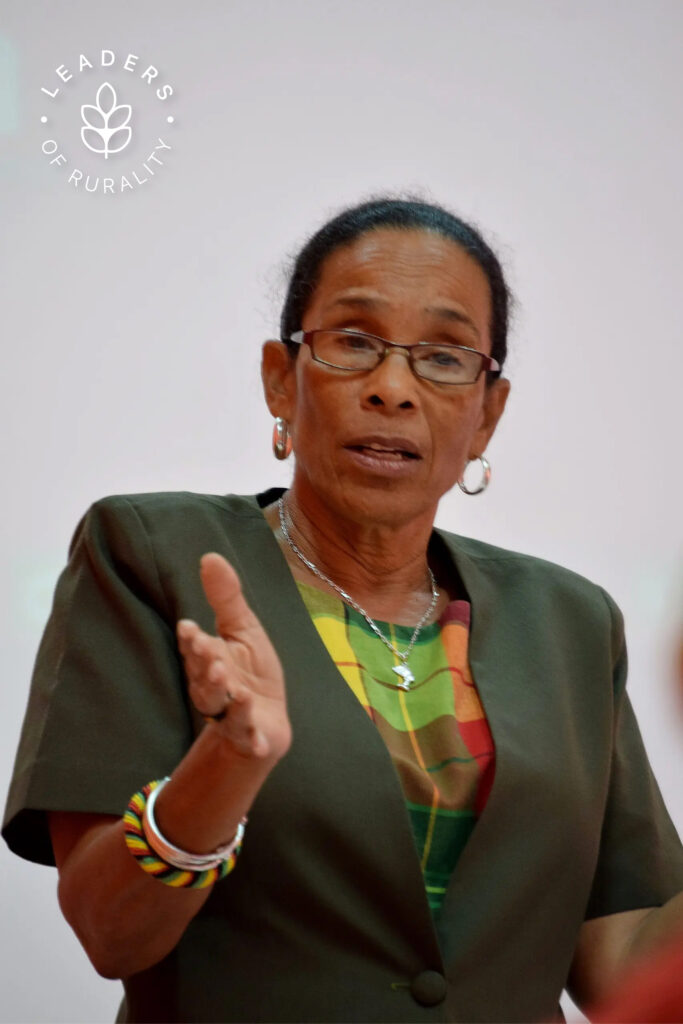
San Jose, 24 February 2025 (IICA) – Having worked for more than thirty years to advance small farmers in the Caribbean country of Grenada, by providing them access to credit, technical support and training, Sandra Ferguson has been recognized by the Inter-American Institute for Cooperation on Agriculture (IICA) as a Leader of Rurality of the Americas.
Ferguson will receive the “Soul of Rurality” award, as part of an initiative by the specialized organization in agricultural and rural development, to shine the spotlight on men and women who are leaving their mark and making a difference in the rural Americas – a region that is pivotal to food and nutritional security and the environmental sustainability of the planet.
In 1992, Ferguson joined the Agency for Rural Transformation (ART), a non-governmental organization in Grenada. This small nation that lies in the Caribbean Sea obtained its independence in 1974 and remains a part of the Commonwealth, the community of countries with historical ties to Great Britain. Grenada is famous for its nutmeg production, the main reason for its being known as the Spice Island.
ART is an organization that works to empower rural communities to improve their standard of living, with a particular focus on women, youth, family farmers and artisans.
Ferguson is a spirited advocate for the cultivation of healthy food and local consumption, which is a matter of critical concern throughout the Caribbean, as a region whose food security is largely dependent on imports.
She has also played an instrumental role in campaigns such as “Grow What You Eat and Eat What You Grow” and “Eat Local! Eat Healthy!”, whose messages have resonated throughout the country.
She explains that, “Eating what we grow locally is healthier and our priority is to use food as a means of improving community health. We developed a program to distribute vegetable and fruit seeds, as a means of encouraging households to grow their own food. Along with this, we introduced training programs on preparing and combining foods to increase their nutritional value. We mainly worked with the mothers in the family and with young people”.
Sandra has also worked on programs to provide loans to small-scale businesses—which are often sidelined from the main sources of financing—and has played a key role in revitalizing the Grenadian beekeeping sector, whose honey production has gained international recognition for this Caribbean country. She also promoted an initiative to support beekeepers through the provision of packaging and other services to boost the efficiency of their businesses.
In 1997, she coordinated Grenada’s participation in the International Honey Show in Great Britain, where the island copped several prestigious awards. IICA’s projects with the country’s Ministry of Agriculture further contributed to the success of Grenadian honey overseas.
The Leader of Rurality of the Americas accolade is granted to individuals who play a unique dual role, as guarantors of food and nutritional security, who also safeguard the planet’s biodiversity, by producing under all manner of circumstances. The award also seeks to highlight these individuals’ capacity to promote positive examples for the region’s rural areas.
Understanding farmers
“Grenada is famous for its nutmeg production. Before Hurricane Ivan devastated the island in 2004, we were the world’s second largest producer of that spice. Unfortunately, we lost that position. Then, Hurricane Beryl clobbered us again (in 2024)”, recalls Ferguson, who tells us that when she was a child, her father was a nutmeg and cocoa farmer.
She attended the Faculty of Agriculture of the University of the West Indies (UWI), St. Augustine, Trinidad and later pursued post-graduate studies in Caribbean Agricultural Development at the Universite’
Antilles- Guyane campus in Guadeloupe and in Development Studies at the Institute of Social Studies in the Netherlands.
“One of the best lessons that has stuck with me for life is that a farmer knows what he or she must do. In principle, you don’t have to bother to teach them but rather you must seek to understand the system in which they operate. You must find out about their ambitions, their resources and the surrounding context, in order to work with them. Recognizing this prepared me to function in civil society and then I entered the Agency for Rural Transformation, starting first in the division of economic projects”, recalls Sandra.
Ferguson explained that in 1981, the Agency was established as a quasi-governmental agency to support agricultural and rural development and worked closely with the government in office at that time. With the collapse of that administration in 1983, the Agency was closed. One year later, it re-opened; resumed its projects to support the rural population and was registered as an NGO.
She explains that, “It has spearheaded pioneering micro-credit projects in the country and also enabled small farmers to access technical assistance”.
Sandra also implemented sensitization programs for rural women and was instrumental in their empowerment, encouraging them to participate and to become involved in making the decisions that impact their lives.
She argues that, “Food sovereignty is becoming increasingly important, given the impact of climate change on the Caribbean, triggering more hurricanes, more heat waves, more flooding and more drought. We must revisit ancestral practices and indigenous knowledge, many of which are unknown to young people”.
In closing, she stressed that, “We must work to empower small farmers. We cannot give in. They are our source of inspiration in the Caribbean and the rest of the Americas, because we know that without them, we cannot have healthy food”.

Sandra also implemented sensitization programs for rural women and was instrumental in their empowerment.
More information:
Institutional Communication Division.
comunicacion.institucional@iica.int