In the third edition of this competition, participants were presented with a virtual world in Minecraft consisting of a densely populated city with no spaces where crops could be grown, and tasked with generating innovative and efficient solutions for sustainable food production.

San José, 12 August 2025 (IICA). Students from the Colegio Científico de Alajuela, Costa Rica, have won the third edition of the Minecraft Education Challenge for Agriculture, organized in this country by the Inter-American Institute for Cooperation on Agriculture (IICA) with the support of Cedes Don Bosco and the Farmtastica corporation, for their virtual project involving the design of sustainable agricultural systems in urban environments.
The competition, which this year focused on urban and vertical agriculture, is designed to introduce young people to the use of new technologies, highlight the importance of agriculture, and foster creativity.
In the Challenge, students were given a design in the Minecraft video game consisting of a world facing problems of overpopulation and overbuilding, and with few areas suitable for crops, limited water and energy resources, extreme events such as heat waves, torrential rainfall and periods of drought, water and air pollution, and a protected area that they could use provided they did not damage it.
The young people were tasked with developing alternative ways of producing food, and conserving and restoring natural spaces within the urban environment.
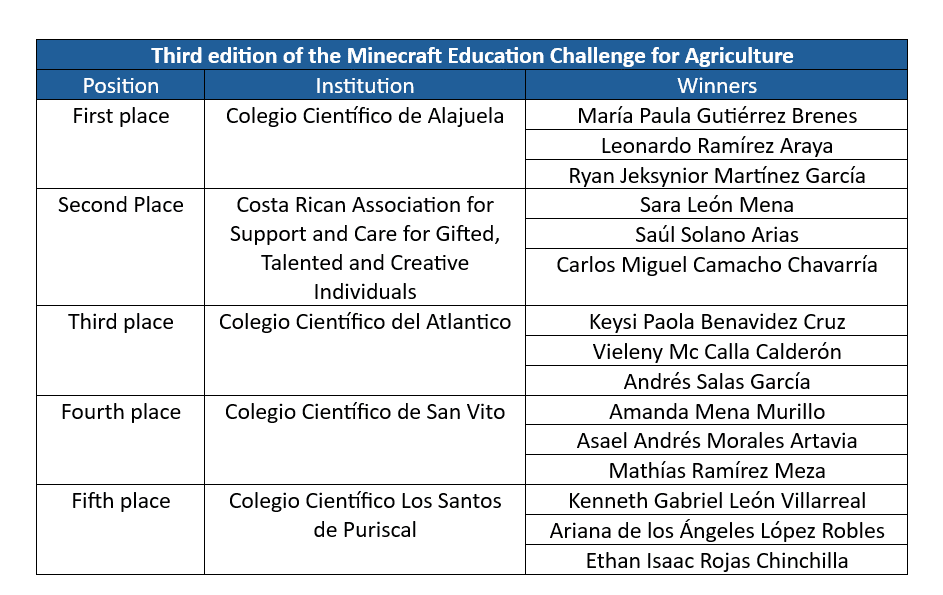
María Paula Gutiérrez, Leonardo Ramírez, and Ryan Martínez, the members of the winning group, presented a solution that entails the creation of an automated chicken coop, green flat roofs with trees to purify the air, a medicinal and edible mushroom farm that uses artificial intelligence, rainwater purification, and the use of aquaponics for crop and fish production.
The project is notable for its innovative use of algae bioluminescence to generate light and purify the air, and for its implementation of a crop monitoring app that awards citizens points they can use to purchase products each time they record an action taken in urban kitchen gardens, nurseries, or animal care facilities.
“This challenge was very enriching; it allowed us to connect with nature and with real solutions. I’ve always been interested in agriculture, and by hosting these events IICA provides an excellent opportunity for more people to learn about these topics”, remarked María Paula Gutiérrez.
Panama’s Deputy Minister of Education Infrastructure, Delia Marcela Herrera, who took part in the ceremony held to announce the winning teams in Costa Rica, said: “It’s an honor to be here with you at IICA, and I’ll be taking valuable lessons away with me that we can replicate. It’s inspiring to see how you have awakened in these young people such a deep awareness of what’s happening in the world and how they can use a game to find sustainable solutions”.
“For IICA, it is essential that new generations, young people, develop digital skills, learn about agriculture, and acquire the skills required to develop and present their projects to an audience, because they are the present and the future of the planet”, emphasized Emmanuel Picado, IICA’s Manager of Information and Communication Technologies and Digital Agriculture.
This year, five of the 50 groups that competed made it through to the final round and presented their solutions to a jury at IICA Headquarters in San José. A total of 150 students from different Costa Rican high schools took part, all aged between 12 and 17.
The goal of the challenge was for students to develop skills fostered by the STEAM approach to learning, which integrates science, technology, engineering, the arts, and mathematics; expand learning about urban agriculture, sustainability, and food in urban contexts; and encourage the use of digital technology to create real-life models of urban agricultural production using vertical farming, hydroponics, and other emerging techniques.
The competition also promoted critical and collaborative thinking, teamwork, greater awareness of, and commitment to, food security, and the efficient use of natural resources.
David Ulloa, technology manager at Núcleo Eléctrico and the IT department of Cedes Don Bosco, expressed his enthusiasm for seeing the new generations becoming more aware and seeking real solutions. “In this challenge, young people started out having fun, but they also acquired valuable knowledge. They are the future of Costa Rica. The inventions they created today can be carried into the future and implemented in the real world”.

During the challenge, students received training in sustainable urban agriculture, effective communication, and the use of Minecraft Education.
Innovative solutions to tackle global challenges
Second place went to students from Costa Rica’s Association for Support and Care for Gifted, Talented and Creative Individuals, who presented an innovative solution that includes community gardens, the use of chickens to control pests, and the use of aquatic plants to purify rainwater. They also implemented a fog-harvesting system in the mountains to generate water for agricultural use, and an automated wheat farm that produces bread.
Third place went to students from the Colegio Científico del Atlántico, who proposed using composting centers to treat urban waste and generate biogas as a source of energy and fuel. They also promoted community gardens and the use of trees molded to alongside the walls of buildings and produce fruit and oxygen in small spaces.
Fourth place went to young people from the Colegio Científico de San Vito, who proposed using titanium dioxide paint on flat roofs to reduce pollutants, wetlands to purify wastewater, solar streetlights, and a dual-rail train to transport food and people. They also promoted urban agriculture through gardening kits and green roofs for low-income communities.
Finally, fifth place went to the Colegio Científico Los Santos de Puriscal, whose project proposed the use of hydroponics to absorb carbon dioxide and improve air quality, storage tanks to separate waste, and a biofilter to purify water for rooftop farming.
More information:
Institutional Communication Division.
comunicacion.institucional@iica.int