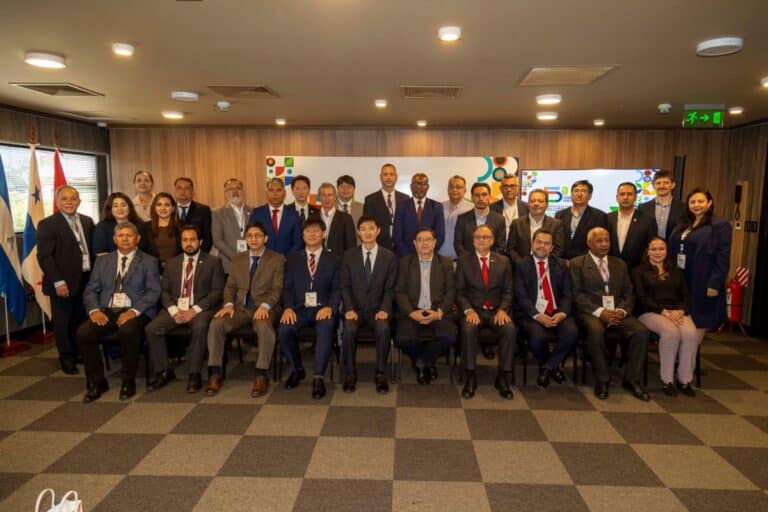

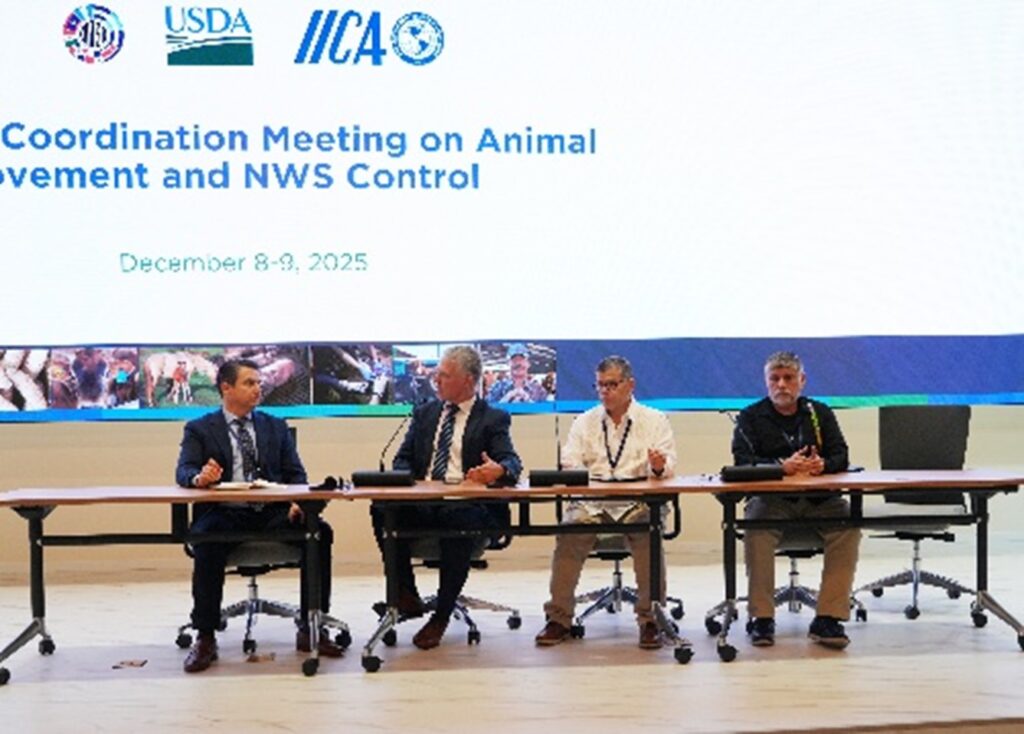
San José, 12 December 2025 (IICA) – Authorities and technical teams from the veterinary services of the United States, Mexico, Belize, Guatemala, El Salvador, Honduras, Nicaragua, Costa Rica and Panama met in San José to build strategies addressing coordinated response frameworks for the movement, surveillance and inspection of animals, with the aim of strengthening regional coordination for the control and prevention of the spread of the New World Screwworm (NWS).
The meeting, entitled “Regional Coordination Meeting on Animal Movement and Control of the New World Screwworm (NWS)”, was organized by the Inter-American Institute for Cooperation on Agriculture (IICA) in collaboration with the Animal and Plant Health Inspection Service of the United States Department of Agriculture (USDA-APHIS). More than 50 key stakeholders participated, including representatives from the International Regional Organization for Plant and Animal Health (OIRSA) and the Food and Agriculture Organization of the United Nations (FAO).
NWS is a pest caused by a fly whose larvae primarily affect cattle, but also other domestic and wild species, and even humans. Its reappearance, after more than two decades since eradication in the region, once again poses significant health, economic and social impacts.
IICA Director General Manuel Otero stressed that establishing an inspection-point system in Central America would be key to halting the advance of NWS, stating: “IICA has the capacity to bring together all the actors involved in this critically important issue and to demonstrate that we can be of real assistance in addressing the priority challenges shaping agricultural development”.

Lloyd Day, IICA Deputy Director General, emphasized that the resurgence of NWS constitutes an urgent threat to animal and human health, livestock productivity, trade and rural livelihoods, and underscored that it can only be successfully addressed through a coordinated regional response. He stressed that cooperation among countries “is not optional, but essential”, and reaffirmed IICA’s commitment to providing technical support to the nations.
Ibrahim Shaqir, Deputy Administrator for International Services at USDA-APHIS, recalled that although extensive knowledge exists on this pest, the current outbreak entails new challenges: “Work must focus on aligning surveillance systems, analyzing animal movements, finding practical ways to share information and mitigate risks, and strengthening daily operational practices in the field. At the same time, long-term capacities must be developed, including research on new methodologies and transparency among all countries must be maintained”.
The meeting promoted an open dialogue on surveillance systems and regulatory frameworks related to animal movement and compliance mechanisms, identifying shared regional priorities and approaches for the prevention, control and eradication of NWS.
Raúl Rodas, Director of OIRSA, emphasized the importance of creating spaces for discussion and the relevance of joint work to maintain a clear strategic vision: “This is a space for analyzing what we have done and what we must do going forward to succeed in containing and eradicating this disease”, he said. Likewise, Karin Garnier, FAO Liaison Officer for North America, noted: “At the request of our Member States, we are developing a four-year program to address and mobilize resources for transboundary animal diseases, and we are pleased to be here working hand in hand with you to maximize impact”.
Jose Urdaz, Manager of IICA’s Agricultural Health, Safety and Agrifood Quality Program, emphasized the strategic nature of the meeting “because it seeks to change course through joint action to close dispersion routes, reinforce surveillance, inspection and treatment prior to movement, reduce irregular transit and ensure agile information exchange”. He also recalled that no country can face this challenge alone and that the region succeeded in eradicating the pest precisely when it acted in a coordinated manner.
Countries shared their epidemiological situation and national control measures, reviewed regulatory frameworks for animal movement and compliance mechanisms, and agreed on regional priorities to prevent the pest’s expansion. The meeting also provided an opportunity to examine progress in national and bilateral plans and explore opportunities to expand strategies that have proven effective.
Adis Dijab, Associate Deputy Administrator for APHIS Veterinary Services, presented the United States’ action plan, which is built on five pillars: “stopping the pest’s movement in Mexico; strengthening detection at the border; collaborating with states to ensure preparedness for any health event; raising awareness of the pest’s reality; and driving innovation”.
Key actions learned from the United States–Mexico Action Plan
During the meeting, participants examined the movement control protocols developed under the United States–Mexico action plan, including inspection processes, ivermectin treatment and certification.
Jeromy McKim, USDA-APHIS representative, underscored the importance of integrating producers into control efforts. “There are not enough facilities or government personnel to inspect every animal each day; we need producers to be active partners in the program”. He explained that although progress is currently ahead of the pest, the real challenge arises when an infected animal manages to move, enabling the fly to disperse.
Gerardo Guerrero, Head of Mexico’s Agency for Phytosanitary and Zoosanitary Inspection, noted that efforts are underway to provide producers with “information and training so that livestock are treated at the point of origin and inspection stations serve only as verification”.
Finally, Armando García, Director of the Mexico–United States Commission for the Prevention of Foot-and-Mouth Disease and Other Exotic Animal Diseases (CPA) within the National Service for Agri-Food Health, Safety and Quality (SENASICA), warned that the pest has revealed long-standing inadequate practices: “There is a strong resistance to change, but we cannot keep doing the same thing and expect different results. We need full commitment from livestock producers, the official sector, and veterinarians”, he said.
This meeting strengthened coordination mechanisms among IICA, USDA, OIRSA, FAO and national animal health services to ensure timely response, data exchange and follow-up to control the spread of this pest, establishing a regional roadmap to guide coordinated action.
More information:
Institutional Communication Division.
comunicacion.institucional@iica.int