
Georgetown, Guyana, 4 December 2025 (IICA). Guyana’s Ministry of Agriculture is to have a Situation Room, which is already being set up and will serve to strengthen data monitoring in real time,analysis efforts, and the capacity to respond rapidly to extreme weather events in the South American country’s agriculture sector.
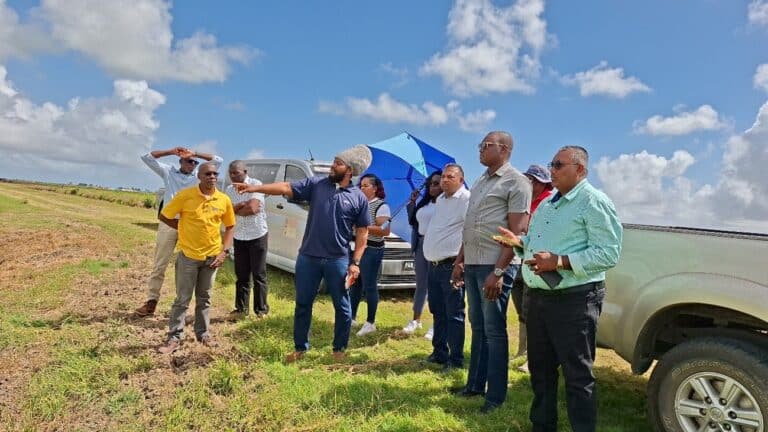
The initiative is being implemented by the ministry in collaboration with the Inter-American Institute for Cooperation on Agriculture (IICA). Recently, Guyana’s Minister of Agriculture, Zulfikar Mustapha, and technical officials from the ministry and the inter-American agency carried out an on-site inspection to assess the progress of the project.
Guyana, whose agriculture benefits from the country’s large swathes of arable land and tropical climate, is engaged in modernizing the sector, widely viewed as the future ‘food basket’ of the Caribbean, a region heavily dependent on imports.
IICA has suggested that, through increased public and private investment, the incorporation of science and innovation, and training for its farmers, the agriculture sector can make a big contribution to the sustainable development of the country and other nations in the region.
The decision to create a Situation Room is aligned with the objective of transforming Guyana’s agriculture sector by incorporating new technologies, including digital infrastructure, and promoting evidence-based decision-making.
The aim is to incorporate smart monitoring systems and predictive analytics into every phase of agriculture, to increase efficiency, improve resilience,and generate competitiveness.
Once it is operational, the Situation Room will serve as a hub for collecting data on weather patterns, agricultural production, flood and drought risks, pest and disease outbreaks, and other critical factors, all of which will permit more proactive and coordinated responses.
During the visit, ministry and IICA officialsreaffirmed their commitment to speeding up completion of the project and ensuring that the infrastructure, equipment, and technical systems meet international standards.
Minister Mustapha stressed that IICA’s collaboration continues to be vital, to support Guyana’s transition to a smart, technology-driven agriculture sector and that the Situation Room will significantly enhance the ministry’s ability to safeguard production and support farmers acrossthe country.
More information:
Institutional Communication Division.
comunicacion.institucional@iica.int