Both the government, the productive sector and the academic sector, with the support of IICA, formed a main part of the workshop for the creation of AMR the pilot program
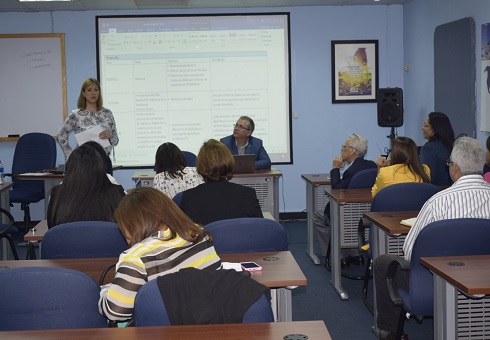
Santo Domingo, Dom. Rep., may 2018 (IICA). The 24th and 25th a workshop was carried out for the implementation of a pilot program on Epidemiological Surveillance of Microbial Resistance (AMR) in Animal Health, this workshop has the intention of establishing a pilot program in the AMR surveillance in animal health.
The workshop facilitated by Armando E. Hoet, DVM, PhD, DACVPM from Ohio State University and Dr. Ericka Calderón Specialist in Animal Health and Food Safety, from IICA Costa Rica. The moderators indicated that the objective of this initiative is to design national policies and guidelines that are simple but scalable, working systematizing how to make a surveillance plan under the recommendations of the WHO, OIE, FAO, among others.
The activity counted with the participation of the most relevant sectors of interest in the AMR surveillance. Among them are: LNSPDD and DIGEMASP, of the Ministry of Public Health and Social Assistance; DIGEGA, DIA, LAVECEN, of the Ministry of Agriculture; participants from the academia area such as the Veterinary School and the IMPA, from the UASD; representatives of the productive sector pig farmer and aviculturist; members of INDOCAL; as well as representatives of international cooperation organizations such as PAHO. WHO, OIRSA.

the AMR surveillance.
The success stories of the United States of America (NORMS) program and the Canadian system (CIPARS) were present during the workshop, as well as an example of the pilot programs of other countries in the region. Attendees were empowered to use tools to establish baselines, identify priorities and establish actions and policies for the management of AMR surveillance.
As result of the workshop, the draft of the basic components of the surveillance program for the Dominican Republic was establish, beginning with the assignment of responsibilities and leaving the stage open to coordinate, with the accompaniment of IICA, of subsequent work meetings to definitively define the guidelines and strategies for Dominican Republic.
More information: IICA Delegation in the Dominican Republic, iica.rd@iica.int