Counties and international organizations believe the program must be the focus of international cooperation for agriculture in Haiti.
Dominican Republic, January 28, 2010 (IICA). Meeting with representatives of the international community, the Minister of Agriculture of Haiti, Jonas Gue, presented a program of action aimed at rebuilding the agricultural sector of his country, improve food security and create jobs for the rural population and for those forced to flee to the countryside in the wake of the January 12 earthquake.
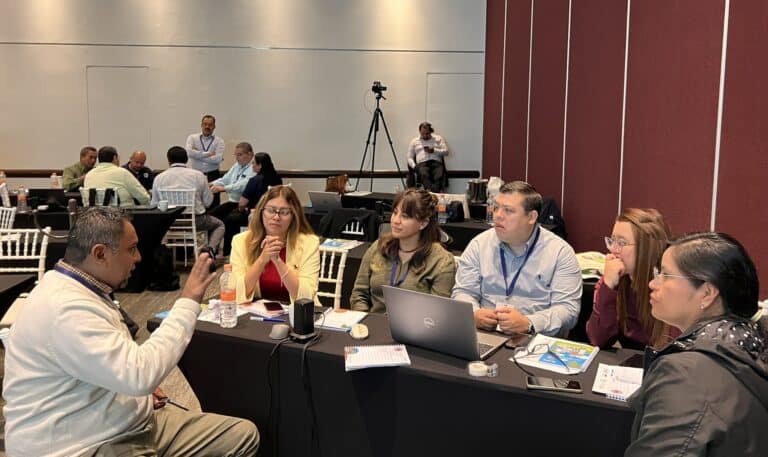
Minister Gue presented the program, prepared by his ministry with support from the Inter-American Institute for Cooperation on Agriculture (IICA) and the United Nations Food and Agricultural Organization (FAO), at a meeting of donors held on Wednesday, January 27, in the Dominican Republic, attended by representatives of a number of countries and international organizations. The meeting was convened by IICA. 
The “Special program to provide urgent support for food production in Haiti following the January 12, 2010, earthquake and for displaced populations” is aimed at reactivating agriculture through the implementation of short-, medium- and long-term actions. It contains an 18-month action plan and will cost an estimated US$700 million.
The program is intended to increase food production in the country and improve marketing channels; facilitate access to food; create jobs; more effectively distribute food produced locally and that provided by NGOs; and prepare for the next planting season, which begins in March.
Minister Gue, thanking IICA and FAO for their support, asked that “only those actions agreed upon in the program, which are urgent for restoring agriculture in the short, medium and long terms, be implemented.” He added that his government has taken “decisive actions and has the resolve required to take the agricultural sector in a new direction and create” with the needs of the country.
During the meeting, the minister provided updated figures on the scope of the disaster: more than 150,000 dead, 250,000 wounded, 1 million homeless and more than 1.5 million have fled to the rural areas of the country.
The Secretary of State for Agriculture of the Dominican Republic, Salvador Jimenez, urged the donors to act rapidly. “Haiti cannot wait. If something is going to be done, it must be done now. It is necessary to help the rural population. If not, poverty will never be reduced.”
For his part, the Director General of IICA, Victor M. Villalobos, explained that the Institute, along with the ministry of agriculture, had conducted an on-site assessment of damage to determine how much investment would be required in the short term and what measures would need to be taken in the medium and long terms.
Referring to the analysis, Villalobos emphasized that the next planting season, which would begin in March and would be the first opportunity to produce food and generate jobs, which would require seeds, fertilizer, tractors, water and other agricultural inputs.
He added that in the medium term it would be necessary to strengthen the agricultural capacity of the country. To do that, “It must be the Haitian farmers, with help from the international community, who cultivate the land.” In the long term, he added, we want to help make agriculture sustainable and competitive.”
He mentioned the possibility of drawing on the Dominican experience in the construction of simple greenhouses, with a specific program for Haitian producers and a program from hydroponic production.
These points are addressed in Minister Gue’s program, which, in the judgment of the Director of the regional program of the World Food Programme, Francisco Izquierdo, should be the focus of all cooperation provided by international organizations. This sentiment was shared by other organizations and diplomats accredited in Santo Domingo.
The Mexican ambassador to the Dominican Republic stated that his country was interested in supporting the greenhouse program, in contributing to the recovery of soils by planting walnut trees, and in combating fruit flies with sterile flies produced in a plant operated by the Mexican government in Tapachula, Mexico.
Secretary Jimenez invited the participants to meet again within ten days to present specific proposals on how they will contribute to the Plan.
In addition to the representatives of FAO and the International Fund for Agricultural Development (IFAD), the meeting was also attended by officials from the United States Agency for International Development (USAID), the World Bank, the Inter-American Development Bank (IDB), the Pan American Health Organization (PAHO), the Japanese International Cooperation Agency (JICA) and the Spanish International Cooperation Agency (AECI).
For more information, contact
victor.delangel@iica.int
alfredo.mena@iica.int
patricia.leon@iica.int