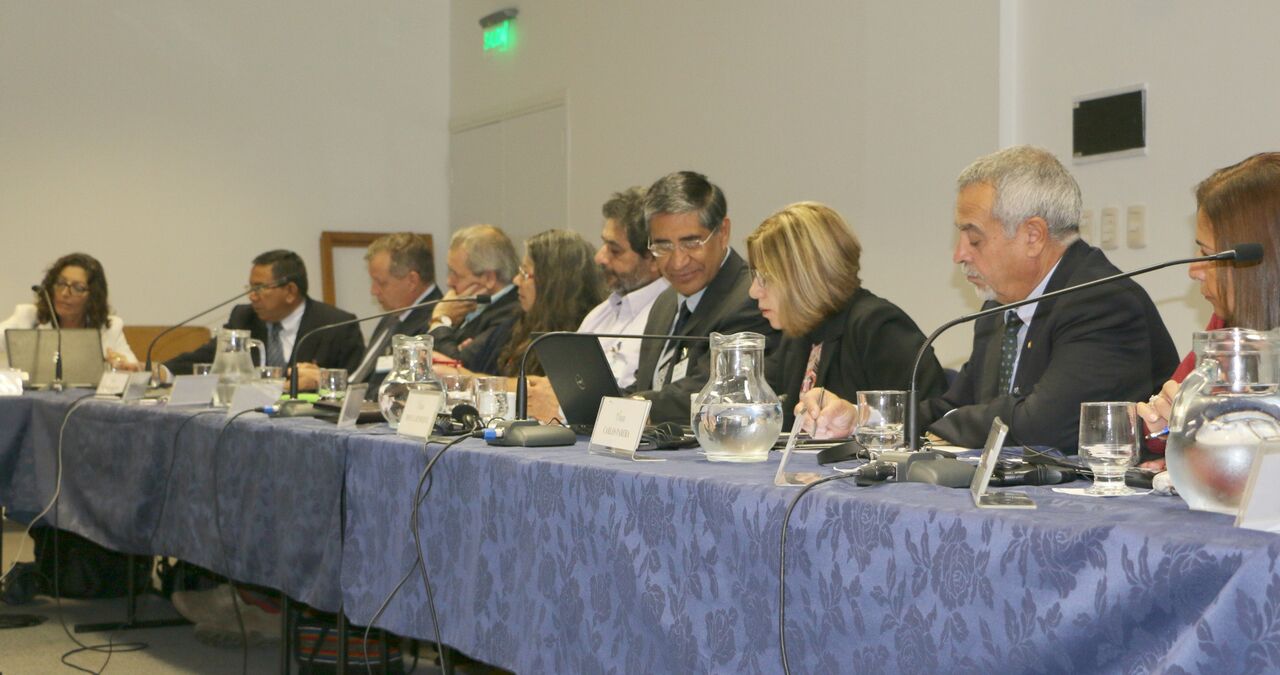
Argentina’s national agricultural research institute hosted the FORAGRO board of directors this past April. The workshop centered on the contribution of FORAGRO to achieving the SDGs: end hunger, achieve food security and improved nutrition, promote sustainable agriculture, and create partnerships.
Policy makers recognize that increased investments in agricultural research and development is fundamental to improve agricultural productivity. However, with few exceptions, in the countries in the Western Hemisphere these investments are still below the minimum target of 1 percent of agricultural gross domestic product recommended by the United Nations.
What is required to promote sustained investments in agricultural research and development? How can national agricultural research institutes be more effective at disseminating their results to their constituents? How to address the barriers to adoption of research outcomes? How to measure the impact of the investments in research, especially for smallholder farmers?
These key questions are being addressed within the Forum of the Americas on Agricultural Research and Technology Development (FORAGRO), the unique multi-stakeholder forum on agricultural research and innovation in the Americas. FORAGRO links those interested in innovation and the future of agriculture, particularly farmers and their communities. It aims to break the institutional silos that prevent stakeholders from working together to achieve their research and development objectives.
Argentina’s national agricultural research institute hosted the FORAGRO board of directors this past April. Representatives from public and private research institutions, the academia and farmers’ organizations engaged in forward thinking of current issues in agriculture and rural development. The workshop centered on the contribution of FORAGRO to achieving the Sustainable Development Goals (SDGs): end hunger, achieve food security and improved nutrition, promote sustainable agriculture, and create partnerships.
The workshop was facilitated by IICA acting as FORAGRO’s Executive Secretariat and the Food and Agriculture Organization of the United Nations (FAO).
Federico Villarreal, IICA’s Director of Technical Cooperation indicated, “Through several integration mechanisms, IICA is supporting agri-food research and innovation, to make it more effective, responsive and equitable, towards achieving Sustainable Development outcomes”.
IICA innovation specialists presented the funding trends to public research, emphasizing the need to improve research quality and focus on impact. Data shows that the world-class research infrastructure and outputs of the United States, Canada and Brazil contrast sharply with the lagging infrastructure, investment levels, and capacity in many Central American and Caribbean island nations. Also, long-term recruitment constraints have left many research institutes with aging pools of researchers. Furthermore, female scientists, who are in a unique position to address the challenges of women farmers, remain severely under-represented in research.
While opening debate on the future of agricultural research for development, the exercise stimulated creative thinking about a variety of controversial and plausible futures for agriculture in the hemisphere.
Facing these challenges, FORAGRO is delineating a strategy for effectively communicating with stakeholders, and for securing external funding.
More information:
Priscila Henriquez, IICA Specialist in Management of Technological Innovation in Agriculture priscila.henriquez@iica.int
Viviana Palmieri, IICA Specialist in Technological Innovation Management and Executive Secretary of FORAGRO
viviana.palmieri@iica.int
*The opinions expressed in this newsletter are those of the authors and they do not reflect the position of the Institute on the topics presented.
*This post appears in the IICA Delegation in the USA Newsletter – March – April 2018