The cocoa, a key crop that keeps the Dominican Republic as one of the leading countries in the export of organic products in the world.
The production of cocoa (Theobroma cacao L.) and the Dominican Republic’s capacity for cultivation were evident when exports of this product reached US$ 261 million in 2015. It is currently a world leader in organic cocoa, with 60% Volume of exports.
The cocoa, a key crop that keeps the Dominican Republic as one of the leading countries in the export of organic products in the world.
The production of cocoa (Theobroma cacao L.) and the Dominican Republic’s capacity for cultivation were evident when exports of this product reached US$ 261 million in 2015. It is currently a world leader in organic cocoa, with 60% Volume of exports.
In the last decade, cocoa exports have grown in the country by 322% and it is pointed out that this tendency of the behavior of exports for this crop will be maintained. The authorities of the Ministry of Agriculture and the private sub-sector of cocoa production and agro-export have the goal of doubling the current levels of exports in the next decade, so that they reach a value equivalent to US$ 500 million annually. Achieving this will not necessarily require expansion of planting areas, but renewing existing plantations and managing the capture of new markets abroad.
As for the destination of exports, it is estimated that the United States is the largest, with a third of foreign sales, followed by Holland, where it reaches around 18%, Belgium receives 14% and Mexico, Spain and other nations.
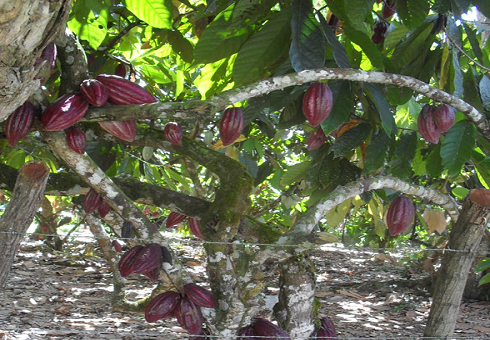
In the Dominican Republic, there are around 150,000 hectares planted with cocoa by about 40,000 producers, with 36,236 farms registered, of which 16.5% are engaged in the production of organic cocoa.
One of the main problems faced by cocoa producers is the low productivity of their farms and requires significant investment of resources to improve plantations. In the country the average productivity is 800 lb per hectare; however, a small group of producers, equivalent to 5%, exceed this average production limit.
Among the associations and companies engaged in the production and marketing of organic cocoa in the country, the most important are: National Confederation of Dominican Cacaocultores (CONACADO), with 49.8% of the production; Nazario Rizek, with 15.8%; Commercial Roig with 13.2%.
The quality of the cocoa produced in the country is one of the best at the international level; noting that 40% of nationally produced cocoa can be sold as «fine», according to the specialized committee of the International Cocoa Organization, with the potential to reach 70%.
The Dominican Republic was included in the select group of 15 countries recognized as producers of gourmet cacao.
Organic cocoa is divided into two types: a) Sánchez (unfermented), which constitutes 70% of the Dominican cocoa export and is preferred by the US market, and the Hispaniola type (fermented) of high demand by the European market.
Companies in the most important export markets for the country employ internationally recognized certifiers. For example, BCS ÖKO-Garantie (Germany), Demeter (Germany), IMO-Control (Germany-Switzerland), Bio Suisse (Switzerland), Japanese Agricultural Standard-JAS (Japan) and National Organic Program- NOP ).
One of the most latent threats to cocoa cultivation is the risk of introducing devastating diseases, such as Moniliasis (Moniliophthora roreri) and Witch’s Broom (Crinipellis perniciosa). In the Dominican Republic there is no report of the presence of these diseases which could put the economy of the cocoa subsector at risk. IICA and the Ministry of Agriculture have developed a project for the development of a prevention plan and emergency system against Cocoa Moniliasis, to respond to this problem.
(SOURCES: Ministry of Agriculture; http://www.dominicanaonline.org).