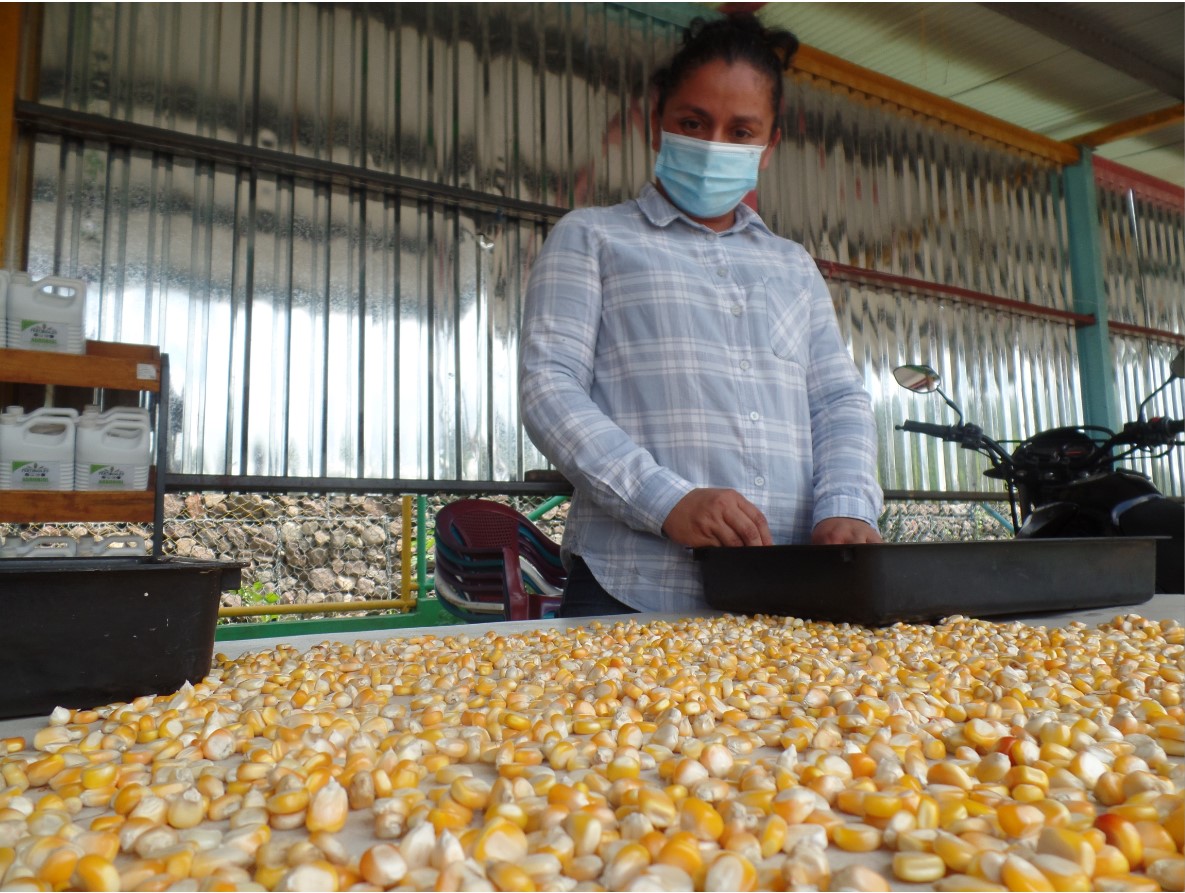
With the support of the Central American Program for Comprehensive Management of Coffee Leaf Rust, the European Union and IICA, the Manantial de Virtudes cooperative gained access to inputs, capital and capacity building for its members.
Jinotega, Nicaragua, 4 March 2021 (IICA) – Carmen Onelia Pérez is a role model in her community, in the municipality of Yalí, Jinotega, in northern Nicaragua. Her leadership as a coffee grower seems to come naturally, but in her view it is the result of a long process of learning, setbacks and achievements that have led her to the position of president of Manantial de Virtudes, a cooperative of women coffee growers. This association is supported in the region by the Central American Program for Comprehensive Management of Coffee Leaf Rust (PROCAGICA),
“The cooperative was created by a group of women who identified a specific need and realized that it was the only way to move forward and somewhat improve their economy. And so, in 2015 we decided to create the cooperative, but we had no experience and it was difficult because we did not have any support to start our organization”, Pérez recalled.
However, this scenario changed when they learned of the existence of PROCAGICA, a program financed by the European Union and executed by the Inter-American Institute for Cooperation on Agriculture (IICA), which opened doors for them and facilitated their access to inputs, capital and capacity building as coffee growers.
The reality of women in coffee farming is very different from that of most men. “Sometimes we do not even have the deeds for our land; sometimes there is discrimination for not having assets in our name, it is always the husband or the father who owns them; and when we inherit land, they do not give us the papers. For me, this has been one of the biggest obstacles; I have my plot of land but I still don’t have the deed. This is a major limitation because all doors are closed, and even more so for long-term financing” said Pérez.
The members of Manantial de Virtudes have access to a wide range of benefits including agroinputs, tools and equipment, and can increase the capital of the cooperative, engage in a more diversified management of the land and, above all, acquire the knowledge required to strengthen their organizational and leadership capacities.
In addition, one of the major achievements that received the support of PROCAGICA is the consolidation of bioinput production units, as a service provided by the cooperative to its associates.
“I think PROCAGICA is a very solid project because it supports small cooperatives, which has a great impact. Every year, the project has helped us become stronger through different management techniques, in different areas, as part of the crop diversification practice. This constitutes a great help for rural families”, she explained.
The Manantial de Virtudes cooperative was originally founded with 32 women. In order to have an initial capital, they participated in open-door fairs; little by little they became known at the municipal and then departmental level. Currently, they also participate in national forums supported by the Ministry of Family, Community and Cooperative Economy (MEFCCA).
In total, 83 women within the cooperative have been beneficiaries of PROCAGICA. Of these, 36 members have received support for the production of basic grains, bananas and citrus fruits and other products such as chaya, pipián and ayote.
The president of the cooperative went on to say that “we began seeking support and organizing activities that generated income, such as selling food; we built a greenhouse, the women contributed 100 or 300 córdobas in cash, and that is how we became entrepreneurs”.
“The women in the organization do not have a decent salary, because we do not have the capital,” she said. PROCAGICA has supported them with 70% of the cost for the acquisition of inputs aimed at the productive recovery of the coffee plantations. The remaining 30% is covered by members, and is used as a revolving fund to cover the needs of the organization.
Since 2017, PROCAGICA has delivered inputs such as vegetative material, agroinputs and equipment for the management and improvement of coffee plantations. With the recovery of the distributed resources, a revolving fund was consolidated for 35 cooperatives in Nicaragua, which is capitalized to offer further financial assistance to its members.
More information:
Institutional Communication Division
comunicacion.institucional@iica.int