“My greatest satisfaction is knowing that I can use what PROCAGICA taught me to help others”, says Honduran coffee farmer, Eustasio Nicolás Aguilar.
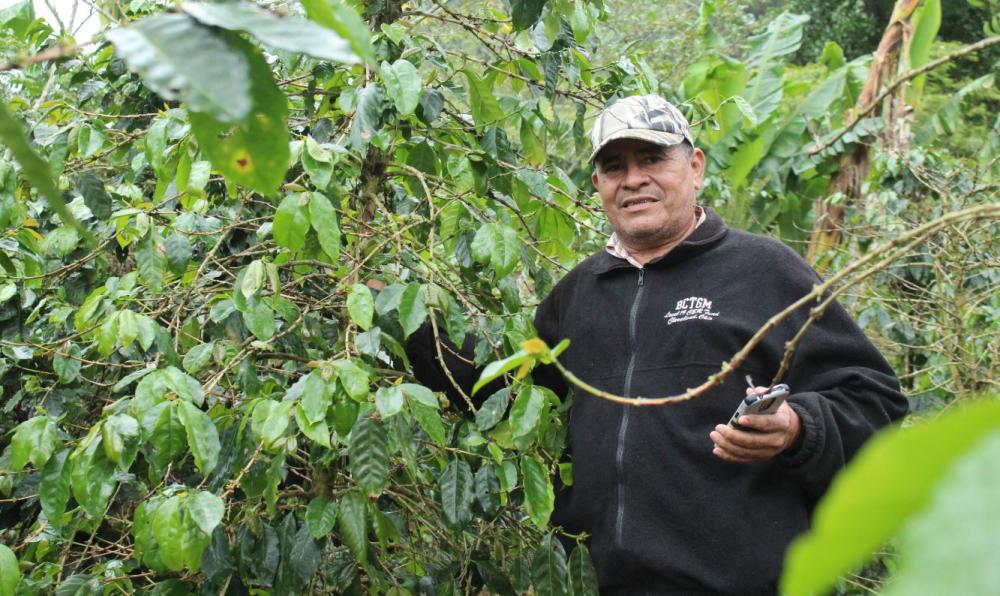
Santa María, Honduras, 17 May 2021 (IICA)-. Eustasio Nicolás Aguilar, a veteran of the Honduran army, has enjoyed great success as a coffee farmer.
His farm was one of those that the Central American Program for Integrated Coffee Rust Management (PROCAGICA) selected as a model farm, in view of the production and financial results it has achieved.
The former President of the coffee organization, Cafés Especiales Santa María, CAFESA, also remarked that, “This program has given me the satisfaction that what I learned will be my greatest legacy and will be of use to others. I thank God for this vocation of service; we are very satisfied about this”.
He proudly shows off his farm, Liquidambar, to all and sundry. Here he has achieved results using organic fertilizer from PROCAGICA, which he has applied to a one-manzana (0.7 hectare) plot of land, in addition to implementing techniques to maintain productivity, to manage shade levels and most importantly, to diversify crops, which provide him with another source of income.
Aguila insists that he has applied the lessons from the PROCAGICA training, exactly as instructed.
He explained that, “They extended technical support, trained us and also provided us with various inputs, such as organic fertilizer. Therefore, today, I think that farms should not only stick to chemical fertilizer, but should also apply organic fertilizer”.
The product of effort and work
Speaking of the results, he said that, “They have been magnificent. On this plot here, we have been producing 50 to 54 quintals of beans per manzana, which is an excellent output, compared to other places. For example, it is greater than the average output here in La Paz”.
The coffee farmer, who joined the PROCAGICA program four years ago, owns approximately 40 manzanas of land, cultivated using traditional practices. PROCAGICA is providing support on one of the 40 manzanas, which has allowed him to acquire new cultivation techniques.
Knowledge, the greatest legacy
Aguilar maintains that the program’s success lies in the knowledge imparted to all the beneficiaries. “They are leaving us with the most important thing – the lessons learned. As in all projects, in addition to the inputs, technical support and other elements, we are now trained. This has a multiplier effect, since we can bring on other producers and teach them how to move forward”, he said.
“We believe that the coffee itself is very good and provides earnings. The only thing is that we have to be methodical, manage our finances, and develop a savings culture. The program has taught us all of this”.
He reflected that, “Generally, farmers produce coffee, sell it, and sometimes process it, but we often do not consider that the farm will need maintenance. That is why producers have to be educated about this aspect, so that they can always consider the savings aspect”.
PROCAGICA is spearheaded by the European Union (EU) and the Inter-American Institute for Cooperation on Agriculture (IICA) in the municipalities of Marcala, Chinacla, Santa María and San José, and the department of La Paz, in Honduras.
More information:
Institutional Communication Division
comunicacion.institucional@iica.int