Otero and Fávaro also discussed the organization of the Conference of Ministers of Agriculture – Inter-American Board of Agriculture (IABA), which will be held in Brazil in 2025. The Conference brings together the 34 Agriculture Ministers of the Americas every two years and is the main governing body of IICA. It will be held prior to COP30, which will be hosted in Belém do Pará, Brazil. Fávaro assured the full support of his country in organizing this meeting.
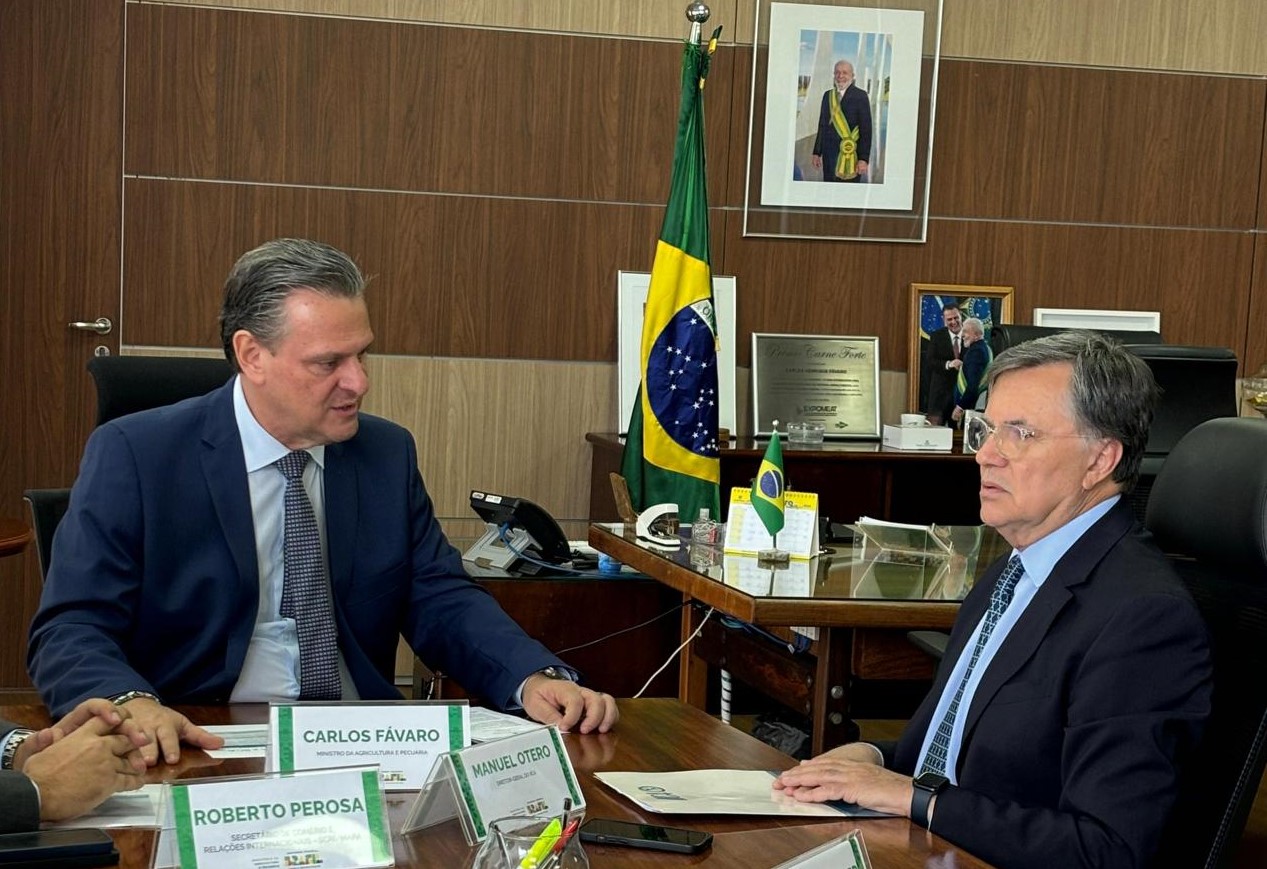
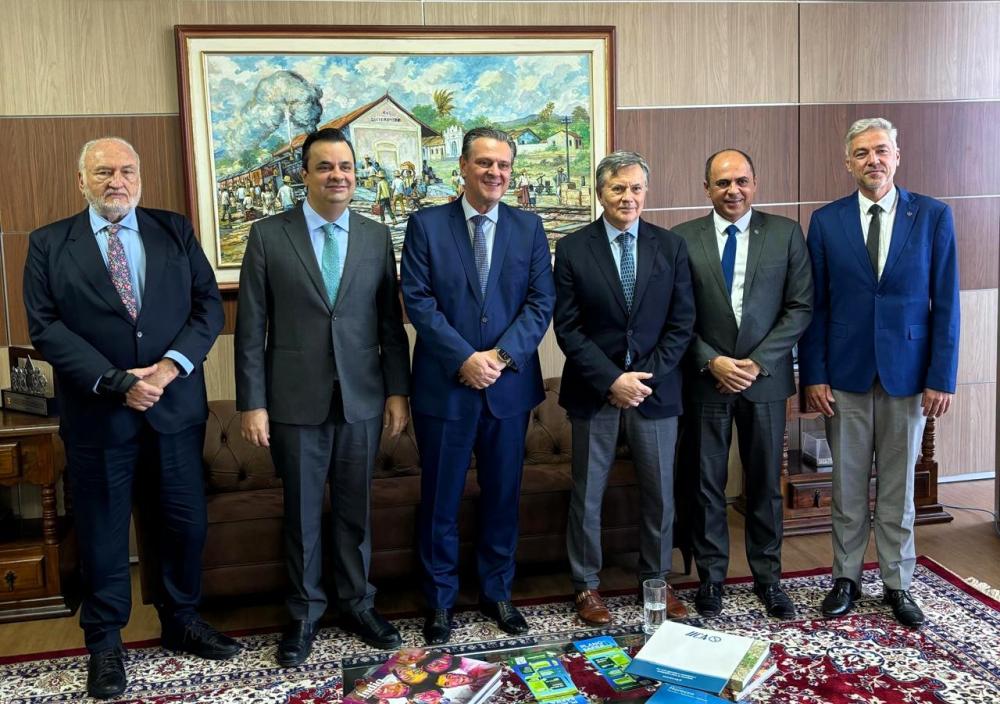
Brasilia, 16 August 2024 (IICA) – Minister of Agriculture and Livestock of Brazil, Carlos Fávaro, received the Director General of the Inter-American Institute for Cooperation on Agriculture (IICA), Manuel Otero on Wednesday in Brasília. They agreed to strengthen the collaboration between Brazil and the Caribbean, a region highly dependent on food imports and whose weak agricultural sector suffers from increasingly extreme climate events.
Fávaro, accompanied by the Secretaries of Commerce and International Relations, Roberto Perosa, and Innovation, Sustainable Development, Irrigation, and Cooperativism, Pedro Neto, invited Otero to speak at the summit that Agriculture Ministers from G20 countries will hold next month in Cuiabá, in the Brazilian state of Mato Grosso, as part of Brazil’s presidency of this global cooperation forum this year.
Fávaro informed Otero that at this Ministerial Summit, Brazil—a global agricultural power that has significantly evolved over the past fifty years, transitioning from a net importer to one of the world’s major food exporters—intends to showcase the sustainability of its agriculture, supported by science, technology, and innovation processes, as well as conservation practices.
Otero, in turn, invited the Brazilian Minister to participate in the activities that IICA, its member countries, and private sector partners will hold at the upcoming COP29, the UN-organized Conference of the Parties, which is the largest global environmental negotiation forum.
In Baku, the capital of Azerbaijan and the venue for the next COP, IICA will once again set up the “Home of Sustainable Agriculture of the Americas” pavilion, as it did at COP27 and COP28, together with its public and private sector partners. This pavilion will host political and technical events with ministers, high-level officials, sectoral representatives, and experts, addressing topics such as agriculture’s contributions to the decarbonization of the economy, its carbon sequestration capacity, and the necessary balance between production and conservation.
Otero and Fávaro also discussed the organization of the Conference of Ministers of Agriculture – Inter-American Board of Agriculture (IABA), which will be held in Brazil in 2025. The Conference brings together the 34 Agriculture Ministers of the Americas every two years and is the main governing body of IICA. It will be held prior to COP30, which will be hosted in Belém do Pará, Brazil. Fávaro assured the full support of his country in organizing this meeting.
The Brazilian Minister of Agriculture and the Director General of IICA also reviewed the cooperation projects that IICA is executing in Brazil, aimed at strengthening family farming and its ability to generate income, access technologies, and innovations. Fávaro expressed his intention to visit beneficiaries of these projects as soon as possible.
During his visit to Brasília, the Director General of IICA was accompanied by his Special Advisor, Jorge Werthein, and the Acting Representative in Brazil, Christian Fischer.
More information:
Institutional Communication Division.
comunicacion.institucional@iica.int