
San José, 5 May 2025 (IICA) – Experts brought together by the Inter-American Institute for Cooperation on Agriculture (IICA) presented the latest progress in plant breeding programs aimed at developing varieties resistant to the disease threatening banana production—a key crop for food security and the livelihoods of small-scale farmers across the continent and around the world.
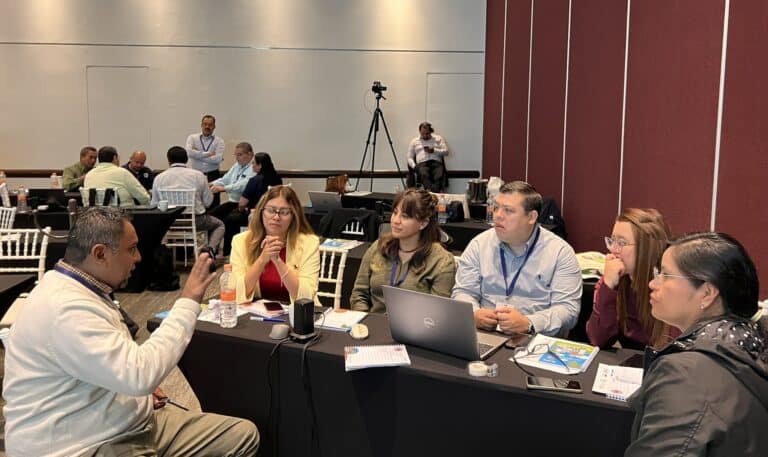
The presentation was made to more than 190 stakeholders in the banana production, marketing, and research sectors from 22 countries in the Americas and Europe, all of whom are on alert due to the spread of the Fusarium TR4 fungus.
This disease originated in Asia but has been moving westward and was detected in the Americas in 2019, raising alarms in tropical areas of South America, Central America, and the Caribbean—regions that are among the world’s largest banana producers and exporters.
In 2020, representatives from the private sector, academia, civil society organizations, government agencies, and international bodies formed the Global Alliance for Cooperation against Fusarium TR4, with IICA serving as its technical secretariat.
The event was organized by the Tropical Race 4 Fusarium Musaceae Network (FR4T), made up of a broad team of IICA specialists working in collaboration. It featured presentations from experts at the Tropical Agricultural Research and Higher Education Center (CATIE), based in Costa Rica, and Agrosavia—the Colombian Corporation for Agricultural Research.
In addition to detailing the progress made in developing banana varieties resistant to the disease, both institutions offered strategic insights on phytosanitary management.
The Role of Science
Muhammad Ibrahim, IICA’s Director of Technical Cooperation, opened the meeting by highlighting the banana sector’s importance for global food security and the critical role of science in strengthening phytosanitary prevention across the hemisphere.
Luis Pocasangre, Director General of CATIE, presented advances in genetic breeding programs aimed at developing tolerant varieties, including those led by the Brazilian Agricultural Research Corporation (EMBRAPA), Costa Rica’s National Banana Corporation (CORBANA), and the French agricultural research and cooperation organization CIRAD.
Pocasangre emphasized that successfully containing the disease will depend on strengthening technical capacities, fostering regional coordination, and implementing an integrated approach.
Mónica Betancourt Vásquez, Senior Researcher at AGROSAVIA, shared the results of introducing and evaluating promising materials in Colombia. She concluded that while there are promising genetic options, there are still no Cavendish-type varieties fully resistant to TR4.
In closing remarks, José Urdaz, Manager of IICA’s Agricultural Health and Food Safety Program (AHFS), and Erika Soto, Coordinator of the Musaceae Network – Foc TR4, called for stronger technical cooperation, better access to science-based knowledge for decision-making, and continued efforts to coordinate regional action.
The meeting reaffirmed IICA’s role as a technical facilitator in the region and a promoter of scientific cooperation, capacity building, and public-private partnerships to confront this threat to food security and the livelihoods of millions of rural producers.
Representatives from Ecuador, Peru, Venezuela, Colombia, Mexico, Bolivia, Costa Rica, Belize, Guatemala, and other countries joined the call to strengthen a hemispheric strategy based on prevention, genetic innovation, and the phytosanitary protection of banana and plantain crops.
More information:
Institutional Communication Division.
comunicacion.institucional@iica.int