• Brazil accounts for 78% of the startups identified. It is followed by Argentina, Mexico, and Chile.
• For the first time, the AgTech Radar identified the production chains in which agricultural startups (AgTechs) operate in Latin America and the Caribbean.
• The survey provides insights into the current landscape and contributes to strengthening the innovation ecosystem in the region.
• Digital solutions for farm operations are the main products offered by AgTechs.
• The AgTech Radar LAC will be launched on June 23 and will be available in Portuguese, Spanish, and English.
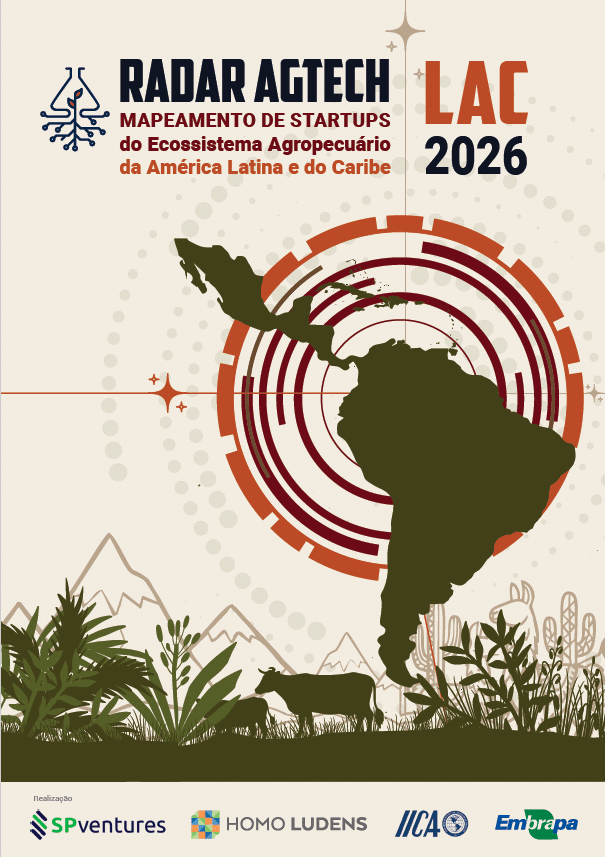
A study identified 2,656 technology-based startups in the agricultural sector across 23 countries. The highest concentration is found in the Southern Cone countries.
Brasilia, 23 June 2026 (IICA) – The AgTech Radar experience developed in Brazil has expanded and, for the first time, has mapped agricultural startups across Latin America and the Caribbean. A total of 2,656 AgTech companies were identified in 23 countries, with the highest concentration located in the Southern Cone.
The study was led by the Brazilian Agricultural Research Corporation (Embrapa), in collaboration with the Inter-American Institute for Cooperation on Agriculture (IICA), Homo Ludens and SP Ventures. It also received support from the Cooperative Program for the Technological Development of the Agri-Food and Agro-Industrial Sector of the Southern Cone (PROCISUR) and the Instituto Tecnológico de Monterrey, Mexico.
The mapping exercise showed that Brazil accounts for 78% of the startups identified, with a total of 2,075 companies. Argentina, with 158; Mexico, with 110; Chile, with 91; Colombia, with 79; and Uruguay, with 74, follow on the list of countries with the largest number of AgTech companies.
“The AgTech Radar LAC 2026 data show that Latin America and the Caribbean are undergoing a steady process of maturation of the agricultural innovation ecosystem. Although there is still a strong regional concentration, there is a growing capacity to generate technological solutions adapted to local production realities,” noted Aurélio Favarin, Embrapa analyst and one of the authors of the study.
According to Federico Bert, Manager of the Digitalization of Agrifood Systems Program at IICA, the combination of Embrapa’s experience in developing the AgTech Radar and IICA’s territorial reach across the region was essential for characterizing the current state of the regional ecosystem and designing actions to strengthen it.
“Understanding how the ecosystem is integrated and evolves is the starting point for fostering its growth and development in both the public and private sectors,” said Bert, who highlighted the large number of AgTech companies as a positive aspect compared to other regions of the world.
According to the survey, no AgTech companies were identified in ten of the 33 countries of Latin America and the Caribbean. The limited territorial size of some countries, small populations, and still-emerging agricultural sectors help explain this absence. Even so, the authors believe the figures may be underestimated, since the lack of a local reference institution participating in the survey made access to information more difficult. In some cases, the mapping was conducted using secondary databases.
“This is a first effort, and we now have an initial milestone, a benchmark for a broader and more reliable survey next year,” said Favarin.
Differences among countries also reflect the level of technology adoption within each agricultural sector.
“At IICA, we observe significant heterogeneity in the development of AgTech ecosystems across countries, and there is still much work to be done to consolidate the regional ecosystem. The Radar serves as a reference and inspiration tool, especially for countries promoting the development of their ecosystems and, even more importantly, as a means for actors from different countries to connect and build networks, facilitating the creation of a framework that drives innovation throughout the region,” Bert explained.
Area of specialization: methodological innovation
The AgTech Radar for Latin America and the Caribbean introduced a methodological innovation compared to previous editions of the AgTech Radar in Brazil. In addition to classifying AgTech companies according to whether they operate before, within or beyond the farm gate, and identifying the type of technological solution they provide, this edition mapped startups according to the production chains in which they operate. Participants could indicate up to three production chains in the questionnaire.
Most companies, 1,480, operate across multiple production chains. Crop production is the focus of 751 companies, while 136 target cattle production. Horticulture and fruit production are the focus of 88 AgTech companies, while forestry accounts for 84.
“The diversity of production chains represented reinforces the heterogeneous nature of agriculture and livestock production in the region and highlights the ability of startups to develop solutions tailored to local production specificities,” said Aurélio Favarin.
The AgTech Radar LAC revealed that digital solutions predominate among AgTech companies in Latin America and the Caribbean, with 1,404 startups. According to the study’s authors, this highlights the progress of data-driven agriculture in the region, including sensors, management software, drones, artificial intelligence, and digital platforms. Physical-chemical technologies (403) and biological technologies (374) follow as the main solutions offered by AgTech companies.
In terms of where solutions are applied, most startups operate within the farm gate, offering solutions focused on operational efficiency, production management, monitoring, and decision-support systems.
Launch
The AgTech Radar LAC will be launched by Embrapa and IICA on Tuesday, June 23, during the World Agri-Tech South America Summit, to be held in São Paulo, Brazil.
Following the launch, a panel discussion will explore what the data reveal about innovation and entrepreneurship in the agricultural ecosystem of Latin America and the Caribbean.
Panelists will include Vanessa Bello of SP Ventures, Vitor Mondo of Embrapa, and Federico Bert of IICA. Aurélio Favarin of Embrapa will serve as moderator.
The publication will be available free of charge in Portuguese, English, and Spanish at the website: https://radaragtech.com.br/.
More information:
Institutional Communication Division.
comunicacion.institucional@iica.int