Brazilian farmers are expanding their role in water protection through payments for environmental services and watershed restoration initiatives.
Brasilia, 17 June 2026 (IICA) – In a global scenario increasingly marked by droughts, erosion, and pressure on water resources, Brazil is relying on a quiet and often underestimated ally: farmers. Through projects that combine environmental conservation, watershed restoration, and sustainable soil management, rural producers have begun to become true “guardians” of water as part of a strategy aimed at protecting one of the most critical resources for life and food production.
At the center of this transformation is Brazil’s Produtor de Água program, an initiative led by the National Water and Basic Sanitation Agency (ANA), with support from the Inter-American Institute for Cooperation on Agriculture (IICA). Over the past 25 years, the program has brought together rural producers, municipalities, and water utilities around a shared objective: protecting watersheds through environmental restoration practices and sustainable land management.
Farmers and water security
The model combines environmental and economic incentives. Through a mechanism known as Payment for Environmental Services (PES), rural producers receive financial compensation for protecting springs, restoring native vegetation, reducing erosion, or implementing practices that help conserve water and soil on their properties. The underlying principle is that those who safeguard strategic resources for society should be compensated for their efforts.
Over the years, the program has supported more than 70 projects across Brazil’s different river basins, with investments exceeding BRL 144.4 million. According to official data, these initiatives have helped conserve more than 22,800 hectares of vegetation, restore an additional 4,180 hectares of degraded land, and directly benefit more than 27 million people. In addition, more than 1,200 rural producers have received payments linked to environmental services associated with watershed and water resource protection.
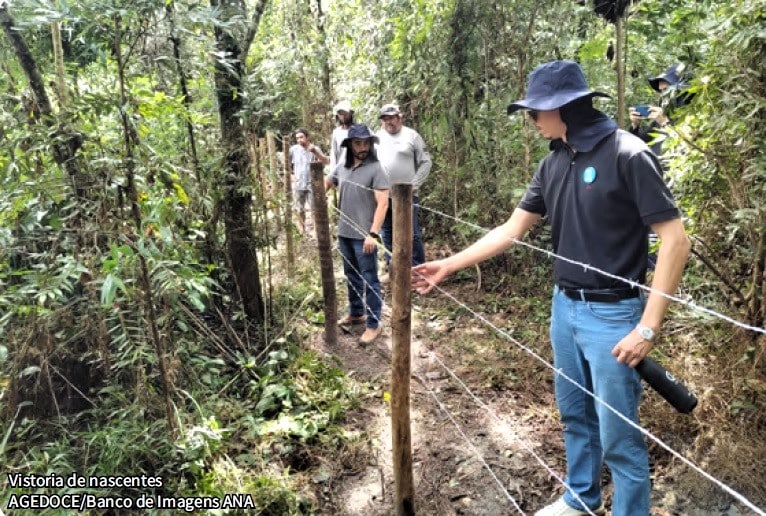
In many of the regions where the program operates, transformation begins with small but tangible changes. A fence around a spring to keep livestock away. A terrace built on sloping land to prevent erosion. A rural road redesigned to keep rainwater from carrying tons of sediment into streams. Or a “barraginha”—a small earthen reservoir designed to capture rainwater, promote infiltration, and gradually recharge groundwater reserves.
The program’s impact extends beyond visible infrastructure. It also involves a gradual shift in the relationship between rural producers, municipalities, and urban water users at a time when prolonged droughts and extreme weather events are placing increasing pressure on water supplies.
According to ANA, in a comprehensive report available through IICA’s publications repository, one of the greatest challenges has been building and maintaining trust with the rural communities participating in each project.

The program is fostering new relationships among farmers, municipalities, and water users as climate pressures on water sources continue to increase.
Watersheds, soil, and environmental restoration
In Capitólio, in the state of Minas Gerais in southeastern Brazil, one project focused on the Ambrósio Stream watershed, which supplies water to the local urban population. There, rural producers implemented fencing for protected areas, restored native vegetation, built small infiltration structures, and improved rural roads to reduce erosion and sedimentation.
The objective was relatively simple, yet ambitious: to prevent soil degradation from affecting the quantity and quality of water available to the population.
As in other initiatives under the program, producers who voluntarily join the scheme can access payments for environmental services tied to improvements made on their properties.
According to the report, many of these measures are part of what are known as nature-based solutions, an approach aimed at strengthening watershed resilience to droughts, extreme rainfall, and other climate-related events that are becoming increasingly frequent across Brazil.
Another notable case highlighted in the report comes from Minas Gerais. “The municipality of Ubá experienced extreme events related to water management. During drought periods, public water supply was affected, whereas in the rainy season, destruction, flooding, and waterlogging caused significant socioeconomic damage,” the document states.
In response, the municipality adopted water and soil conservation practices linked to the Payment for Environmental Services system. Between 2018 and 2024, more than 156 rural producers received payments associated with revitalization, conservation, and environmental protection activities covering nearly 945 hectares. In addition to financial incentives, participating farmers also benefitted from technical assistance aimed at promoting the sustainable development of family farming.
According to the report, several of the participating properties have already shown improvements in water availability and increases in the number of active springs within restored areas.

A new way of thinking about water
In addition to the specific results achieved in individual municipalities, the program reflects a broader shift in how water management is conceived. For decades, many water policies focused primarily on large-scale infrastructure such as dams, canals, and water transfer systems. The Brazilian model instead seeks to complement these tools with a dispersed network of small-scale interventions across rural landscapes, including vegetation restoration, soil management, spring protection, and micro-watershed restoration.
In a regional context increasingly shaped by prolonged droughts, extreme rainfall, and environmental degradation, the report argues that these practices can function as “natural infrastructure,” helping improve water infiltration, reduce erosion, and increase watershed resilience to critical climate events. The challenge now, according to program leaders, is to scale up these initiatives and secure long-term financing, particularly in Brazilian regions facing greater water stress.
The systematization effort published with IICA may also serve as a reference for other countries in Latin America facing similar challenges related to watershed degradation, soil loss, and growing pressure on water resources.
The Brazilian experience also points to a less visible, yet increasingly important conclusion: water security does not depend solely on large infrastructure projects or urban investments. More often than not, it begins much earlier—with small-scale farmers who are silently becoming true guardians of water.
More Information
comunicacion.institucional@iica.int
Report: Programa Produtor de Água. Resultados e Perspectivas